

India's Net-Zero Commitment and Energy Transition: Need to Avoid Disruptions in Job Security and Livelihood Opportunities
A just transition in India therefore requires targeted, context-specific strategies—supporting coal-dependent regions, strengthening reskilling and social protection (especially for informal workers), and aligning sectoral decarbonisation with employment generation. Ultimately, the transition’s success will depend not only on reducing emissions, but on its ability to protect livelihoods and enable inclusive, equitable growth.
 Jun 26, 2026

Over 150 administrative districts across India remain significantly dependent on fossil fuel supply chains, directly or indirectly sustaining livelihoods for nearly one-third of the country’s population. Within these systems, informal workers constitute a substantial share of the workforce and are estimated to be at least twice as numerous as those directly employed in coal mining, coal-based thermal power generation, and fossil fuel-linked manufacturing and downstream industries.
The ongoing transition from fossil fuels to renewable energy sources raises important concerns regarding employment, particularly within the vast informal sector. Shifts in technology, production processes, and energy systems are likely to alter the nature of work and skill requirements. As a result, sections of the existing workforce may face disruptions in job security and livelihood opportunities, while new forms of employment may demand significantly higher or different skill sets.
Workforce Dynamics Across Sectors
The distribution of workers across sectors of the Indian economy indicates clear shifts over time, with distinct gendered patterns. The share of male workers in agriculture has declined, while their participation in construction and services has increased. In contrast, the share of female workers in agriculture has risen, alongside a decline in their participation in other sectors.
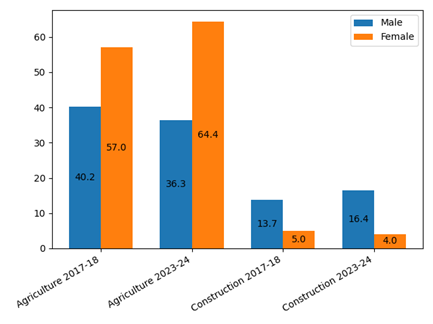
Data from the Periodic Labour Force Survey (PLFS)(principal +subsidiary status), conducted by the Central Statistical Office (CSO) since 2016–17, highlights these trends. The share of male workers in agriculture, across both rural and urban areas, declined from 40.2 percent of the total male workforce to 36.3 percent in 2023–24. During the same period, the share of male workers in construction increased from 13.7 percent in 2017–18 to 16.4 percent in 2023–24.
In contrast, the share of female workers in agriculture increased from 57 percent of the total female workforce to 64.4 percent in 2023–24. At the same time, their share in construction declined from 5 percent to 4 percent. In the manufacturing and mining sectors, both male and female participation registered a marginal decline as a proportion of the total workforce between 2017–18 and 2023–24 (Figure 1).
Figure 1: Gendered Comparison of Workforce Distribution in Agriculture and Construction (2017–18 and 2023–24)
Source: Periodic Labour Force Survey (PLFS), various rounds (2017–18 to 2023–24), Central Statistical Office (CSO), Government of India.
Note: Values represent percentage share of total workforce by gender
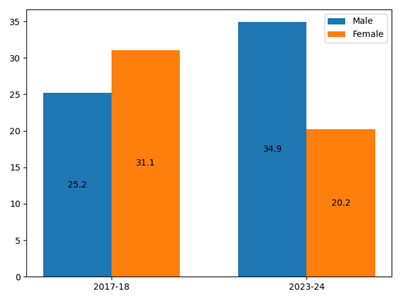
The services sector reflects a particularly notable shift. The share of female workers declined from 31.1 percent in 2017–18 to 20.2 percent in 2023–24, while the share of male workers increased from 25.2 percent to 34.9 percent over the same period. Notably, female participation in services was higher than that of males in 2017–18 but fell below male participation by 2023–24. This reversal reflects disruptions observed during the pandemic, when many women withdrew from the workforce (Figure 2).
Figure 2: Gendered Distribution of Workforce in the Services Sector (2017–18 and 2023–24)
Source: Periodic Labour Force Survey (PLFS), various rounds (2017–18 to 2023–24), Central Statistical Office (CSO), Government of India.
Note: Values represent percentage share of total workforce by gender.
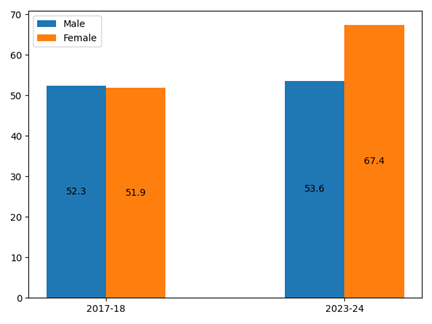
PLFS data on employment categories, combining both rural and urban areas, further shows an increase in self-employment among both men and women between 2017–18 and 2023–24. The share of self-employed male workers increased from 52.3 percent to 53.6 percent, while that of female workers rose more sharply from 51.9 percent to 67.4 percent (Figure 3). At the same time, there has been a decline in the share of regular wage and salaried employment among women, from 21 percent in 2017–18 to 15.9 percent in 2023–24 (Figure 4).
Figure 3: Rising Self-Employment Among Women Relative to Men (2017–18 and 2023–24)
Source: Periodic Labour Force Survey (PLFS), various rounds (2017–18 to 2023–24), Central Statistical Office (CSO), Government of India.
Note: Values represent percentage share of total workforce by gender.
Energy Transition and its Implications
In the Indian context, a just energy transition must prioritise the protection of livelihoods for those likely to be adversely affected. This includes workers engaged across the coal value chain, from exploration and extraction to processing, segregation, and transportation. Ensuring livelihood security for these workers is central to any equitable transition pathway.Similarly energy transition pathways will also have to be created for all other sectors using fossil fuels.
In developing economies such as India, where regional diversity is pronounced, policy responses must be sensitive to the differentiated economic and resource profiles of regions. Some regions may be endowed with abundant natural resources, while others may possess stronger human capital bases. Accordingly, investments need to be strategically directed towards sectors that can expand and absorb workers displaced from fossil fuel-dependent activities.
Several structural features of the Indian energy economy underline the complexity of this transition. Coal accounts for over 70 percent of total electricity generation, and a number of sectors with strong forward and backward linkages, including cement, iron and steel, and railways, remain heavily dependent on coal and other fossil fuels.Energy transition from coal and fossil fuels is likely to affect the rest of the sectors dependent on coal.
The geographical distribution of energy resources is uneven. Coal reserves are largely concentrated in eastern and central India, whereas renewable energy generation is regionally dispersed. Solar energy production is primarily located in western India, hydroelectric power in the northern regions, and wind energy in the southern and certain Himalayan regions.
These factors make the transition away from coal particularly challenging. The dual objective of transiting away from coal while simultaneously generating alternative employment opportunities through renewable energy expansion requires careful alignment of regional development strategies, labour market policies, and investment flows.
As the country prepares for a transition away from fossil fuels, employment across the coal value chain is likely to be adversely affected. This includes jobs in mining, transport and storage, processing and manufacturing, and trade. Workers engaged in transport, processing, and trade may possess skills that are relatively transferable across sectors. In contrast, mining workers often have more specialised skill sets, which limits their mobility into alternative forms of employment. As a result, the transition is likely to be more difficult for those directly engaged in mining.
This spatial concentration has important distributional implications. While economically stronger states which are away from the major coal bearing regions are more exposed to energy transition, coal mining employment is concentrated in regions that tend to have lower average incomes and fewer alternative livelihood opportunities. Even in relatively better-performing states such as Telangana, mining activity is located in economically disadvantaged districts rather than in major urban centres such as Hyderabad. In contrast, the impact on more economically diversified states such as Maharashtra and Tamil Nadu is likely to be relatively limited.
Coal-dependent states such as Jharkhand, Madhya Pradesh, Chhattisgarh, and Odisha are largely located in the eastern region and tend to have lower levels of renewable energy capacity. These states are also relatively poorer and therefore more vulnerable to the economic impacts of the transition. In contrast, states such as Gujarat and Maharashtra, which are relatively more diversified and less dependent on coal, are located in regions with higher renewable energy potential.
This uneven geography implies that states most exposed to the risks of transition are not necessarily those best positioned to benefit from the growth of renewable energy. In addition, the fiscal implications of declining fossil fuel revenues may be particularly severe for states with higher levels of debt, further constraining their ability to manage the transition effectively.
To translate these structural differences into more concrete state-level implications, it is useful to examine how these risks combine across key dimensions. Existing analyses bring together fiscal exposure, employment dependence, and energy infrastructure to assess the relative intensity of transition challenges across major states.Drawing on such a synthesis, a few broad patterns emerge. Coal-dependent states such as Jharkhand, Chhattisgarh, and Odisha face a combination of high employment dependence, limited renewable capacity, and relatively weaker fiscal positions, making them particularly vulnerable to the transition. In contrast, more diversified states such as Maharashtra and Gujarat, while still exposed through power sector investments, are better positioned to manage the transition due to stronger fiscal capacity and higher renewable energy potential.
These differences highlight that the transition challenge is not uniform, but instead reflects a layered interaction between labour markets, state finances, and energy systems.The preceding analysis highlights that the impacts of the energy transition will vary significantly across states. While a gradual transition may ease adjustment pressures, the challenges are likely to remain substantial in certain regions.
Different groups of states are likely to face distinct types of risks. Some states will confront significant employment losses in fossil fuel mining. Others may be more adversely affected by declining revenues linked to fossil fuel extraction. A third set of states will face challenges related to the replacement of coal-based power assets and the associated investment requirements.
Energy transition, by definition, involves a shift away from fossil fuels towards renewable sources such as solar and wind. In this context, geographical factors create uneven advantages across states.
Just Energy and Labour Transition
A rapid shift to a low-emissions economy has the potential to significantly disrupt workers’ livelihoods and the communities that depend on them. If not carefully managed, such a transition risks exacerbating existing inequalities and reinforcing structural injustices.
A Just Labour Transition seeks to address these risks through deliberate policy design. It involves preparing workers for new forms of employment, ensuring inclusive decision-making with meaningful participation of workers and their representatives, and securing broader social acceptance for the transition process. At its core, it is concerned with safeguarding livelihoods while enabling structural economic change.
Addressing these challenges requires a multi-pronged policy approach:
First, reskilling and upskilling efforts must extend beyond the energy sector and align with local economic opportunities. Training programmes should be designed in consultation with workers and their representatives to ensure relevance and accessibility.
Second, transition strategies must be embedded within broader national and regional development frameworks. This includes aligning climate goals with industrial policy, education systems, and labour market planning to ensure that job creation pathways are predictable and sustained over time.
Finally, institutional mechanisms must address existing power imbalances. Ensuring meaningful participation of workers, unions, and affected communities in decision-making processes is critical to building trust and enabling a smoother transition.
India's Net-Zero Commitment
India's commitment to achieving net-zero emissions by 2070, at the COP26 in Glasgow. India has adopted a gradual and differentiated decarbonisation pathway. Alongside its net-zero target for 2070, India has pledged to expand non-fossil electricity capacity, improve energy efficiency, reduce the emissions intensity of GDP, and increase forest carbon sinks.
A just transition seeks to ensure that the shift from carbon-intensive economic activities to low-carbon alternatives does not disproportionately burden workers, communities, or regions dependent on fossil fuels.For India, the issue is particularly significant because coal remains central to its energy system.
The concept of a just transition therefore goes beyond environmental policy. It encompasses labour rights, social protection, regional development, skills training, and economic diversification
The transition to a green economy presents both opportunities and risks. Studies by international agencies suggest that green sectors could become major sources of employment over the coming decades.However, these jobs are unlikely to emerge automatically in the same locations where fossil-fuel jobs disappear. Coal miners in eastern India may not easily transition into solar manufacturing or green hydrogen industries without substantial retraining and support.This geographic and skills mismatch is therefore one of the central challenges of a just transition.
Targeted, Context-Specific Strategies
India’s energy transition is not only a shift in energy systems but a restructuring of livelihoods, regions, and labour markets. While fossil fuel sectors account for a small share of national employment, they sustain highly concentrated local economies and extensive informal workforces, making transition impacts uneven and deeply localised.
The evidence shows that employment outcomes will vary across sectors and regions. Energy-intensive sectors generate fewer jobs per unit of energy, while labour-intensive sectors offer greater employment potential. At the same time, spatial and skill mismatches, persistent informality, and gendered vulnerabilities constrain smooth workforce transitions.
A just transition in India therefore requires targeted, context-specific strategies—supporting coal-dependent regions, strengthening reskilling and social protection (especially for informal workers), and aligning sectoral decarbonisation with employment generation. Ultimately, the transition’s success will depend not only on reducing emissions, but on its ability to protect livelihoods and enable inclusive, equitable growth.
(The writer is a retired Special Secretary, Government of India, and a commentator on geoeconomic and regional issues. The views expressed are personal. He can be reached at ppmitra56@gmail.com.)





Post a Comment