

Welfare Politics and State Borrowing in India: Easy Populism or Developmental Necessity?
The evidence indicates that the increase in state borrowing over the past decade is best understood as the outcome of a changing fiscal federal system rather than simply an expansion of welfare politics.
 Sep 09, 2026

Over the last decade, welfare expenditure by Indian states has expanded significantly. Successive state governments, irrespective of political affiliation, have introduced schemes such as free electricity for specified consumers, subsidised public transport for women, direct income transfers, farm support, old-age pensions, scholarships, health insurance, and food security programmes.
Public debate often attributes rising state debt to these welfare measures. While welfare commitments undoubtedly affect fiscal balances, this explanation is incomplete and warrants closer examination. The expansion of borrowing must instead be analysed within the broader context of India's fiscal federal structure after the introduction of GST, the end of GST compensation, demographic pressures, urbanisation, infrastructure requirements, and the COVID-19 shock.
The central question, therefore, is not whether welfare schemes exist, but whether financing these schemes has weakened fiscal sustainability or crowded out productive public investment.
Changing Political Economy of Welfare
Competitive electoral politics has increased pressure on state governments to expand welfare programmes. Across the political spectrum, political parties have relied on social protection and targeted subsidies to address poverty, inequality, and livelihood insecurity. Examples include subsidised or free electricity for certain categories of consumers, transport concessions, cash transfers to women and farmers, expanded health insurance, social pensions, scholarships, and food security measures. These programmes often respond to genuine social needs, particularly in an economy where labour markets remain largely informal and household vulnerability remains high.
Distinguishing Welfare from Populism
An important analytical distinction must be drawn between productive social expenditure and consumption-oriented subsidies. Productive expenditure includes education, public health, nutrition, skill development, sanitation, and early childhood development. These investments strengthen human capital and improve long-term productivity.
Consumption-oriented subsidies include untargeted electricity subsidies, broad consumption transfers without clear developmental objectives, and recurrent loan waivers. The economic returns from these forms of expenditure differ considerably. The debate, therefore, should not focus on whether expenditure is labelled "welfare," but on whether it generates long-term economic and social returns.
One criticism frequently advanced is that rising welfare commitments reduce the fiscal space available for infrastructure investment. The evidence, however, is mixed. In 2023-24, states spent 53% of their revenue receipts on salaries, pensions, and interest payments, while subsidies accounted for about 9% of revenue expenditure.
States have nevertheless maintained capital expenditure at around 2.8-2.9% of GSDP. At the same time, the RBI has cautioned that expanding subsidies and cash transfer schemes could eventually crowd out productive investment.
We now turn to the equally important question of resource mobilisation. The introduction of GST fundamentally altered state fiscal incentives. Before GST, states had relatively greater discretion over several important indirect taxes. Following its introduction, a significant share of indirect tax revenue became part of a common pool, with tax rates determined collectively through the GST Council.
This shift had three important consequences. First, states lost part of their independent tax policy flexibility. Second, revenue uncertainty increased because collections became more closely tied to national economic conditions and GST settlements. Third, the expiry of GST compensation in June 2022 increased fiscal pressures, particularly for states experiencing slower revenue growth.
Borrowing by States
Borrowing therefore became an important adjustment mechanism. In this context, borrowing was not necessarily driven by political convenience. Rather, it became one of the few remaining fiscal instruments available to states to maintain expenditure commitments amid growing financial pressures.
Figure 1: Debt Position of Select States Before the Expiry of GST Compensation
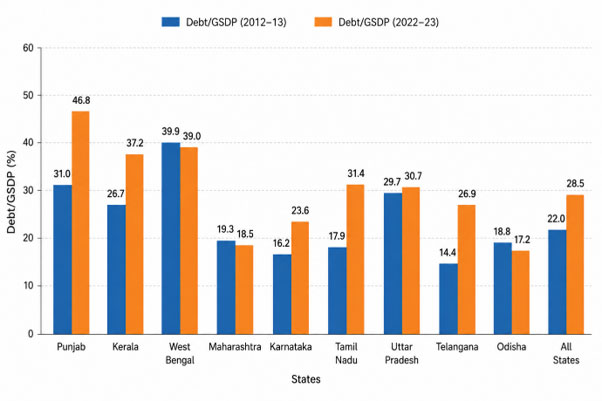
Source: The State of the States: Federal Finance in India, NCAER, February 2025.
Figure 2: Debt Position of States in 2024-25 After the Expiry of GST Compensation
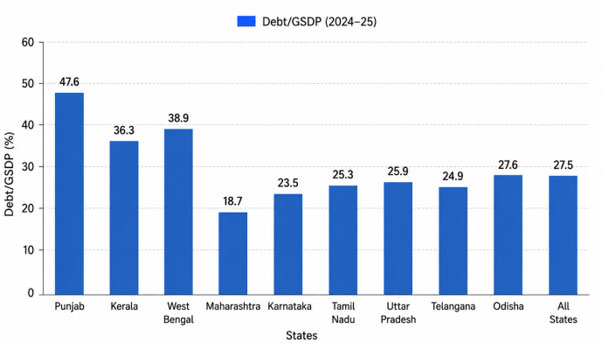
Source: RBI, State Finances: A Study of Budgets 2024-25; PRS Legislative Research, State of State Finances 2024-25.
States have lost significant independent revenue-raising powers since the implementation of the Goods and Services Tax (GST) in 2017. By transitioning to GST, state legislatures surrendered their authority to levy and modify several indirect taxes independently. According to data compiled by PRS Legislative Research, the aggregate revenue from taxes subsumed under GST declined from 6.5% of GDP before GST to 5.5% in recent fiscal years, indicating a contraction in states' tax-to-GDP ratios. With slower revenue growth and rising expenditure commitments, states have increasingly relied on borrowing to finance their budgets.
The Goods and Services Tax (GST) subsumed multiple indirect taxes into a unified tax structure to eliminate the cascading, or tax-on-tax, effect. The taxes brought under GST are categorised below.
Central Taxes Subsumed
The following Central taxes were absorbed into the Central GST (CGST) and Integrated GST (IGST) framework:
·Central Excise Duty
·Service Tax
·Additional Duties of Excise (for example, on goods of special importance and textiles)
·Additional Duties of Customs (Countervailing Duty or CVD)
·Special Additional Duty of Customs (SAD)
·Central Sales Tax (CST)
·Central cesses and surcharges
State Taxes Subsumed
The following State taxes were absorbed into the State GST (SGST) framework:
·State Value Added Tax (VAT) and Sales Tax
·Luxury Tax
·Entry Tax (except where levied in lieu of octroi)
·Entertainment and Amusement Tax (excluding taxes levied by local bodies)
·Taxes on Advertisements
·Purchase Tax
·Taxes on Lotteries, Betting, and Gambling
·State cesses and surcharges
·Octroi
Taxes Not Subsumed Under GST
A few indirect and direct taxes remain outside the GST framework:
·Petroleum products, including petrol, diesel, crude oil, natural gas, and aviation turbine fuel
·Alcohol for human consumption, which continues to be subject to State Excise
·Basic Customs Duty
·Direct taxes such as Income Tax and Corporate Tax
·Local taxes such as Property Tax and Stamp Duty
Punjab: Persistent Fiscal Stress
Punjab has remained one of India's most fiscally stressed states for over a decade. Its fiscal challenges predate GST and stem from a combination of high committed expenditure on salaries, pensions, and interest payments, relatively slow growth in own tax revenue, and extensive subsidies, particularly in agriculture and electricity.
The RBI identifies Punjab as one of the states with the highest debt burdens relative to GSDP. A large share of its revenue receipts is absorbed by committed expenditure, leaving limited fiscal space for capital investment. As a result, additional borrowing is increasingly used for fiscal adjustment rather than the creation of productive assets.
Kerala: High Human Development, High Fiscal Commitments
Kerala presents a different model. The state has achieved strong social outcomes through sustained investment in education, health, and social welfare. However, these achievements have been accompanied by high committed expenditure and rising interest payments.
Kerala's fiscal challenge lies not in inadequate development spending, but in maintaining fiscal sustainability while financing an ageing population, pensions, and social protection programmes. The RBI has repeatedly emphasised the need for improved debt management and greater transparency regarding off-budget liabilities. Kerala therefore illustrates that high debt does not necessarily imply poor governance, but it does constrain future fiscal flexibility.
West Bengal: Revenue Constraints and Debt Legacy
West Bengal inherited a substantial stock of debt accumulated over previous decades. Although the state has expanded welfare programmes and infrastructure investment, interest payments continue to absorb a significant share of its revenue receipts.
GST has also reduced West Bengal's fiscal autonomy, as the state historically relied heavily on indirect taxes. Consequently, its dependence on tax devolution and central transfers has increased. The state's fiscal challenge is therefore to balance developmental expenditure with debt servicing.
Maharashtra: Borrowing with a Strong Revenue Base
Maharashtra contributes the largest share to India's economy and has one of the strongest own-tax revenue bases among all states. Although its absolute level of borrowing is high, its fiscal capacity is correspondingly strong. Borrowing has largely financed infrastructure projects, including transport, urban development, and industrial investment.
Evaluating Maharashtra solely on the basis of total debt would therefore be misleading. Debt sustainability depends not only on the size of liabilities but also on the state's capacity to generate future revenue.
Karnataka and Tamil Nadu: Tax Buoyancy Alongside Growing Welfare Commitments
Both Karnataka and Tamil Nadu have diversified economies supported by manufacturing and services. Their tax bases are relatively buoyant, enabling them to sustain higher capital expenditure alongside social sector investments. While welfare commitments have expanded, both states continue to allocate substantial resources towards infrastructure, industrial development, and urban transport.
Their experience demonstrates that borrowing can coexist with relatively sound fiscal management when supported by sustained economic growth.
Uttar Pradesh: Debt Sustainability Amid Growing Budgetary Commitments
As India's most populous state, Uttar Pradesh faces substantial expenditure requirements in health, education, rural infrastructure, and social protection.
The state receives significant transfers from the Union Government because of its population and income profile. At the same time, recent budgets have placed considerable emphasis on roads, expressways, airports, and logistics infrastructure. Whether these investments generate sufficient future revenue remains an important question for long-term debt sustainability.
Telangana: Concerns About Guarantees and Contingent Liabilities
Telangana has pursued an ambitious development strategy centred on irrigation, infrastructure, and welfare programmes. However, concerns have emerged regarding guarantees extended to public sector entities and off-budget borrowing. Recent assessments indicate that Telangana has one of the highest ratios of state-backed guarantees to GSDP, highlighting the importance of monitoring contingent liabilities alongside conventional measures of debt.
Odisha: Prudent Fiscal Management
Odisha is frequently cited as an example of prudent fiscal management. The state has maintained relatively moderate debt levels while strengthening its own revenue mobilisation through mining royalties, GST collections, and improved financial management. Odisha illustrates that prudent borrowing, combined with disciplined expenditure and efficient revenue mobilisation, can create greater fiscal space for development.
Rising Debts vs Fiscal Discipline
The evidence suggests that there is no single explanation for rising state debt. Three broad patterns emerge.
·High-debt states with persistent revenue stress, such as Punjab and, to varying degrees, Kerala and West Bengal, face structural fiscal constraints arising from high committed expenditure and debt servicing.
·Economically stronger states, including Maharashtra, Karnataka, and Tamil Nadu, generally have a greater capacity to sustain borrowing because of stronger own-tax revenues and more diversified economies.
·Development-oriented states such as Odisha demonstrate that fiscal discipline and public investment can coexist.
The RBI similarly argues that states have improved fiscal prudence since the pandemic, but should adopt a medium-term debt consolidation strategy, improve transparency, and increasingly restrict borrowing to growth-enhancing capital expenditure under the "golden rule". Although this is primarily a fiscal rule, it is often discussed in the context of the RBI's concerns about fiscal sustainability.
Excessive borrowing to finance revenue expenditure can contribute to inflation, crowd out private investment, and complicate the conduct of monetary policy.
Need for Renewed Fiscal Compact
The common narrative suggests a simple sequence: higher welfare expenditure leads to higher borrowing, which in turn leads to fiscal deterioration. As a result, the debate is often framed as one of "welfare versus fiscal discipline." However, the more relevant question is whether India's current fiscal architecture provides states with adequate, predictable, and autonomous revenue sources to meet their constitutional responsibilities.
The evidence indicates that the increase in state borrowing over the past decade is best understood as the outcome of a changing fiscal federal system rather than simply an expansion of welfare politics. Borrowing has become more prominent because states face growing expenditure obligations while operating within a more constrained revenue framework after the introduction of GST.
The evidence also suggests that India may require a renewed fiscal compact between the Union and the states. Such a compact could include:
- Greater predictability in GST settlements.
- Stronger incentives for states to mobilise their own tax revenues.
- Improved transparency in guarantees and off-budget liabilities.
- Adherence to a "golden rule" under which borrowing is used primarily to finance capital expenditure.
- Periodic reviews of the vertical distribution of fiscal resources by the Finance Commission.
These reforms would strengthen fiscal sustainability while preserving the developmental role of state governments.
(The writer is a retired Special Secretary, Government of India, and a commentator on financial, geoeconomic and regional issues. The views expressed are personal. He can be reached at ppmitra56@gmail.com.)







Post a Comment