

The New Economic-Military Architecture of India-Japan Ties
Amid concerns regarding U.S. reliability on trade and defence commitments under the current White House, both India and Japan are leaning on each other to build supply chain and economic resilience—acting as a pragmatic "middle power" buffer rather than purely relying on Washington.
 Sep 01, 2026
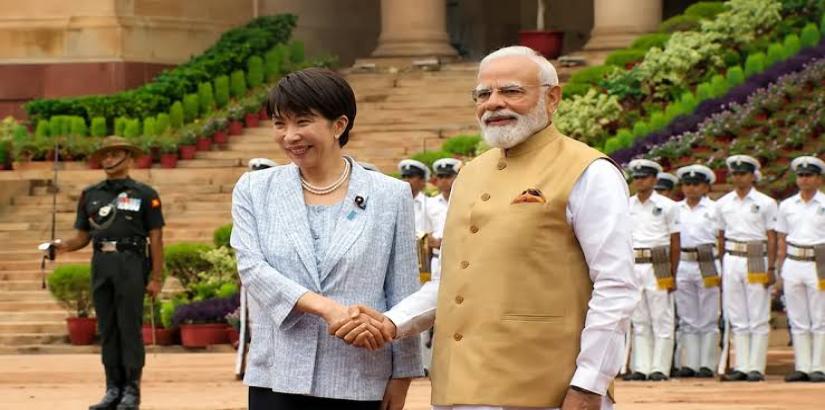
Japan’s Prime Minister Sanae Takaichi’s arrival for the 16th Annual India-Japan Summit in New Delhi on July 1, 2026, began with a warm welcome by Prime Minister Narendra Modi at Rashtrapati Bhavan’s forecourt, followed by an impressive reception, including a Guard of Honour. The following day, heightened cooperation was announced in: (a) artificial intelligence and joint research; (b) military technology transfers and Make in India collaboration; (c) economic security measures and a shared target for expansive Japanese investments over the coming decade; and (d) clean energy cooperation, critical mineral supply chains and green energy projects.
The Summit was followed by Japan’s Defence Minister Shinjiro Koizumi beginning his maiden official visit to India on August 19, 2026, in Mumbai, where he held high-level discussions with Chief of the Naval Staff Admiral Krishna Swaminathan and Western Naval Command C-in-C Vice Admiral Sanjay Vatsayan regarding the Indian Navy's regional responsibilities and operational capabilities.
He boarded the India-built guided-missile destroyer INS Chennai to assess India's indigenous warship-building proficiency, demonstrating a strong focus on maritime readiness and operational synergy before proceeding to formal bilateral talks in New Delhi.
On August 20, 2026, Defence Minister Rajnath Singh welcomed Mr Koizumi to co-chair a meeting at which discussions focused on deepening maritime security, Make in India defence technology and expanding strategic trust.
Both ministers signed a Memorandum of Arrangement on Maritime Security Cooperation. Its operational scope includes enhancing Maritime Domain Awareness (MDA), rapid intelligence sharing, joint search-and-rescue coordination, reciprocal naval visits, shared logistical support, ship maintenance and repair facilities between the Indian Navy and the Japan Maritime Self-Defense Force, and the strategic goal of securing critical sea lines of communication while maintaining a free and open Indo-Pacific.
It is worth noting that former Prime Minister Shinzo Abe aimed to “normalise” Japan's security posture and move the Japan Self-Defense Forces (JSDF) closer to a conventional, full-fledged military. He worked to increase military flexibility, upgrade equipment, boost defence spending towards 2 per cent of GDP, and deepen operational integration with the US military, while stopping short of making it a fully offensive military.
Historical Connections
Founded in India during the 6th to 5th centuries BCE, Buddhism travelled through China and the Korean kingdom of Baekche before reaching Japan in the 6th century, traditionally cited as 552 CE. Indian culture, carried through Buddhist teachings, laid the foundation for the deep historical connection and mutual affinity between the two nations.
In 736 CE, an Indian monk named Bodhisena travelled directly to Japan and later performed the eye-opening ceremony for the Great Buddha at Tōdai-ji Temple in Nara in 752 CE. Ancient records indicate that Japanese scholars travelled to India to study at the ancient Buddhist centre of Nalanda. Formal government-to-government and direct political ties, however, did not begin until much later, during the Meiji era in the late 19th century.
The Indian National Army (INA) received crucial military, financial and logistical support from Japan during World War II in its fight against British colonial rule and to weaken British forces in Asia. The Japanese army captured thousands of Indian soldiers in Singapore and Malaya, who formed the backbone of the INA.
India and Japan signed a peace treaty and established diplomatic relations on April 28, 1952. In the post-World War II period, India's iron ore helped Japan's recovery from the devastation. Following Japanese Prime Minister Nobusuke Kishi's visit to India in 1957, Japan began providing yen loans to India in 1958, the first such yen loan assistance extended by the Japanese government.
Japan also began providing Official Development Assistance (ODA) to India in 1958, subsequently becoming India's largest bilateral aid donor.
A significant milestone in India-Japan relations came in 2000, when the relationship became a Strategic and Global Partnership. It was further upgraded in 2006 and, in 2014, under Prime Ministers Narendra Modi and Shinzo Abe, to a Special Strategic and Global Partnership.
During the 16th India-Japan Annual Summit in July 2026, a massive boost was given to the relationship through landmark agreements focusing on military co-development, a ¥10 trillion (approximately $68 billion) investment roadmap, critical supply-chain security, private investment plans, a joint economic security declaration and direct industrial partnerships.
In late December 2025, it was announced that India had surpassed Japan to become the world's fourth-largest economy. Simultaneously, India and Japan are aggressively deepening an alliance targeting ¥10 trillion in Japanese investments over the decade. Each country's distinct strengths—Japan's precision technology and India's young workforce—complement each other in building future mega-projects.
New Economic and Technology Initiatives
Economic Security and Critical Minerals: At the July 2026 Summit, both countries signed standalone frameworks to secure resilient supply chains for semiconductors, essential minerals and clean energy, aiming to reduce strategic dependence on Beijing.
10-Trillion-Yen Investment Target: Japan is committed to an expansive 10-trillion-yen (approximately $67 billion) public-private investment and financing target for India over the coming decade, paired with the launch of several key economic, technological and green energy initiatives.
Key Pillars of the India-Japan “Big Leap”
The Mumbai-Ahmedabad High-Speed Rail: India’s first bullet train project, using Japanese Shinkansen technology, is aiming to launch priority sections by 2027. When completed, it will be India’s first high-speed rail line, with a design speed of 350 km/h (215 mph).
Advanced Technology and Semiconductors: Joint roadmaps focus heavily on artificial intelligence, quantum technology, clean energy and chip supply chains.
Manufacturing Hub Integration: Driven by the “China Plus One” strategy, states such as Uttar Pradesh are actively launching multi-billion-rupee manufacturing partnerships with Japanese delegations.
AI and Digital Technology Integration: Agreements linking Indian software strength, such as Sarvam AI, with Japanese precision hardware, alongside digital public infrastructure dialogues, have widened technological collaboration.
Economic Security and Supply Chains
Both nations have signed a joint economic security declaration focusing on trusted supply chains, reducing reliance on single markets and building local industrial depth.
The growing India-Japan partnership provides substantial economic and strategic leverage in the Indo-Pacific, functioning as an effective structural balance against China's regional ambitions. However, rather than an aggressive military containment bloc, New Delhi and Tokyo frame their cooperation around resilience, secure supply chains and maritime safety.
Both nations are reducing reliance on single-source hubs through partnerships in critical minerals, semiconductors and rare earth technologies. Japan serves as a major investor in India's domestic industrial corridors and high-speed transit, combining Tokyo's capital with India's demographic scale.
Deepening Military and Maritime Cooperation
India-Japan bilateral ties have progressed beyond basic military drills into joint equipment research and development, highlighted by naval radar co-development agreements and expanded Quad coordination.
India and Japan initially signed the foundational Memorandum of Implementation for the UNICORN (Unified Complex Radio Antenna) project on November 15, 2024, and formally announced joint military co-development at the 16th India-Japan Annual Summit on July 2, 2026.
Bilateral military exercises between India and Japan began in January 2012 with the launch of the Japan-India Maritime Exercise (JIMEX), focusing on maritime security cooperation. There has also been a focus on joint tactical training, counter-terrorism operations and improving interoperability between their respective armies, navies and air forces.
These drills emphasise semi-urban and jungle warfare, maritime security in the Indo-Pacific and defence-industrial co-creation.
Exercise Dharma Guardian: Conducted annually and alternately between India and Japan, it involves the Indian Army and the Japan Ground Self-Defense Force (JGSDF) practising the establishment of temporary operating bases, creating intelligence, surveillance and reconnaissance (ISR) grids, and conducting house-intervention drills.
Air Exercises Veer Guardian and Shinyuu Maitri: These involve fighter and transport aircraft cooperation with the Indian Air Force to synchronise tactical manoeuvres and air-defence procedures.
Multilateral Engagement—Exercise Malabar: Joint naval operations alongside the US and Australia under the Quad framework reinforce regional stability.
Strategic and Industrial Objectives
Interoperability and Logistics: Both countries are practising shared standard operating procedures and cross-servicing logistics under agreements such as the Reciprocal Provision of Supplies and Services (ACSA).
Military Technology and Co-Production: Bilateral efforts are being aligned under India's Make in India initiative to explore joint research, unmanned systems and military equipment exchanges.
Military and Space Collaboration: India and Japan are significantly deepening military and space collaboration through joint research and development, co-production, advanced exercises and lunar exploration missions to support a free and open Indo-Pacific. Joint initiatives include the Lunar Polar Exploration (LUPEX) mission and advanced maritime security frameworks.
Factors Driving Stronger India-Japan Ties
The transformation of the relationship has been boosted by deliberate diplomatic efforts by top leaders. The deep personal chemistry between former Japanese Prime Minister Shinzo Abe, who laid the conceptual framework of the “Confluence of the Two Oceans”, and Indian Prime Minister Narendra Modi helped firmly institutionalise the partnership.
This momentum has been maintained by successive leadership on both sides, ensuring that annual bilateral summits remain a bedrock of their foreign policies.
The major enhancement of India-Japan relations into a Special Strategic and Global Partnership has been driven by a unique convergence of geopolitical concerns, economic complementarities and high-level political trust. The primary factors that catalysed this transformation include:
(a) Geopolitical Realities and the China Factor: The most significant driver of closer ties is a shared concern over China’s growing military assertiveness, including maritime and underwater activities, and its economic expansionism across Asia.
(b) Deeply Linked Maritime Interests: Both nations recognise that their maritime interests are deeply linked, leading to Indo-Pacific regional convergence and a close alignment between Japan’s Free and Open Indo-Pacific (FOIP) vision and India’s Act East Policy and MAHASAGAR—Mutual and Holistic Advancement for Security and Growth Across Regions—which is India's updated global maritime vision and security doctrine.
(c) Shared Security Interests: These have propelled the two countries to institutionalise the Quadrilateral Security Dialogue (Quad) alongside the US and Australia, establishing a robust multilateral platform to balance regional power.
The US Factor
While the bilateral relationship itself is not a source of anxiety for the US, broader frustrations exist regarding how both nations handle Washington's unpredictable policy shifts.
The Trump administration’s heavy reliance on aggressive tariffs and shifting priorities has occasionally caused friction with both India and Japan. Amid concerns regarding US reliability on trade and defence commitments under the current White House, both India and Japan are leaning on each other to build supply-chain and economic resilience.
Their partnership is increasingly acting as a pragmatic “middle power” buffer rather than relying purely on Washington. The evolving India-Japan relationship, therefore, is acquiring a wider significance—not only as a bilateral partnership, but as an important pillar of the emerging economic and security architecture of the Indo-Pacific.
(The author, a strategic affairs analyst and former spokesperson of the Defence Ministry and the Indian Army, can be contacted at wordsword02@gmail.com. )





Post a Comment