

PLA’s Border Intrusions Make a Mockery of All Meets and Agreements With India
The face-offs in Arunachal Pradesh—specifically around areas like Asaphila, Taksing, and Maza—have reignited intense debate regarding Beijing's commitment to bilateral border agreements. That China signs agreements it has no intention of following on the ground is a perception shared by many Indian diplomatic and security experts.
 Nov 25, 2026
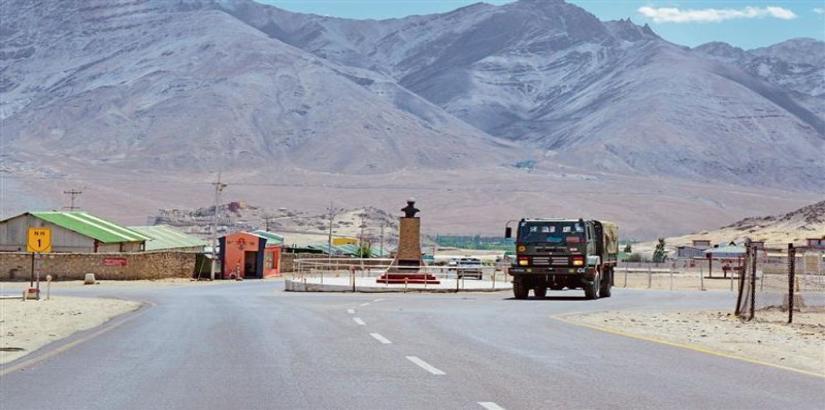
In late July 2026, Indian troops on routine patrol in Arunachal Pradesh’s Upper Subansiri district, near Taksing and Asaphila, came face-to-face with Chinese People’s Liberation Army (PLA) troops, leading to the first of many confrontations that have continued till November 2026. The first confrontation was followed by Chinese soldiers returning in large numbers and pitching tents several kilometres inside Indian territory, formerly part of the North East Frontier Agency (NEFA).
These intrusions and face-offs between the PLA and the Indian Army and Indo-Tibetan Border Police (ITBP) in Arunachal Pradesh, continuing despite and during the August 2026 Special Representatives (SR) meeting and President Xi Jinping’s attendance at the September 2026 BRICS Summit, amount to the Chinese yet again making a mockery of the so-called “maintenance of peace and tranquillity”.
Punctuating visits by Indian and Chinese leaders with intrusions into Indian territory is an old habit of the Chinese Communist Party. Two examples are worth recalling. During Prime Minister Atal Bihari Vajpayee’s official visit to China in June 2003, a Chinese patrol transgressed the Line of Actual Control (LAC) in the Asaphila area of Upper Subansiri district in Arunachal Pradesh. During Chinese President Xi Jinping’s state visit to India in September 2014, while he and Prime Minister Narendra Modi were walking along the banks of the Sabarmati River in Ahmedabad, a major border standoff took place. It involved 1,000 PLA troops who intruded several kilometres into the Chumar sector of Eastern Ladakh and pitched tents.
In October 2026, these incidents were brought to public attention following disclosures by ITBP Director General Shatrujeet Singh Kapur. The Ministry of External Affairs (MEA) confirmed that the face-offs occurred when PLA troops diverged from established patrolling patterns. DG Kapur also confirmed that the confrontations—primarily verbal or physical standoffs over patrolling limits—continued in late 2026.
Physical standoffs, which often involve grappling or fisticuffs, have been the usual method of Sino-Indian “bulletless border management” ever since the post-1967 agreement not to fire at each other.
Engagements and Face-offs
In August 2026, the 25th round of Special Representatives’ talks, co-chaired by National Security Adviser Ajit Doval and Chinese Foreign Minister Wang Yi in Beijing, ended with India and China reaching an eight-point consensus.
What emerged was hope for a cautious diplomatic thaw, institutionalised border stability and renewed high-level engagement. While the long-overdue settlement of the disputed border was to be pursued under the newly coined term “early and substantial harvest”, routine border management, including patrolling, was expected to proceed smoothly. This was especially so considering that the SR talks were very shortly followed by Xi Jinping’s attendance at the BRICS Summit in New Delhi, albeit after a period of uncertainty.
While the activation of these eight points provides valuable channels to prevent an accidental kinetic clash on the ground, the real test of China’s sincerity will not be the joint statements signed in Beijing, but whether the PLA ceases infrastructure build-ups and respects the historical patrolling rights of Indian troops along the LAC.
Considering the long history of the PLA and the Chinese Communist Party signing agreements and not implementing them on the ground, the PLA must establish and maintain trust and win the confidence of the Indian Army for this eight-point agreement to succeed and relations between the armies to remain steadily smooth. The face-offs and confrontations continuing till November obviously mean that the PLA has done nothing to win the confidence of Indian personnel.
On September 6–7, 2026, the Indian and Chinese armies held their first-ever Corps Commander-level meeting in the Eastern Sector, i.e., Arunachal Pradesh, expanding the military dialogue mechanism previously restricted to Eastern Ladakh.
At the Vacha-Damai Border Personnel Meeting Point, near Kibithu and the Kibod sector in Arunachal Pradesh, the Indian delegation, led by Lt Gen Girish Kalia, commanding the Indian Army’s ‘Spear’ Corps, and accompanied by a twelve-member group including representatives from the ITBP and the Ministry of External Affairs, met the Chinese delegation.
Held days before Jinping’s visit to New Delhi for the 18th BRICS Summit, the meeting also aimed to keep diplomatic channels open and prevent immediate escalation ahead of the summit, rather than settle entrenched territorial claims.
The confrontations, which Indian authorities attributed to the PLA’s departures from established patrolling patterns, have resulted in friction points at multiple areas along the frontier in Arunachal Pradesh, including Asaphila and Taksing/Limeking in Upper Subansiri district, which have not been marked, again by the PLA.
The September 6–7 talks between Lt Gen Kalia and his Chinese counterpart focused on implementing new hotlines and two additional Border Personnel Meeting points decided upon during the SR-level talks, rather than immediate troop disengagement.
Following the meeting, it was confirmed that the talks had not resolved the ongoing border confrontations in Arunachal Pradesh. While no violent clashes had occurred, both sides maintained heavy troop deployments. The ITBP had also deployed specialised close-combat units known as Shaurya Commandos to handle the standoffs. Both sides continued to use existing diplomatic and military channels to prevent miscalculations.
China claims Arunachal Pradesh as “Zangnan”, or South Tibet, and does not recognise the 1914 McMahon Line, whereas India firmly maintains that the entire state is an integral part of its territory.
Following the Corps Commander-level talks at Wacha-Damai, both sides scaled down the number of troops at key friction points such as Taksing and Limeking. Meanwhile, officials and fact-checkers have flagged various viral videos circulating online that claim massive PLA incursions as misleading, recycled or manipulated footage.
Salami-Slicing and Strategic Ambiguity
There remains no doubt that the PLA’s persistent transgressions are deliberate and part of a long-term policy, regardless of signed agreements and frameworks. Any unilateral advance or camping by the PLA violates the core tenets of the 1993 Agreement on the Maintenance of Peace and Tranquillity along the LAC, the 1996 Agreement and the 2005 Guiding Principles.
A look back at the period since 1967, particularly the 2020 Galwan clash and other confrontations, confirms that every agreement signed has been violated by the PLA on the ground.
The PLA has also consistently stalled the formal exchange of maps outlining each side’s perception of the LAC, a process explicitly outlined in Article X of the 1996 agreement. This deliberate ambiguity allows the PLA to continuously push its boundaries under the guise of “varying perceptions”.
“Salami-slicing” in various areas along the LAC is the PLA’s process of making frequent incremental encroachments, developing infrastructure and setting up temporary tents. Such activities, including reported positions 6–7 kilometres deep near Maza, are intended to slowly establish a new status quo over time.
These actions are an absolute mockery and a total breakdown of treaty obligations. New Delhi responds in a measured manner, treating these incidents as operational friction rather than a permanent policy failure. Rather than declaring the agreements completely dead, New Delhi maintains that existing military and diplomatic channels—such as the Working Mechanism for Consultation and Coordination (WMCC)—remain the primary tools to manage and defuse these incidents.
The face-offs in Arunachal Pradesh, specifically around areas such as Asaphila, Taksing and Maza, have reignited intense debate regarding Beijing’s commitment to bilateral border agreements.
The perception that China signs agreements it has no intention of following on the ground is widely shared by many Indian military analysts, former diplomats and security experts. However, official narratives and strategic perspectives on this issue differ between the two nations and among various stakeholders.
Local political leaders, including Arunachal Pradesh Chief Minister Pema Khandu, have noted that because China does not recognise the colonial-era McMahon Line, troops from both sides patrol up to their respective lines of perception. These occurrences are officially termed “transgressions” rather than permanent territorial encroachments or intrusions.
From Beijing’s official viewpoint, its military activities do not constitute a breach of agreements, as it rejects the legitimacy of the boundary line itself. As mentioned earlier, China views Arunachal Pradesh as “Zangnan” (South Tibet) and rejects the 1914 Simla Convention boundary as an illegitimate legacy of British colonial cartography.
The Chinese Foreign Ministry consistently frames the PLA’s movements as “normal border patrol and control activities” conducted strictly within Chinese territory to safeguard its own national sovereignty. Beijing officially calls upon India to work cooperatively to implement mutual understandings rather than place the blame on PLA manoeuvres.
Why the LAC Remains Unmarked
Ultimately, while the ongoing face-offs underscore the deep structural vulnerabilities of the existing border-management regime, opinions remain divided on whether they signify a total policy of bad-faith diplomacy by Beijing or inevitable friction stemming from a 3,488-kilometre border that remains undemarcated, primarily because New Delhi and Beijing hold conflicting territorial claims and do not agree on the exact alignment of the LAC.
The reasons this frontier remains unmarked include:
Differing British-era lines: In the western sector (Ladakh/Aksai Chin), India relies on the 1865 Johnson Line, while China’s claims align more closely with the 1899 McCartney–Macdonald proposal, which was never formally settled. In the eastern sector (Arunachal Pradesh), India recognises the 1914 McMahon Line from the Simla Convention, whereas China rejects it and claims the region as “southern Tibet”.
No jointly accepted LAC map: The LAC is a military control line rather than a formally agreed international boundary. Past efforts to clarify and exchange maps stalled—most notably in the western sector—leaving differing perceptions of where the line runs.
Difficult terrain and remote presence: High-altitude Himalayan peaks, glaciers and harsh weather make physical demarcation and continuous administrative presence difficult in many stretches.
Stalled negotiations and strategic rivalry: Decades of diplomatic and Special Representative-level talks have not produced a final boundary settlement. Both sides continue to build infrastructure and patrol areas they view as their own, leading to periodic face-offs even alongside diplomatic engagements.
Whether the border lines drawn by the British Empire reflected muddle-headedness or calculated strategy is a central debate among historians. Most scholars suggest that the reality was a complex mix of hasty administrative pragmatism, local ignorance and deliberate geopolitical strategy, rather than simple incompetence alone.
Many historians and critics argue that British border-making often suffered from a lack of local knowledge, arbitrary decision-making and extreme haste. This haste was, in part, owing to a mutiny by sailors of the British Indian Navy. If it had motivated the then Indian Army—which was 2.5 million strong during World War II—then 1857 would have been like a drop in the ocean.
It should be amply clear that China will not stop its hegemonic crawling or salami-slicing—gradual, incremental territorial or maritime encroachment below the threshold of full-scale war—until it enjoys “bulletless border management”, thanks to the restraint of its neighbour and adversary.
The 1967 Sikkim skirmishes showed how poorly the PLA performed in a confrontation involving firearms. While India has never opted to use firearms, even when 20 of its soldiers were killed barbarically with crude, spiked weapons in Galwan in June 2020, the least New Delhi should do is sanction enhanced arms deployment and much greater assertiveness during talks.
(The author, a strategic affairs analyst, is a former Defence Ministry and Indian Army spokesperson. The views expressed are personal. He can be contacted at wordsword02@gmail.com.)







Post a Comment