

He Taught India How to Laugh at Itself: Reflections on Johnny Walker's Birth Centenary
Impressed by Kazi’s mimicry and raw acting skills, Dutt took a gamble on the bus conductor, cast him, and renamed him after his favourite Scotch — Johnny Walker.
 Nov 11, 2026

Bombay (now Mumbai) was creatively evoked on celluloid in the film C.I.D. (1956) and internalized in a memorably lyrical and import-laden song:
“Ae dil hai mushkil jeena yahan, zara hat ke zara bach ke, yeh hai Bombay meri jaan.” (“Oh heart, it’s difficult to live here. Step aside a little, be careful a little — this is Bombay, my love.”)
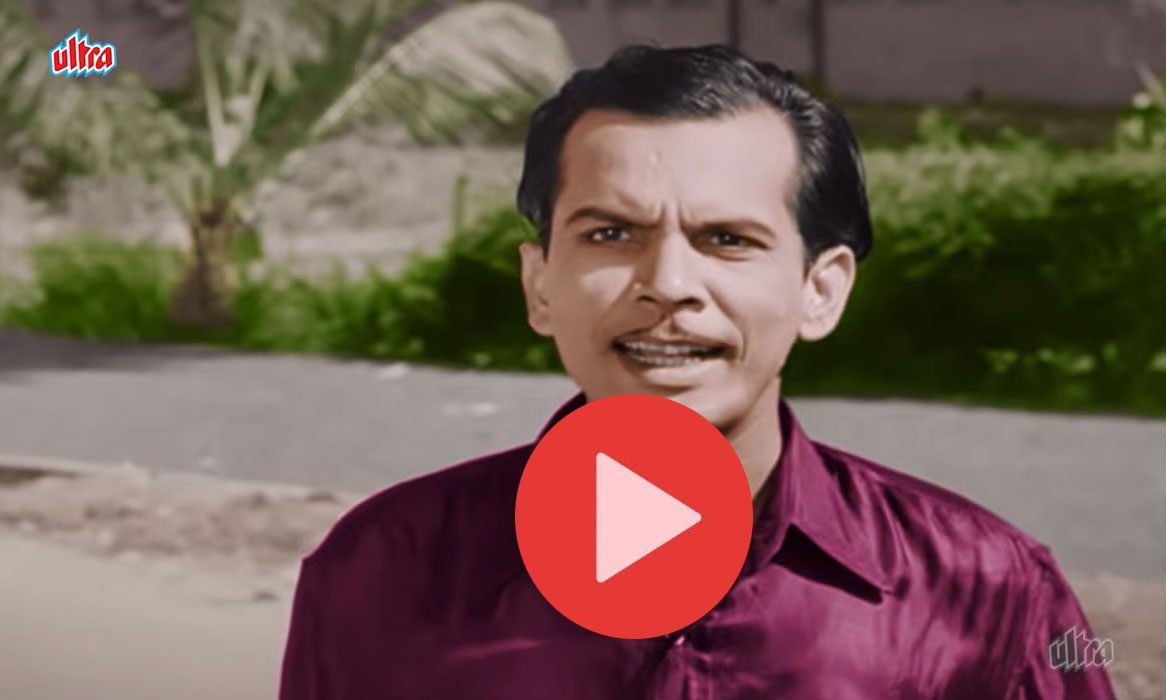
Millions of cine fans across India and South Asia knew this song even if they had not seen the film, and hummed it across generations. Seventy years later, it remains evergreen.
The song is indelibly associated with the comedian Johnny Walker, whose birth centenary falls on 11 November. He performs it on screen as Master, the pickpocket; the playback voices belong to Mohammed Rafi and Geeta Dutt.
Born Badruddin Jamaluddin Kazi in Indore to a mill-worker (most sources place the date as 11 November 1926), he was one of a large family. After his father lost his job, the family moved to Bombay. The young Badruddin worked as a BEST bus conductor on a salary of roughly Rs 26 a month and entertained passengers with witty antics and impressions of a drunkard.
Actor-writer Balraj Sahni saw him on a bus and told Guru Dutt, who was casting his first film, Baazi. Impressed by Kazi’s mimicry and raw acting skills, Dutt took a gamble on the bus conductor, cast him, and renamed him after his favourite Scotch — Johnny Walker.
Sociology of India
The irreverent baptism became a legend in Hindi cinema. The more endearing irony was that the industry’s most famous and loved drunk on screen never touched alcohol in real life.
This contradiction symbolises Johnny Walker in a distinctive manner: he was more than a comedian. Guru Dutt understood it instinctively and did not give him fillers; he gave him philosophy cloaked in comedy.
Guru Dutt, among the most gifted actor-directors of that period, gave the comic actor space to improvise one-liners. With his pencil-thin moustache, nasal drawl, and a hunch and shrug that became his grammar, Johnny Walker became a hit. Stories were written with him in mind, and the lyrical songs with layered interpretations that were mandatory in Bollywood of the era, became a form of sociology of India.
The 1956 song from C.I.D., “Yeh Hai Bombay Meri Jaan,” is illustrative. Raj Khosla directed the film that Guru Dutt produced. Johnny Walker plays Master, a pickpocket found at a murder scene who refuses to sell his soul to let a killer escape. He steps out on Marine Drive and the film cuts to Majrooh Sultanpuri’s memorable lines set to O.P. Nayyar’s lilting tune.The song “Ae dil hai mushkil…” looks like a comic number but is a searing critique of post-Independence India:
“Kahin building kahin tram, kahin motor kahin mill / Milta hai yahan sab kuchh, ik milta nahin dil; Beghar ko aawara yahan kehte hans hans, khud kaate gale sabke kahein isko business.” (“Somewhere buildings, somewhere trams, somewhere cars, somewhere mills. Everything is available here — only a heart is not. They laughingly call the homeless ‘wanderers,’ while everyone cuts each other’s throats and calls it business.”)
It captured what Bombay was in the 1950s — buildings and mills, gambling and cards, theft and races, the homeless labelled vagabonds while throat-slitting was called business. Majrooh penned the words and the versatile O.P. Nayyar supplied the musical template for Rafi, whose voice made satire melodious. Only Johnny Walker could deliver it lightly, “shorn of anger or bitterness, almost as a matter-of-fact description,” as Ashwini Deshpande noted.
Another song that merits recall is “Sar Jo Tera Chakraye,” also known as “Tel Malish,” from Pyaasa (1957). A champi-wala’s song, again by the legends - written by Sahir Ludhianvi, music by S.D. Burman, and sung by Rafi. The nation hummed a head-massage number; Guru Dutt leavened it with empathy, gentle humour, and the dignity of labour. That was his genius.
Etched in Collective Memory
The Johnny Walker trajectory is further burnished by another highly successful film, Anand (1971), which featured mega-star Rajesh Khanna and a budding Amitabh Bachchan.
By then Johnny Walker was in his mid-forties and his mantle as top comedian had largely been taken by Mehmood, but director Hrishikesh Mukherjee wanted him in a special role.
In Anand he is Issabhai Suratwala, a Gujarati theatre director whom Anand (Rajesh Khanna) keeps calling Murarilal and Jaichand. He has funny lines, but the final scene is etched in collective memory: on learning that the hero Anand is dying, he laments that the stage curtains were now down forever.
“Marte marte chela guru ko jeena sikha gaya” — the inversion of the whole film. The chela (pupil) teaches the guru (master) how to live while dying.
In a moving scene, Issabhai walks out after promising Anand that he will prepare a theatre troupe in heaven and breaks down inconsolably outside. That one scene embodied more tragedy and pathos, and distilled the finality of life in an understated but powerful manner.
From “Yeh Hai Bombay Meri Jaan,” which dwelt on how to live in a heartless city, to Anand — how to die in a heartful way — lies an arc that is not just comedy but a celluloid bouquet of socio-politically rooted moral education.
This was possible because of the man himself. Unlike many in the industry, he never invested his money in production except once, in the mid-1980s film Pahunche Huey Log, which he also directed. He married Noorjahan, younger sister of actress Shakila, raised six children, and lived opposite a bus stop in Bandra that conductors still call the “Johnny Walker bus stop.” Friends — Dilip Kumar, Naushad, Majrooh, Rafi — lived nearby.
He often said: “I acted in 300 films and the Censor Board never cut even one line.” No vulgarity, no double meaning, but character as craft.
The Indian Chaplin?
Is there a global parallel to contextualise Johnny Walker? Charlie Chaplin may seem the obvious one — the Tramp who makes you laugh and then shows you homelessness, unemployment, fascism — but Chaplin was an auteur, writer-director, silent-era myth. Johnny Walker was never an auteur; he was an actor who electrified someone else’s film.
Closer parallels would perhaps be Jacques Tati in France — Monsieur Hulot, the gangly, moustached outsider who exposes modernity’s absurdity by just walking through it. This is like Johnny Walker’s Master in Bombay. Afficionados have compared him to Totò in Italy — Antonio de Curtis, a comic who in films like Big Deal on Madonna Street made poverty dignified and philosophy street-level. Buster Keaton’s deadpan acceptance of catastrophe, or Peter Sellers’ Chance in Being There (1979), whose simple lines are taken as wisdom, come to mind as comparable in degree to Johnny Walker’s Issabhai. But these are degrees of correspondence among gifted actors who did comedy.
Perhaps the best comparison remains Chaplin after all — not the silent Chaplin, but the Chaplin of Limelight — a comedian aware that laughter is serious business.
On Johnny Walker’s birth centenary, his songs will be heard: “Main Bambai ka Babu” (Naya Daur), “Jungle Mein Mor Naacha” (Madhumati, for which he won a Filmfare award), and “Aye Dil Hai Aasaan Jeena Yahan” — the female reply to his own Bombay song that a hopeful Kum Kum (voiced by Geeta Dutt) gave.
What will remain abiding is the celluloid space he so effortlessly traversed: between the enthusiastic champi and the vicissitudes of Bombay to the theatre in heaven, he taught a newly independent country how to laugh at its embedded foibles without hating itself.
(The writer is an Indian Navy veteran & President, Society for Policy Studies, New Delhi and a leading security analyst who occasionally writes on film and art. The views expressed are personal. He can be reached at cub.sps@gmail.com)







Post a Comment