

The Shrinking Policy Space for Small States: Lessons from Bangladesh, Implications for India
New Delhi's wariness is not really about the river, or even the defence talks in isolation. It is about what Chinese capital and now a nascent security channel, both sitting in a border-adjacent basin, imply for India's own economic and security position.
 Aug 03, 2026
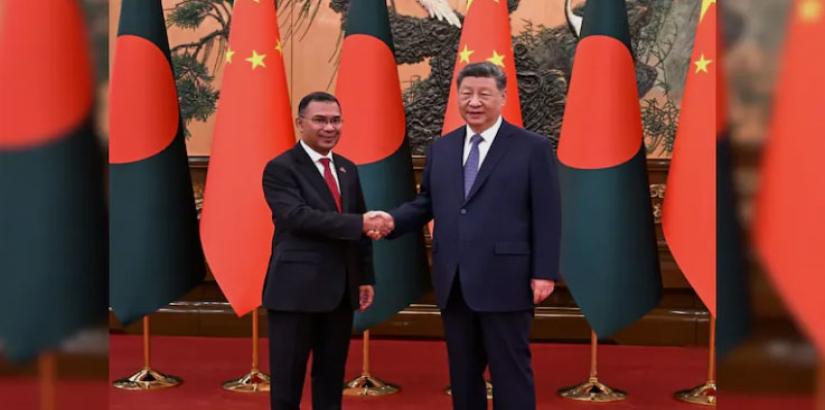
When Bangladesh Prime Minister Tarique Rahman chose Malaysia and China for his first overseas trip since taking office, rather than India, the decision was read in New Delhi as a deliberate signal. Indian commentary framed it as Dhaka bypassing a relationship that has traditionally received the inaugural visit of a new Bangladeshi premier. The five days Rahman spent in Beijing in June only sharpened that reading. Bangladeshi officials confirmed the two sides had reached, for the first time, an understanding to explore a “2+2” dialogue mechanism pairing their foreign and defence ministries — a format historically associated with Western alliance partnerships that Beijing has increasingly adopted to deepen strategic ties elsewhere. Officials in Dhaka were careful to describe it as still at an exploratory stage.
Beijing also pledged support for Bangladesh's accession to BRICS and the Shanghai Cooperation Organisation, and one memorandum of understanding even commits Bangladeshi schools to teach Mandarin.
It is tempting to read this purely as geopolitical positioning — a new government signalling its alignment. The more useful lens is geoeconomic, though the defence dialogue is a reminder that the geoeconomic and the geopolitical no longer stay in separate lanes.
Most of what actually moved in Beijing were financing commitments, infrastructure cooperation, market access, and institutional membership — economic instruments being deployed, on both sides, to register a strategic message. But the exploratory 2+2 mechanism shows the same relationship now growing an explicit security channel alongside the economic one.
That is precisely the pattern reshaping policy space for small states everywhere: geopolitical rivalry is conducted primarily, but not exclusively, through economic channels, and development decisions once judged on their economic merits are increasingly read as strategic signals, whatever their intent.
A Narrowing Space
The post-Cold War era gave smaller states an unprecedented opportunity. Expanding trade, integrated supply chains, and multilateral institutions let them diversify partnerships, attract capital, and grow without having to treat every economic choice as a geopolitical one. That era is closing.
As rivalry between China and the United States deepens and regional powers grow more assertive, infrastructure projects are scrutinised through security lenses, trade agreements carry strategic conditions, and even water management and climate-resilience initiatives are evaluated for their geopolitical consequences as much as their developmental worth.
This is the defining feature of the geoeconomic turn: economic interdependence, once treated as a commercial fact, is now wielded as an instrument of statecraft. Infrastructure finance, trade access, and technology standards are the tools; the objective is strategic influence. Policy space — the practical freedom of governments to pursue development priorities without incurring prohibitive geopolitical cost — has not disappeared, but exercising it now carries a price tag that development logic alone cannot calculate.
Bangladesh's Triple Balancing Act
Bangladesh's predicament makes this transformation unusually visible. Sitting at the crossroads of South and Southeast Asia, it must manage three relationships whose economic logics increasingly collide.
China has become one of Bangladesh's principal economic partners through infrastructure finance, industrial investment, and the Belt and Road Initiative. The proposed Teesta River Comprehensive Management and Restoration Project extends that pattern: for Dhaka it promises better water management and climate resilience; for Beijing it offers deeper economic engagement in a part of South Asia where India has historically predominated. The exploratory defence dialogue agreed in June adds a further layer neither side has attempted before.
New Delhi's wariness is not really about the river, or even the defence talks in isolation. It is about what Chinese capital and now a nascent security channel, both sitting in a border-adjacent basin, imply for India's own economic and security position.
India, meanwhile, remains indispensable on economic grounds that geography cannot substitute. The two countries share one of the world's longest borders, more than fifty rivers, and deep trade and migration linkages; border management and water-sharing cooperation are economic necessities as much as diplomatic ones.
The United States supplies the third leg through market access. The recently concluded US–Bangladesh trade agreement lowers tariff burdens on Bangladeshi exports, but embeds a condition that lets Washington terminate the deal if Bangladesh enters agreements with non-market economies that the United States judges to undermine it — a clause that converts a trade instrument into a standing constraint on Dhaka's other economic relationships.
The result is a structural trilemma, not ordinary hedging. China supplies capital and infrastructure; India, geographic access and river management; the United States, export markets and investment. None of the three is substitutable for either of the others, which is what makes balancing them a matter of economic necessity rather than diplomatic preference — and why Rahman's Beijing trip registered as a strategic event even though almost everything actually discussed was economic.
What Other Small States Show
Bangladesh's experience is not a regional peculiarity; it is a global pattern, and other cases show what enforcing economic leverage for strategic ends actually costs the target state.
Lithuania's decision to let Taiwan open a representative office under that name, rather than the usual diplomatic convention, triggered a sweeping Chinese trade response: informal import bans, pressure on European firms sourcing Lithuanian components, and losses researchers at CSIS have tied to tens of millions of dollars for Lithuanian exporters, resolved only after EU-level intervention. If a state backed by NATO and the EU absorbed costs of that scale for a single diplomatic choice, the price is higher still for states without comparable institutional buffers.
Sri Lanka shows a different cost: cumulative economic dependence hardening into strategic constraint. Unable to service its Hambantota port debt, Colombo handed a 70 percent stake and a 99-year lease to a Chinese state firm in 2017. Since then it has had to manage Chinese financing obligations, Indian security concerns, and IMF conditionality all at once — a single financing decision generating overlapping constraints that persist years later.
Mongolia illustrates the limits of diversification. Despite pursuing a “Third Neighbour” policy to offset dependence on China and Russia, Beijing froze bilateral economic talks after Mongolia hosted the Dalai Lama in 2016, at a moment when Ulaanbaatar badly needed Chinese financing. It soon pledged not to repeat the visit. Diversification did not remove the economic leverage; it only raised the price of testing it.
Development in Geopoliticised Economy
None of this means Bangladesh, or any small state, lacks options. It means every option now carries a strategic price tag, because the instruments through which that price gets paid are economic ones: financing terms, market access, trade conditions, technology partnerships. The Teesta project may improve water security, but it also invites strategic scrutiny of Chinese financing in a sensitive basin. The US trade agreement expands market access while narrowing Dhaka's room to manoeuvre with other partners.
Development decisions that once turned primarily on economic merit must now also account for their geopolitical afterlife.
Rahman's opening months in office capture the dilemma precisely. Most of what his China visit produced was economic — financing, trade, institutional membership — but the exploratory 2+2 dialogue signals that the economic and security tracks are starting to merge, and that shift will shape how Dhaka is perceived in Washington and New Delhi long after the details of any single MoU are forgotten.
That is the defining condition of the geoeconomic age: the scarcest resource for small states is no longer capital, technology, or market access itself, but the freedom to acquire them, and to manage security cooperation alongside them, without having every transaction read as a choice of side.
(The author is Professor and Chair of the Department of Economics, International University of Business Agriculture and Technology (IUBAT), Dhaka and a current affairs commentator. The views expressed are personal. He can be reached at golam.grasul@gmail.com)





Post a Comment