

Sri Lanka’s Ruling Marxists-Leninists on Delhi, Beijing Visits: Embracing Diplomatic Pragmatism?
For Sri Lankan politics, this is more than diplomatic sightseeing. It raises a fundamental question whether the JVP is developing a sophisticated strategy of balancing relations with India and China or is it gradually adapting itself to the organisational models of powerful one-party or dominant-party systems in China and India respectively?
 Oct 05, 2026
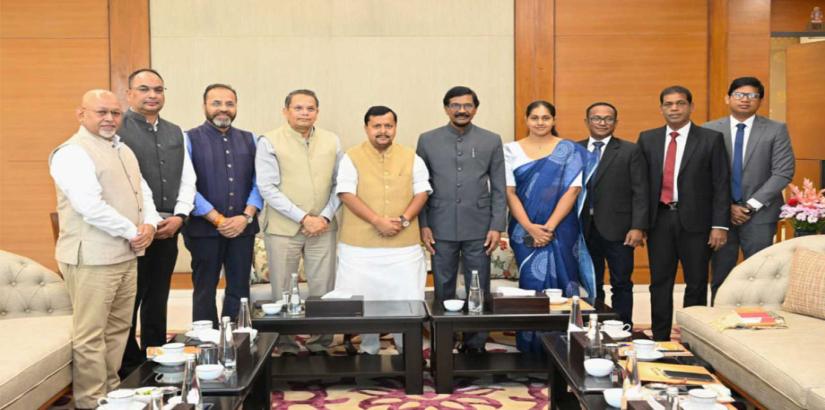
A high-powered delegation of Sri Lanka’s Janatha Vimukthi Peramuna (JVP), the Marxist-Leninist party that leads the National People’s Power (NPP) government, concluded a New Delhi visit at the invitation of India’s Bharatiya Janata Party (BJP), the Hindu nationalist governing party, marking a radical turn in its political evolution. The delegation, headed by General Secretary Tilvin Silva, conducted talks with party and government stalwarts, including BJP president Nitin Nabin, External Affairs Minister Subramanyam Jaishankar, on October 1, 2026.
A party historically associated with revolutionary Marxism that carried out an anti-India campaign and two armed insurrections in 1971 and 1988-89 now appears to follow a pro-India, pro-US political line. It is also cultivating relationships simultaneously with two very different political establishments: India’s BJP and China’s Communist Party (CPC), the world’s largest ruling communist party.
According to the BJP, the purpose was to strengthen party-to-party engagement and exchange organisational experience. Political analysts believe the JVP policy is very much in line with the current solid relationship between the United States and other QUAD countries, and Sri Lanka’s economic package with the International Monetary Fund (IMF).
“JVP’s Delhi ‘darshan’ may demonstrate political pragmatism,” said Prof Rohana Piyadasa of Kelaniya University. “Its Beijing engagement demonstrates ideological and strategic flexibility. What remains to be demonstrated is how the party reconciles that flexibility with the democratic pluralism that brought it to power.”
For Sri Lankan politics, this is more than diplomatic sightseeing. It raises a fundamental question: Is the JVP developing a sophisticated strategy of balancing relations with India and China, or is it gradually adapting itself to the organisational models of powerful one-party or dominant-party systems in China and India, respectively?
From Revolutionary Marxism to the Corridors of Power
The JVP was born as a revolutionary Marxist movement in the late 1960s and spearheaded two armed insurrections in 1971 and 1988-89, before entering the democratic mainstream and spending decades in opposition to the established political order. Today, through the NPP, it controls the presidency and an overwhelming parliamentary majority.
That transformation inevitably changes the party’s external relationships. It is not difficult to understand this change, as the JVP can no longer operate simply as an ideological opposition movement. It is now the principal organisation behind the governing political establishment and must maintain relations with Sri Lanka’s two most consequential Asian powers, China and India, despite the party’s historical anti-India policy.
Its recent activities suggest that the party understands this reality. In China, Tilvin Silva led a large JVP delegation on a CPC-sponsored study tour in June 2025. During discussions following the visit, Silva acknowledged that China operates under a one-party system but argued that it had what he described as positive features, including the ability to pursue one direction and one plan over the long term.
The issue became politically sensitive because reports subsequently attributed to Tilvin the view that long-term transformation required a ruling party to remain in power for 15–20 years. The JVP, however, claimed that its own political objective is to remain in government through elections rather than abolishing electoral competition.
The JVP’s relationship with Beijing has not disappeared because of its Delhi engagement. Indeed, the party’s own website records continuing high-level contacts with the CPC. Last month, new Chinese Ambassador Wei Huaxiang met Tilvin Silva at the JVP headquarters, with discussions covering bilateral relations and aspects of the government’s development and anti-corruption programmes.
The JVP website also records recent meetings between Silva and senior CPC representatives. The Chinese envoy and Tilvin were seen sitting together at the centre table at a Chinese National Day reception in Colombo on September 23.
Balancing Beijing and New Delhi
Chinese analysts say there is a crucial distinction between learning from China’s economic and administrative experience and embracing the political structure through which China governs.
Liu Yang Sloan, CEO of Human-AI Collaboration and Coexistence Laboratory (HACOLAB) in MASDAR, UAE, said that Sri Lanka could study China’s infrastructure development, poverty reduction programmes, digitalisation or administrative practices without importing its political system.
Likewise, the JVP can learn from India’s BJP about electoral organisation, party management, communications and mass mobilisation without adopting BJP ideology, he said.
The Delhi visit therefore looks less like a departure from China and more like an attempt to maintain political space on both sides. This is particularly significant because the BJP itself has recently reopened party-to-party channels with Beijing. In January 2026, a CPC delegation headed by Sun Haiyan met BJP leaders at the BJP headquarters in Delhi, the first such formal party-to-party engagement between the two sides since the 2020 Galwan crisis.
Sri Lankan analysts believe that Tilvin Silva’s comments about China’s one-party system deserve continuing public discussion, not necessarily because they reflect any intention to abolish multiparty democracy, but because they raise legitimate questions about the kind of political system the JVP believes is most effective.
What the Delhi Visit Means for India
For India, the JVP’s Delhi visit is strategically significant. New Delhi has an obvious interest in maintaining direct channels with the political organisation that dominates Sri Lanka’s present government. India has intensified high-level engagement with Colombo in recent years, including President Anura Kumara Dissanayake’s December 2024 visit to India and Prime Minister Narendra Modi’s April 2025 visit to Sri Lanka.
The JVP delegation’s BJP engagement therefore complements state-to-state relations. For the JVP, Delhi provides access to the political establishment of Sri Lanka’s closest major neighbour.
For India, party-to-party engagement provides another channel through which New Delhi can understand the thinking of Sri Lanka’s ruling political movement.
The ultimate test of the JVP’s transformation will not be whether it can talk to the BJP and the CPC. It will be whether, after winning power, it remains as committed to political competition as it was to winning it.
(The author, a former Sri Lankan diplomat, is a political and strategic affairs commentator. Views expressed are personal. He can be reached at sugeeswara@gmail.com.)





Post a Comment