

What's in a Name? Nomenclature Diplomacy Says Much About Changing Geopolitics
By removing the ‘Indo’ prefix from Indo-Pacific the US implicitly acknowledges that it no longer unilaterally defines the eastern strategic landscape. Regional organisations like BRICS continue to redefine the lexicon of ‘rules-based order’ to insulate themselves from western domination.
 Sep 13, 2026
Nomenclature was always as much a political construct as a geographic one. Such acts are rarely bureaucratic shifts but have wider implications in geopolitics. At the recent Shangri-La dialogue in Singapore, U.S. Secretary of Defense Pete Hegseth, hinted that a change to the US Pacific Command was imminent when he explicitly emphasized the US as a Pacific nation. Following this, on 16th June, the Trump administration decided to drop the prefix ‘INDO’ from US Indo Pacific Command, ‘INDO-PACOM’ and reverted back to its historic designation as United States Pacific Command ‘USPACOM.’
The USPACOM was established in 1947 and currently operates as the oldest and largest of the 11 unified combatant commands in the US military. The strategic significance of this command is underpinned in its decisive role in shaping America’s post WW-2 security architecture, especially during the Vietnam and Korean wars. Its area of operation stretches from the waters of the west coast of the U.S. to the east-coast maritime borderlines of India.
With the realignment of USA’s focus towards safeguarding its homeland and regions closer to the mainland, experts speculate that India’s significance in Washington’s ‘Asia Nexus’ is witnessing a downward curve.
The Weight of ‘INDO’ in INDO-USPACOM
The ‘Indo’ prefix was first introduced in the command’s name in 2018 in a deliberate attempt to unify both the theatres strategically and simultaneously leveraging New Delhi as the load bearer of American grand strategy. Additionally, it also signalled the American commitment to countering Beijing’s hegemony in the Indo-Pacific, under Quad’s banner of a ‘free and open’ Indo-Pacific.
For a long time, the USPACOM was Washington’s strategic counter to China’s regional ambitions. This shift also subtly signals a more accommodative U.S.-China relation as the Indo-Pacific construct has long since been regarded with hostility by Beijing.
This move comes at a time when India intends to align more closely with U.S. regional security frameworks. This shared interest is reflected in the growing cooperation between the armed forces of both the nations underscored by joint naval exercises like RIMPAC and land and air components like Yudh Abhyas and Red Flag spanning maritime domain awareness and logistics exchange.
But the ambiguity that has been created with this shift also prompts us to speculate that the Indo in Indo-Pacific has ceased to be a geography proactively dominated by Washington, but characterised by regional agency, sanction insulated financial architecture, and even a new currency to counter the US dollar.
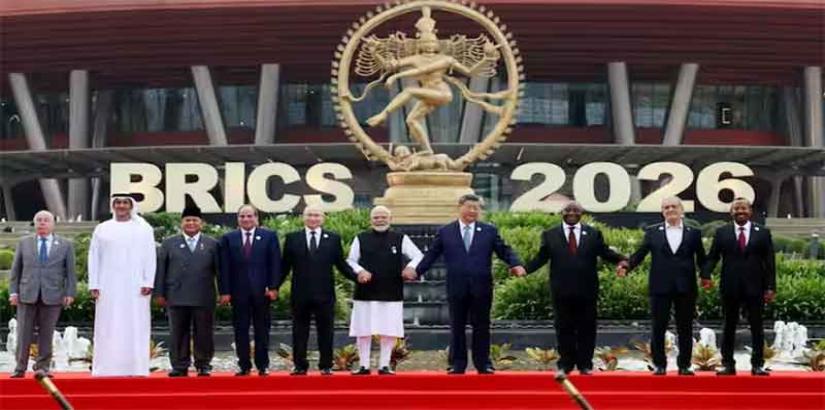
Growing Salience of BRICS
Regional multinational architectures like BRICS have started to gain prominence and have emerged as a potential avenue for the constituent nations to be resilient to US induced economic shocks. On the economic front, the creation of the New Development Bank (NDB) has substantially reduced the dependence of the BRICS nations on the Bretton Woods institutions. The NDB mitigates exchange risk rates by prioritising local currency financing.
As per NDB’s annual report of 2024, 43.5% of all the projects approved by the Bank were financed in the respective member country’s local currency. This long term attempt of de-dollarisation is increasingly being perceived by the White House as a direct geopolitical and economic threat, which became evident in July, 2025 when President Trump told his cabinet, “BRICS was set up to hurt us, BRICS was set up to degenerate our dollar and take our dollar…..off as the standard”.
Strategically, BRICS is actively transforming itself from a purely consultative economic platform to an effective instrument of geopolitical hedging and non-aligned deterrence. Through its aggressive push for expansion, the 11-nation grouping has managed to bring aboard important middle powers who control key maritime chokepoints, vital mineral supplies, and global energy resources.
In terms of diplomacy, the BRICS bloc acts as a buffer against unilateral sanctions and extra-territorial jurisdiction of the US on the world stage. Through the unison of their diplomatic approach at the international level, the BRICS countries manage to diminish the efficiency of Washington’s classic coercive statecraft tool. This is gradually leading to the normalisation of an international order where Washington is no longer the indispensable arbiter of global crises.
Nomenclature Diplomacy and Accounts From History
“Defense is too defensive. And we want to be defensive, but we want to be offensive too, if we have to be,” these were the words of U.S. President Donald Trump in September 2025 when he signed an executive order renaming the ‘Department of Defense’ as the ‘Department of War’ harking back to the nation’s early military roots. This decision ignited international debates with concerns mounting over a perceived shift in America’s military policy from a defensive to a more offensive posture.
If we look far east we have another instance when naming a sea became a hotly contested topic for decades. In 1997, South Korea advocated the use of the term ‘East Sea’ for the body of water between the Korean peninsula and Japanese archipelago. The reason behind South Korea’s insistence is that the term “Sea of Japan” was coined and popularised at a time when Japan colonised the Korean Peninsula. This prompted South Korea to advocate for its removal, contending that the nomenclature referenced its imperialistic past, bringing both nations to a tipping point.
Another controversy gained traction in late January 2025, when President Trump signed an executive order to rebrand the Gulf of Mexico as the Gulf of America. What followed soon after was a legal tussle between the Associated Press and the White House administration after the news agency refused to give up the long-established name of the gulf for its international readership. Experts worldwide viewed this as another episode of what they described as, ‘Trump-style intimidation’.
For centuries, geography provided the grammar of strategy. Halford Mackinder's Heartland Theory imagined Eurasia as the fulcrum of global dominance while Nicholas Spykman later redirected the focus towards the Rimland. Throughout the twentieth century, the focus of the global superpowers has been to establish firm dominance over the rimland. But modern warfare and diplomacy are increasingly organised around infrastructure and information rather than territory.
The theatre of war extends as much into the realm of cognitive manipulation and narrative engineering as it does into that of conventional armed conflict. Nomenclature diplomacy has become a potent instrument of modern statecraft in this case.
The Grammar of Strategy
Consequently, the grammar of strategy has evolved past Spykman's physical oceans and landmasses into the realm of what defence experts John Arquilla and David Rondflet termed as Noopolitics, the network-based geopolitics of knowledge and human perception premised upon establishing dominance over the noosphere – the collective intellect of the global society.
The reversion to USPACOM, rebranding of the Department of Defense and fraught debates over maritime nomenclature signify conscious attempts at ontological supremacy. By removing the ‘Indo’ prefix from Indo-Pacific, the US implicitly acknowledges that it no longer unilaterally defines the eastern strategic landscape. Regional organisations like BRICS continue to redefine the lexicon of ‘rules-based order’ to insulate themselves from western domination.
This dual phenomenon: the retraction of expansive American nomenclature alongside the rise of regional clusters of power, hints at the gradual end of unipolar geopolitical order.
(The author is a Commonwealth Scholar pursuing an MSc in Public Policy at University College London (UCL). The views expressed are personal. He can be contacted at connect@tanujsamaddar.in Linkedin: https://www.linkedin.com/in/tanuj-samaddar-frsa/ Twitter: https://x.com/TanujSamaddar )





Post a Comment