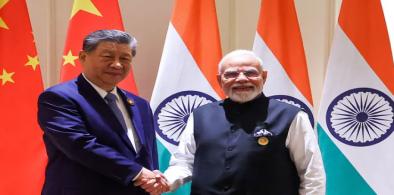

Representational Photo

Global Governance In The Maritime Domain: Can China And India Rise To The Challenge?

As two large maritime nations with aspirations to be global leaders, and who have also been identified as contributors to both these problems (China in both cases and India in relation to plastic pollution),  if Beijing and Delhi  are committed to equitable global governance, their actions on the ground must harmonize with their policy rhetoric. The oceans offer an opportunity to pursue their own initiatives – GGI in the case of China and the Mahasagar vision for India

Delhi Needs A Blue Sky Accord With Beijing: India And China Must Lead Through Environmental Diplomacy

The 75th anniversary of India–China relations offers a rare diplomatic opening. In a world of strategic rivalry, climate change and air pollution represent a shared threat where national interests converge. Environmental cooperation provides a low-politics entry point for rebuilding trust—through joint work on crop-residue management, high-density air-monitoring networks, and clean-energy transitions. Moreover, the Himalayan region—the planet’s “Third Pole”—is acutely vulnerable to black carbon and atmospheric pollutants from both sides of the border. Cooperation on air quality is therefore an act of Himalayan stewardship, protecting the water security of over a billion people.

Riyadh’s High-Stakes Power Game: Balancing US and Chinese Interests

At the same time, MBS has skilfully leveraged China as a strategic counterweight, signalling that any American hesitation could push Riyadh towards deeper military and technological cooperation with Beijing—an outcome the United States would prefer to avoid. China has already become Saudi Arabia’s largest trading partner, while the United States remains its primary arms supplier and security guarantor.

Japan Shaping New Asian Security Narrative With Taiwan Stance

If Taiwan were to fall, Japan’s security architecture would be fundamentally compromised. The First Island Chain would fracture, opening a northern pathway for Beijing toward Okinawa and Kyushu. Takaichi recognised this reality and voiced what many regional strategists have long acknowledged: Japan has little choice but to act, even at the cost of Beijing’s displeasure.

More on Indo Pacific - China Watch

Indian and China: Two different paths to economic progress

It is not possible for India to follow the China model of governance of less political freedom and more economic freedom. Yet, the present government may be well advised to implement pending reforms like land, labor, and judicial at the earliest.

Tonga's 'debt trap' illustrative of China's strategic stakes in South Pacific

The debt problem facing Tonga sheds light on the intricate nature of economic reliance and the broader geopolitical landscape in the South Pacific. Concerns regarding geopolitical control in a strategically significant region and the sustainability of debt have been highlighted by China's growing influence, not just in the region but beyond stretching to South Asia

US could play a larger role in shaping Bangladesh's future trajectory

This visit was strategically important for both the US and Bangladesh. For the US, it was an opportunity to solidify its presence in South Asia at a time when the region is becoming increasingly important in the broader context of US-China competition. Bangladesh, situated at the crossroads of South and Southeast Asia, plays a crucial role in the Indo-Pacific region.

Indian states have growing stake in a Free and Open Indo Pacific

India’s ties with South Korea, Japan and Taiwan which have grown in recent years have become even more important in the context of the current geopolitical and economic situation in the Indo-Pacific. India would also want to be one of the beneficiaries of the China+1 strategy being followed by many companies in East Asia. 

Pakistan needs to play a larger role in the geopolitics of the Indian Ocean

The evolving Indo-Pacific strategy, led by the United States, has added a new layer of complexity to the geopolitics of the Indian Ocean. As the U.S. and its allies seek to counter China's influence in the region, India has emerged as a key partner in this strategic framework. However, this realignment has implications for regional stability, particularly for Pakistan

The Quad remains relevant in upholding Indo Pacific security

Quad does create an overarching arc of stability in the region, checking the expansion capacity of Beijing, which will in turn boost India’s regional ambitions that are mutually aligned with the Quad’s objectives.

Modi visits to Brunei, Singapore show India's commitment to Indo Pacific engagement

Modi marked a new chapter in his strategic geopolitical moves over the past few months since the start of his third term with visits to the region and to Ukraine. All these marked a new frontier for India’s power projection while sending a clear message to allies and adversaries that New Delhi has its own bargaining chips in pursuance of its strategic neutrality while ensuring the best returns for its national security and international interests.

With increased militarisation, is a PLA demobilisation possible in Ladakh?

Vacating the Kailash Range without linking it to PLA withdrawal from Depsang-Demchok was a strategic blunder, proving how easily China cons our negotiators. Our political hierarchy wouldn't know how poorly this decision was viewed by our units/soldiers

How China-inspired democratic model empowering Sri Lanka's local communities

Sri Lanka’s TEPES and PEC share many similarities with China’s whole-process democracy. Both nations are working closely to exchange experiences and collaborate on the implementation of these systems in Sri Lanka.  

‘Axis of Upheaval’: China, Russia-led coalition threatens West-led global order

First, Russia is engaged in a war that marks Putin's point of no return in his effort to undermine NATO and the West—particularly the U.S.—pursuing a long-term confrontation. To better position Moscow for this conflict, Putin has effectively doubled down on relations with like-minded partners - China, Iran, and North Korea.

US sanctions three Chinese companies for aiding Pakistan’s ballistic missiles programme

China-based  Hubei Huachangda Intelligent Equipment Company, Universal Enterprise Limited, and Xi’an Longde Technology Development Company Limited (also known as Lontek) are sanctioned for having “knowingly transferred equipment and technology” to Pakistan, which is not a member of the Missile Technology Control Regime (MTCR) group, Miller said.

China-Bangladesh relations in an uncertain environment: Regional stakeholders need to see cooperative opportunities, not adversarial challenges

The intensification of geopolitical competition in the Bay of Bengal region may affect the healthy interaction between China and Bangladesh. Bangladesh, strategically located at the crossroads of South Asia and Southeast Asia, is a significant factor in the geopolitical and geoeconomic landscape of the Bay of Bengal. 

Why China is playing the name game with India on Arunachal Pradesh

The historical manipulation of Tibet's relations with Monyul is a front that China plays against India on the China-India border dispute over the Indo-Tibet border. China has misinterpreted the history of Tibet's relations with Monyul to assert its territorial claim in the region.

India ‘will never be formal ally’ of US but can have ‘strongest’ ties as allies on global stage, says US diplomat

“One of the hardest things to keep in mind is that India is also a great power and it has its own beliefs, its own interests”, he said.

Quad foreign ministers warn of terrorists using new technology, demand action against Pakistan-based terror groups

Recalling the 26/11 Mumbai and the 2016 Pathankot terrorist attacks. they called for “bringing the perpetrators of these attacks to justice without delay”.  This explicit mention of terror attacks on India, purported to be engineered from Pakistani soil, is seen as a strong backing by Quad partners of India's stand on cross-border terrorism which New Delhi says is promoted and supported by the Pakistani State.