The budget shows that the government’s commitment to the bottom 30-40 percent of the Indian population seems to be very limited



The ambition exists across the region. Young Indian companies are building rocket engines and computer chips, products India has long bought from abroad. Pakistan sent a delegation to Silicon Valley to show what its technology industry can do
A country can only be as independent in its diplomacy as it is in its economy. A nation that imports its phones, its chips and much of its energy, will always have less room to manoeuvre than one that makes what the world needs.
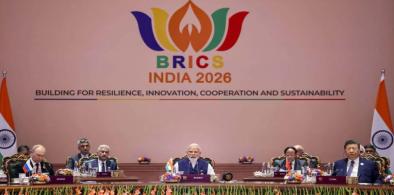
The difference between Xi's New Delhi proposal and the language of the declaration illustrates the distinction between China's ambitions for AI cooperation and the level of agreement achieved among BRICS members. The declaration did not reject China's AI diplomacy; it simply did not explicitly endorse the proposed open-source community.

The AI revolution may indeed change warfare. But the laws of physics, engineering and economics have not been repealed. AI may be extraordinarily powerful in the data centre. The real challenge is carrying that capability to the battlefield.
The budget shows that the government’s commitment to the bottom 30-40 percent of the Indian population seems to be very limited
Amid the worsening economic crisis, Sri Lanka has written to the International Monetary Fund (IMF) seeking “technical support” in tackling the ongoing crisis, confirmed Finance Minister Basit Rajapaksa, after the government kept avoiding the IMF option for months amid domestic pressure
In what comes as a big relief to Pakistan’s struggling economy, the International Monetary Fund (IMF) has approved $1 billion for Pakistan after the latter implemented reform measures suggested by the former, thus reviving the $6 billion package, which was stalled since June last year
Afghanistan, Bhutan, Nepal, see cuts in their allocations in the financial year 2022-23, while Bangladesh, Maldives, and Myanmar receive higher funds in comparison to the last year.
Amid the growing fuel crisis exacerbated by a foreign exchange crisis, the Sri Lankan government has decided to purchase diesel from India’s state-owned Indian Oil Corporation Ltd (IOCL), and a proposal for the purchase has been cleared by the Cabinet on Tuesday

Sri Lanka has sought market access in Turkey for its goods when Turkish Foreign Minister Mevlüt Çavuşoğlu visited Sri Lanka for the promotion of the bilateral trade between the two countries

The advent of Iranian apples has resulted in a drop of over 50 percent in demand for Kashmiri apples, write Suhail Bhat and Sameer Mushtaq for South Asia Monitor
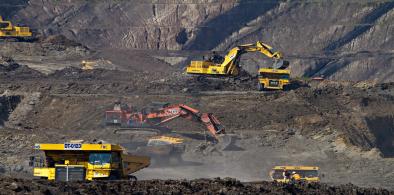
Nepal has become self-sufficient in cement production, with close to 55 plants having an annual production capacity of 15 million tonnes operating across the country

Nearly 70 years after the Indian government took over Air India from a reluctant Tatas, the flag carrier returned to its founder, the salt-to-software conglomerate Thursday
India's economy is projected to grow by 9 per cent in the next fiscal year, retaining its position as the fastest-growing major economy, the International Monetary Fund (IMF) reported on Tuesday citing its expectations of higher investments and consumption due to credit growth and better financial sector performance
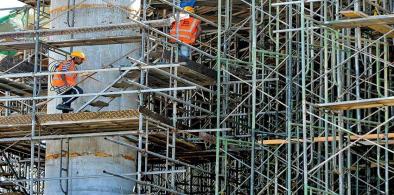
The construction industry, the biggest contributor to the gross domestic product in Sri Lanka, is threatened by the shortage of cement, and now builders have urged authorities to resolve their issues
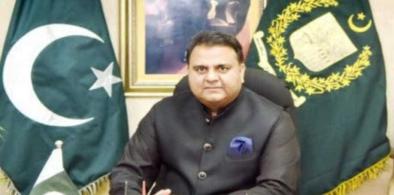
Pakistan recently decided to offer permanent residency to rich foreigners, mainly Sikhs living in the US and Canada, Afghans and Chinese, in exchange for their investment, a move the country’s Information Minister Fawad Chaudhary termed “historic.”
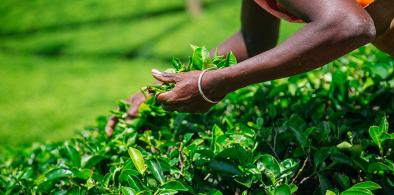
In a bid to revive its prized tea industry facing an export collapse, the Sri Lankan government has said it will provide fertilizer subsidies to tea cultivators who have been suffering since the ban on chemical fertilizer last year
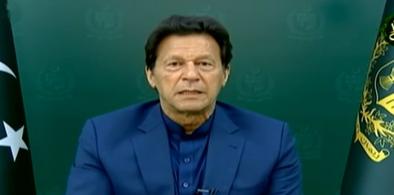
In a tweet on Friday, Pakistan Prime Minister Khan said the Gross Domestic Product (GDP) growth for the last three years was 5.37 percent and congratulated his own government for “substantial job creation” and “rise in per capita income.”
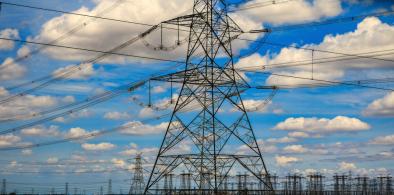
India will not buy Nepal’s surplus electricity produced by hydropower projects having Chinese components or built by Chinese contractors, Indian authorities have reportedly conveyed to Nepal, days after the industry players from the two nations signed a landmark agreement for power trading