

Bangladesh Needs Careful Handling: Neighbourhood Challenges for Indian Foreign Policy
Now, Bangladesh has said that future bilateral relations with India will heavily depend on successful renegotiation and renewal of the 1996 Ganges Water Sharing Treaty, which expires in December 2026. Bangladesh’s Water Resources Minister Shahiduddin Chowdhury Anee and the ruling Bangladesh Nationalist Party (BNP) General Secretary Mirza Fakhrul Islam Alamgir are pressing for immediate talks on new agreements that should not have fixed tenures.
 May 20, 2026
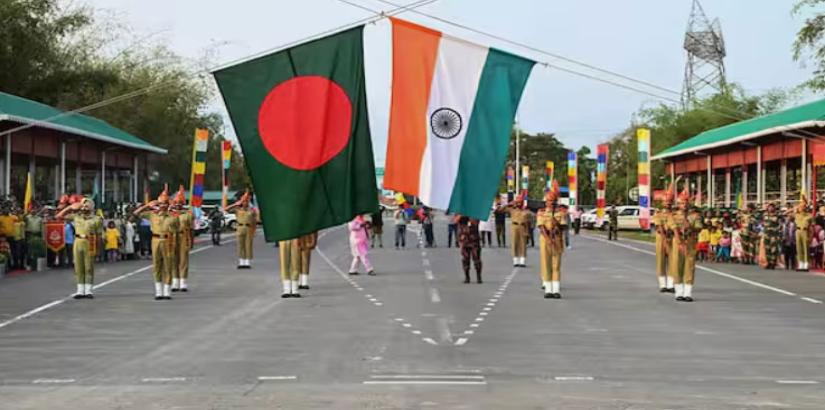
When Tarique Rahman was sworn in as Prime Minister of Bangladesh on February 17, 2026, US President Donald Trump congratulated him and suggested a US-Bangladesh defence arrangement. The US had been eyeing Bangladesh’s Saint Martin Island as a NATO military base.
The US and Bangladesh are presently finalizing two foundational defence agreements, ACSA (Acquisition and Cross-Servicing Agreement) and GSOMIA (General Security of Military Information Agreement), giving the US logistical port access in the Bay of Bengal and ports in Bangladesh.
Key deep-sea hubs under this agreement include Chittagong and Matarbari. Economic incentives tied to these pacts include 19% tariff concession on textiles and a reciprocal trade agreement, with Washington monitoring the Indian Ocean transit lines and regional energy set up.
The US could also cash on the potential India-Bangladesh acrimony over 90-lakh voters declared illegal in recent West Bengal elections and Dhaka firm against India pushing them across the border.
Closer Dhaka-Islamabad Ties
The main opposition party in Bangladesh is the radical Jamaat-e-Islami (JeI) and the long-standing US manipulation of Islamists as a geopolitical instrument when it suits them continues under Trump.
Pakistan PM Shehbaz Sharif and Army Chief General Asim Munir are scheduled to visit Bangladesh immediately following Tarique Rahman’s official trip to China in June 2026. Dhaka and Islamabad are expected to sign multiple agreements during this visit. In January 2025, Pakistan’s Inter-Services Intelligence (ISI) chief made a first-ever visit to Dhaka. Pakistan's Foreign Minister Ishaq Dar visited Dhaka, in August 2025.
Reciprocal Bangladesh-Pakistan military visits are periodic, as are of radical Islamist leaders. Pakistan has been training the Bangladesh Army in four cantonments in Bangladesh, while bureaucrats of Bangladesh are undergoing training in Pakistan, not in Mussoorie (India) as was the case earlier.
In early 2026, Bangladesh sought procurement of JF-17 Thunder Block III fighter jets, jointly developed by Pakistan and China. Flight simulators for the jet have already reached Dhaka and Bangladesh pilots are in Pakistan for training.
China's Strategic Footprints
China has strategic interests in Bangladesh, where it has built Asia’s largest submarine base. China supplies over 80% of Pakistan's total imported weaponry, while China remains the top military supplier for Bangladesh and Myanmar.
China is reportedly establishing an airbase at Lalmonirhat (close to India’s Siliguri Corridor), for construction of which Bangladesh has contracted a Pakistani company.
China is Bangladesh's top trading partner. To partly mitigate the trade deficit in China’s favour, Beijing has granted duty-free access to 97% of Bangladeshi products. Also, Bangladesh is a major participant in China's Belt and Road Initiative (BRI). Chinese investments in Bangladesh include modernization of port facilities. Like in Mongla port, and large-scale infrastructure development.
Bangladesh has welcomed Chinese participation in the USD 1 billion Teesta River Comprehensive Management and Restoration Project and has sought China's financial and technical support.
In addition, Bangladesh and China have signed agreements to exchange hydrological data for the Brahmaputra River. Also, Bangladesh has joined the UN Water Convention to bolster its water security as a lower riparian state. Significantly, unlike India, China does not have a water-sharing agreement with any country.
Differences with India
Dhaka has been asking for the return of former Bangladesh prime minister Sheikh Hasina living in self-imposed exile in India. She has been charged with and convicted of crimes against humanity and corruption. Continuing incidents of infiltration, cross-border smuggling, and return of illegal Bangladeshi immigrants from India to Bangladesh have added to straining relations between the two neighbours.
India and Bangladesh share 54 transboundary rivers, discussion on which continue periodically. However, Bangladesh has arbitrarily approved a mega-project to build a barrage on the Padma (Ganges) River by 2033, citing the need to mitigate impact of the Farakka Barrage.
Now Bangladesh has stated that future bilateral relations with India will heavily depend on successful renegotiation and renewal of the 1996 Ganges Water Sharing Treaty, which expires in December 2026. Bangladesh’s Water Resources Minister Shahiduddin Chowdhury Anee and the ruling Bangladesh Nationalist Party (BNP) General Secretary Mirza Fakhrul Islam Alamgir are pressing for immediate talks on new agreements that should not have fixed tenures.
India will need to be careful in handling Bangladesh, particularly on the issues of the return of "illegal" Bangladeshi migrants and sharing of river waters.
Moreover, New Delhi has to be careful about inimical forces becoming restive in its immediate neighbourhood, another example being Nepal throwing a spanner in the Mansarovar pilgrimage through Lipulekh Pass, which Nepal claims. The issue could have been discussed bilaterally without stopping the pilgrimage.
(The author is an Indian Army veteran and strategic affairs analyst. Views expressed are personal. He can be contacted at prakashkatoch7@gmail.com)







Post a Comment