

India-US Relations: When Objectives Overlap, Perspectives Differ
One of the most durable strengths of India-US relations lies outside the government. The five million strong Indian diaspora has become an extraordinary bridge between the two societies. Indian Americans occupy influential positions in technology, academia, medicine, business and public administration. This human connectivity provides resilience that many bilateral relationships lack.
 Jul 13, 2026
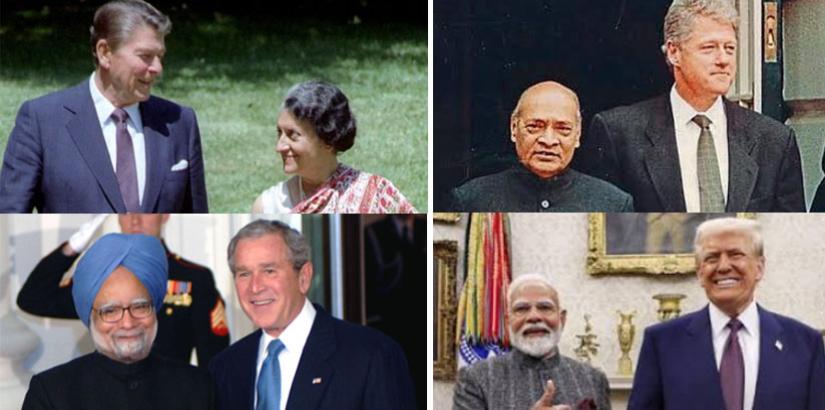
In May 1994, Prime Minister P V Narasimha Rao visited the US, addressed a joint session of the US Congress and met President Bill Clinton at the White House during which Clinton lauded Rao for leading India through "an absolutely astonishing period of economic transformation" and hoped it will be the beginning of "a very close working relationship as our two countries forge stronger partnership".
It was in many ways then considered a breakthrough meeting as it was the first between the leaders of the two countries since Prime Minister Rajiv Gandhi visited the White House in 1987 for a meeting with President Ronald Reagan. Rao spoke of "an unprecedented opportunity to free India-U.S. bilateral relations from the distortions induced by the cold war, to look for areas of converging interest in the changed international situation, and work together for our mutual benefit."
But for the American media, steeped in Cold War thinking, India was not newsworthy enough as the country was still viewed through the prism of timeworn cliches and cultural prejudices. Rao was virtually ignored by the US journalists at the joint news conference post the talks. The questions were mostly directed at Clinton on global affairs and the singular question to Rao was about alleged human rights violations in Kashmir. Mainstream American papers blacked out the Indian Prime Minister's visit in their daily coverage.
Over three decades later, when President Trump and Prime MInister Modi met at Evian, France, on the sidelines of the G7 summit in June 2026, it was a vastly different India that the US president was engaging, the discourse was businesslike, though Trump tried to inject some levity into it by repeatedly praising Modi, calling him "so nice, he's like an angel, but actually he's as tough as he's a killer" and said he was ready to defend India as long as Modi was prime minister.
This was their first meeting in 16 months, though the two have spoken on phone nine times in Trump's second presidency. But despite the congeniality on display, bilateral ties remain troubled and various signals and statements from Washington in the last few months have injected - from the Indian perspective - an element of uncertainty into a relationship which otherwise is classified in official jargon as a Comprehensive Global Strategic Partnership.
For decades after India's independence, bilateral ties were characterised by suspicion, especially after India under Jawaharlal Nehru resisted American overtures to be an ideological camp follower against the rising tide of Communism represented by the then Soviet Union. India's non-aligned posture and close defence relationship with the Soviet Union contrasted sharply with Washington's alliances with Pakistan. India's socialist policies and the "Hindu rate of growth" further inhibited American interest in India and high level engagement was few and far between.
"Relations were strained over most of the last decade, partly because of American arms sales to Pakistan and partly because of India's criticism of American foreign policy", The New York Times then wrote.
A turnaround however came when Indira Gandhi visited Washington in July 1982 for a meeting with Ronald Reagan where the two decided to increase scientific, economic and cultural cooperation between the two countries. Then, in June 1983, Secretary of State George Schultz visited India, and said the United States was prepared to approve the sale of military equipment to India. India, which has bought some military hardware from the United States in the past but had relied in primarily on the Soviet Union to provide weapons for its growing military, had sounded out the Reagan Administration about buying $1 billion in arms, its first major attempt at diversification.
Estrangement to Engagement
The world's oldest and largest democracies have steadily transitioned since then from a phase of estrangement during the Cold War to a much deeper engagement characterized by shared values and mutual interests, particularly in response to the rise of China. This relationship has been significantly shaped by high-level visits from both countries, especially since 2000 when Clinton visited India, the first presidential visit in 22 years since Jimmy Carter came to India.
On the Indian side, four visits by Prime Minister Atal Bihari Vajpayee since two by Narasimha Rao added to the economic momentum. In 1998, India under Vajpayee tested five nuclear bombs, irking the US that had assiduously been seeking to prevent India from turning nuclear. But a series of diplomatic dialogues between Foreign Minister Jaswant and Strobe Talbott, US Deputy Secretary of State, laid the solid foundation for the transformation of India’s relationship with the US.
Eleven rounds of the dialogue, held in different places around the world, covered a comprehensive range of issues confronting India in the strategic arena, bilateral relations, and their expectations from each other. The talk cleared apprehensions about India’s nuclear policy, economic and strategic aspirations, and security concerns, according to strategic experts.
The 2000 Clinton visit reset the relationship and marked the beginning of a structured dialogue that had been suspended since the nuclear tests. The visit also led to the lifting of some sanctions against India, indicating a significant shift in Washington's approach. These set the stage for a more cooperative and strategic relationship that has continued to develop over the years.
Since 2000, five successive presidential administrations have worked—with bipartisan congressional support—to expand and strengthen the strategic partnership with India. The growing economic and geopolitical significance of India to the US reflected a deeper alignment that went beyond historical hesitations, marking a new chapter in Indo-US relations. As a result, US investments in India began to rise slowly and trade increased.
But it was not until Prime Minister Manmohan Singh took charge that the India-US relationship began to mature and deepen. By 2004, India as a fast-growing large economy was visible—it touched the trillion-dollar mark in 2007 and US$ 2 trillion in 2014. But more than the economy and the rising US investments into India, Manmohan Singh and US President George Bush negotiated and delivered a strategic milestone in the form of the US-India: Civil Nuclear Cooperation, a deal that powered the economic and strategic relationship into newer areas and cemented the bonds between the two democracies. The landmark civil nuclear agreement that concluded in late 2008 led to the end of 34-year isolation of India in the global nuclear domain. It fundamentally altered perceptions on both sides. The US began viewing India as a long-term strategic partner, while New Delhi gradually shed its Cold War distrust of Washington. Subsequent administrations in both countries institutionalised the partnership.
During his two terms, Manmohan Singh made eight visits to the US and developed a remarkable personal relationship with Bush who went on to say, "You and I have worked hard to change the relationship between our countries. India is a great country with an incredibly bright future, and it's in the US interests to have a good, strong strategic relationship with India."
Under Barack Obama, India was described as a "defining partnership of the 21st century". The visit of Obama and wife Michelle in January 2015 as guests of India's Republic Day and the bonhomie displayed between Obama and Modi highlighted the growing warmth and partnership in strengthening economies and democracies across different administrations and governments.
Donald Trump's first term deepened defence cooperation despite occasional trade disputes. Joe Biden expanded cooperation in semiconductors, clean energy and critical supply chains. Among the achievements Biden was “proudest” of was his effort to build stronger ties with India, as the two countries worked together more closely than ever before in the Indian Ocean and Indo-Pacific and on emerging technology.
A senior administration official was quoted as saying at that time that leaders on both sides had shed their “ambivalence” about the relationship, and the US sees engagement with India as “central” to everything it does on the global stage. In fact, the Congressional Research Service (CRS) underlined in a policy paper last year (https://www.everycrsreport.com/reports/IF12903.html ) on the growing importance of India:
"India, the world’s largest democracy and most populous country, overtook Japan in 2025 to become the fourth largest economy. India’s expanding strategic horizons and increased engagement with international partners; geography astride vital sea and energy lanes; growing defense and power projection capabilities; and vigorous space, science, and technology sectors have made it an attractive potential partner for U.S. policymakers."
By 2024-25, the relationship had become one of the world's most consequential strategic partnerships.
Trump 2.0 and Transactional Diplomacy
Trump's return to the White House in January 2025 reintroduced a somewhat transactional approach to foreign policy. Unlike traditional American administrations that framed India primarily through strategic considerations, Trump largely views international relationships through a commercial lens.
India, meanwhile, has become far more confident and less willing to accept unequal arrangements. New Delhi seeks partnership without dependence and cooperation without alliance obligations. This divergence is creating a subtle but important shift in bilateral dynamics.
India's strategic autonomy remains a central pillar of its foreign policy irrespective of which government is in power. New Delhi will cooperate closely with Washington while simultaneously maintaining relationships with Russia, engaging with the Global South and preserving independent decision-making. This balancing act frequently frustrates American policymakers but reflects India's own assessment of national interests.
There is little doubt that the India-United States relationship has entered a new and somewhat paradoxical phase. Never before have the two countries been so closely aligned strategically, yet never has the partnership appeared so uncertain tactically.
The bilateral relationship today is characterised by simultaneous convergence and friction. Both countries increasingly view each other as indispensable partners in navigating an unstable international order shaped by China's rise, technological competition, supply-chain vulnerabilities, conflicts in Europe and West Asia, and the fragmentation of global governance. Yet they continue to disagree on trade, market access, tariffs, immigration policies, and the extent to which India should align with American strategic priorities, especially Trump's warming up to Pakistan.
According to Indian media, the first flashpoint in the relationship was Operation Sindoor, the four-day conflict with Pakistan, when Trump claimed he had brokered the ceasefire, a claim that Islamabad endorsed but New Delhi rejected. Trump has since repeated that claim of bringing peace to South Asia umpteen times, but India has now chosen to ignore it rather than join the issue with him.
The underlying tension, with the differences amplified by the media, was visible at the Evian meeting where the two formally shooks hands without the customary hug of their previous meetings. The encounter symbolised diplomatic continuity rather than dramatic political change. The optics remained warm, but the substance underscored an increasingly transactional relationship, the leitmotif of Trump's disruptive foreign policy.
The question confronting both countries is whether India-US relations can move beyond personalities and become resilient enough to withstand changing political winds.
The Economics Deficit
Ironically, economics had become the weakest pillar of an otherwise strong strategic relationship. Bilateral trade continues to grow, but disagreements persist over tariffs, agricultural access, digital regulations, data governance and intellectual property.
Unlike security cooperation, trade negotiations involve powerful domestic constituencies in both countries. For India, protecting farmers and small industries remains politically sensitive. For the US, concerns about market access and trade imbalances remain a bipartisan issue. But both sides, nudged by their leadership, are committed to close the deal quickly and set a bilateral trade target of $500 billion. However, economic friction may become a lasting feature rather than a temporary irritant under Trump, many analysts say.
Technology the New Frontier
If defence defined the previous decade, technology may define the next one. Artificial intelligence, semiconductors, quantum computing, biotechnology, space and critical minerals have become central to bilateral engagement. India offers scale, engineering talent and a growing digital ecosystem. The United States offers capital, advanced technologies and innovation networks.
The challenge will be translating political declarations into sustainable industrial partnerships. Competition from China is accelerating this process, but implementation remains uneven. Both countries must also navigate growing debates over data sovereignty, digital regulations and technology governance.
These are not merely technical disagreements; they are emerging geopolitical fault lines.
The Russia and China Factors
Perhaps the most persistent source of disagreement remains India's relationship with Russia. India continues to depend significantly on Russian defence equipment and energy imports. Western governments often criticise this dependence, particularly in the context of the Ukraine conflict. India argues that its choices are guided by national interest on energy security rather than ideological alignment.
From New Delhi's perspective, strategic autonomy requires maintaining diversified partnerships. In the pre-Trump period Washington has had largely accommodated this position, recognising India's long-term importance and the balancing role its place in keeping global oil prices stable. However, the issue periodically resurfaces and remains an underlying irritant.
If there was one factor that was holding the partnership together it was China. Despite fluctuations in trade relations, both India and the United States shared concerns about Beijing's growing economic, technological and military influence.
The Indo-Pacific framework became the principal theatre of cooperation. The Quadrilateral Security Dialogue (QUAD) involving India, the United States, Japan and Australia evolved into an important strategic mechanism against China's putative rise. Defence exercises expanded, intelligence-sharing increased, and military interoperability improved substantially.
Yet, the US under Trump has been changing its stance towards China as he has set up a working relationship with Xi Jinping with whom he has promoted the concept of G2 (US and China), and perhaps wants to use partners like the Quad as a hedge in managing this difficult relationship with China.
The Diaspora Advantage
One of the most durable strengths of India-US relations lies outside the government. The five million strong Indian diaspora has become an extraordinary bridge between the two societies. Indian Americans occupy influential positions in technology, academia, medicine, business and public administration. This human connectivity provides resilience that many bilateral relationships lack.
Unlike traditional state-to-state partnerships, India-US relations increasingly operate across multiple layers: governments, businesses, universities, technology ecosystems and people-to-people networks. This may ultimately prove more important than any summit meeting.
Evian: Symbolism Amid Uncertainty
Against this backdrop, the Modi-Trump meeting in Evian represented a reaffirmation rather than a reset. The discussions reportedly covered economic growth, AI, investment partnerships, maritime security, supply chains and regional crises. The meeting also took place amid heightened concerns over West Asian instability and disruptions to global trade routes.
The significance of Evian lies less in immediate outcomes and more in what it signals. Both leaders recognise that the relationship is too important to neglect.
Neither side wants a rupture. Yet neither side is prepared to subordinate national interests for the sake of maintaining diplomatic harmony.
Differing Perspectives
The transformation of India-US relations over the past quarter century has been remarkable. Yet a closer partnership has not eliminated fundamental differences.
The partnership is no longer about whether the two countries need each other, which is a given. The real challenge now is managing lofty expectations.
Former US diplomat Greg Newsham lists three points to argue why India still matters to the US, and that the Indian commentariat often swings between extremes about the relationship.
First, the appointment of Sergio Gor as US ambassador was a calculated one. Gor can call up the White House anytime and Trump will respond, a privilege that not many ambassadors have.
Second, the visit to Secretary of Marco Rubio last month was not a random one. The visit of Rubio, who is also national security advisor, was "a gauge of the importance the Trump administration assigns to India".
Third, the India-US military-to-military relationship is stronger than ever. The two forces conduct frequent exercises, while India has become a maintenance and logistics hub for the US Navy and arms sales are robust. And, India also gets a degree of special treatment regarding technology exports .
"And at the end of the day, Indian and American strategic interests align — as the world enters a struggle between free, consensually governed nations and expansionist totalitarian ones, " avers Newsham, who is a fellow at the Center for Security Policy and Yorktown Institute.
There is no doubt India seeks recognition as an independent great power that wants to keep its international choices open. The United States seeks a reliable partner in preserving a stable balance of power in Asia. These objectives overlap but are not identical. The future trajectory of the relationship will depend on how effectively both countries reconcile their different perspectives.
The age of romance in India-US relations may be ending. The age of realism has begun. As Shubhajit Roy of The Indian Express noted post Evian: "India understands that Trump needs to be managed for the next three years, and an openly confrontational approach or submissive behaviour doesn't work. Modi's approach - credit him with peace efforts while working on a trade deal to limit tariffs - is the best possible strategy".
(The author is a former media editor who has travelled with three Indian prime ministers to the US . He is currently Director, Society for Policy Studies that runs South Asia Monitor. The views expressed are personal. He can be reached at tarunbasu.sps@gmail.com)






Post a Comment