

India-China: From Border Management to Boundary Settlement?
The timing of the present diplomatic initiative is also noteworthy. Ajit Doval’s visit to Beijing comes ahead of the BRICS Summit in New Delhi and could create space for political direction at the highest level, including a possible meeting between Prime Minister Narendra Modi and President Xi Jinping.
 Sep 03, 2026
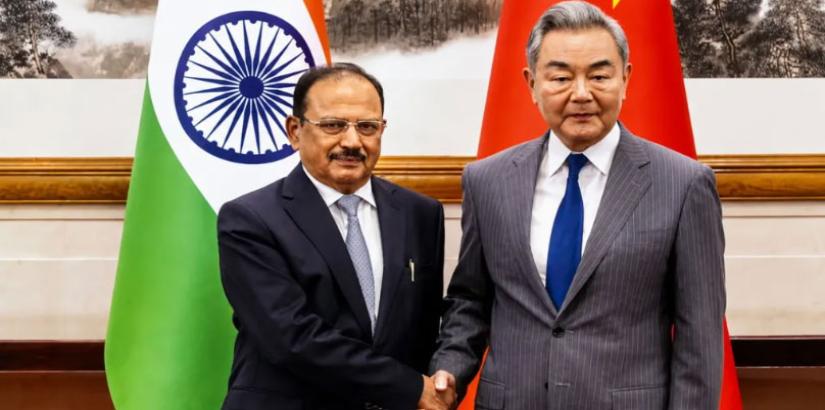
India and China may finally be trying to turn the page on years of border confrontation. After the 2020 military crisis, prolonged deployment along the Line of Actual Control (LAC) and a deep deterioration in political trust, the two countries are cautiously rebuilding their relationship. The latest Special Representatives’ talks in Beijing between National Security Adviser Ajit Doval and Chinese Foreign Minister Wang Yi are particularly significant because the focus appears to be shifting from simply managing the disputed border to discussing boundary delimitation.
The reference to an “early and substantial harvest” is encouraging. But India should judge the process by concrete outcomes, not diplomatic formulations.
For years, New Delhi and Beijing tried to separate the boundary dispute from the broader relationship. Trade expanded, economic engagement deepened and both countries worked together in forums such as BRICS and other multilateral institutions. The assumption was that growing economic interdependence could help insulate bilateral ties from the unresolved border question.
The 2020 Ladakh crisis demonstrated the weakness of that assumption. The violent confrontation and subsequent military mobilisation transformed the relationship. Mutual trust declined sharply, and the border became the central determinant of bilateral ties. The disengagement process that followed has reduced immediate risks, but it has not removed the underlying dispute.
'Early Harvest' Deserves Attention
This is why the renewed Special Representatives’ dialogue is important. Existing mechanisms—including military commander-level meetings, diplomatic consultations and the Working Mechanism for Consultation and Coordination—have helped prevent incidents from escalating. Additional communication mechanisms, including proposed meeting points for senior commanders and hotlines in the Eastern and Middle Sectors, can further reduce the possibility of accidental conflict.
But there is a fundamental limit to such arrangements: a disputed boundary cannot be managed indefinitely. Crisis-management mechanisms can prevent clashes, but they cannot resolve the territorial dispute that produces them.
The proposed “early harvest” therefore deserves serious attention. The Expert Group on Boundary Delimitation and the Working Group on Border Management are expected to take the process forward. The immediate task will be to establish their terms of reference. Yet the crucial questions are political rather than procedural. Which areas will be included in the early harvest? On what principles will they be selected? Will limited agreements represent genuine progress towards a final settlement, or merely create another layer of border management?
India must ensure that the latter does not happen. The reaffirmation of the 2005 Agreement on Political Parameters and Guiding Principles provides an important foundation. That agreement envisaged a framework for resolving the boundary dispute, followed by delineation and demarcation. Rather than creating an entirely new diplomatic architecture, the two sides can build upon this existing framework. What is required now is political will to move from general principles to substantive negotiations.
There are reasons for cautious optimism. China has an interest in a stable external environment as it deals with wider economic and strategic challenges. India, too, does not want a permanently confrontational relationship with its largest neighbour to consume diplomatic and military resources. Both countries also have incentives to maintain communication through BRICS, SCO and other Global South institutions.
However, normalisation should not be confused with reconciliation. The emerging relationship is more accurately described as competitive coexistence. India and China will continue to compete over influence in South Asia and the Indian Ocean. China’s close relationship with Pakistan, its connectivity initiatives and India’s growing strategic partnerships with the United States and other Indo-Pacific countries will remain sources of friction. A reduction in border tensions will not eliminate these structural differences.
The incremental approach advocated by Chinese scholar Hu Shisheng is therefore revealing. Institutionalising stability along the LAC and operationalising an “early harvest” may be more acceptable to Beijing than attempting an immediate comprehensive settlement. India should be open to incremental progress, but it must guard against incrementalism becoming an excuse for indefinite delay.
Other recent developments can contribute to confidence-building. Dialogue on trans-border rivers could address India’s concerns about hydrological data and developments in Tibet. The reopening of border trading points and expansion of the Kailash Manasarovar pilgrimage can also restore some of the practical links disrupted by the deterioration in relations.
Timing is Noteworthy
Yet the fragility of the process remains evident. Arunachal Pradesh continues to be a major point of contention, and China’s objections to India’s naming of places in the state demonstrate how quickly territorial sensitivities can revive tensions. Normalisation cannot mean accepting the other side’s territorial claims. Nor should practical cooperation obscure unresolved sovereignty issues.
For this reason, transparency in the negotiating process will matter. The details of territorial negotiations will necessarily remain confidential, but governments should communicate the broad principles and objectives of the process. In India especially, any perception of secret territorial concessions could generate political opposition and undermine public support for an eventual agreement.
The timing of the present diplomatic initiative is also noteworthy. Ajit Doval’s visit to Beijing comes ahead of the BRICS Summit in New Delhi and could create space for political direction at the highest level, including a possible meeting between Prime Minister Narendra Modi and President Xi Jinping. Such a meeting need not produce a spectacular breakthrough. Its greater value could lie in consolidating the momentum already generated by diplomatic and military contacts.
The sequence matters: disengagement, restoration of diplomatic communication, renewed Special Representatives’ talks, discussions on boundary delimitation and possible leader-level engagement. Together, these steps suggest an attempt to move from crisis management towards managed competition.
But India should remain clear about the destination. Peace on the border and progress on the boundary question must move together. Border stability without substantive negotiations could simply reproduce the pre-2020 model—periodic calm punctuated by renewed confrontation.
The Real Test
The road from border management to boundary settlement will undoubtedly be long and difficult. Territorial disputes between major powers are rarely resolved quickly. But the present moment offers an opportunity that should not be wasted. If the “early harvest” is given a clear mandate, defined areas, a realistic timetable and a direct link to the larger boundary settlement, it could become more than another confidence-building exercise.
The real test of India-China normalisation is therefore not whether the border becomes quiet, but whether the two countries can use that quiet to address the dispute itself. A stable LAC should be the beginning of boundary negotiations, not their substitute.
(The author is an Associate Fellow, Manohar Parrikar Institute for Defence Studies and Analyses (MP-IDSA), New Delhi. The views expressed are personal. He can be contacted at anandkmrai@gmail.com)







Post a Comment