

Mask Drops in Islamabad: How Pakistan’s Terror Calculus Came Undone
The strategic equation has irrevocably shifted. Pakistan’s long-standing attempt to separate itself from its proxies has failed, replaced by the reality of a state struggling with the infrastructure it created. As these groups operate with increasing autonomy, the world community is left with a clear conclusion
 Sep 24, 2026
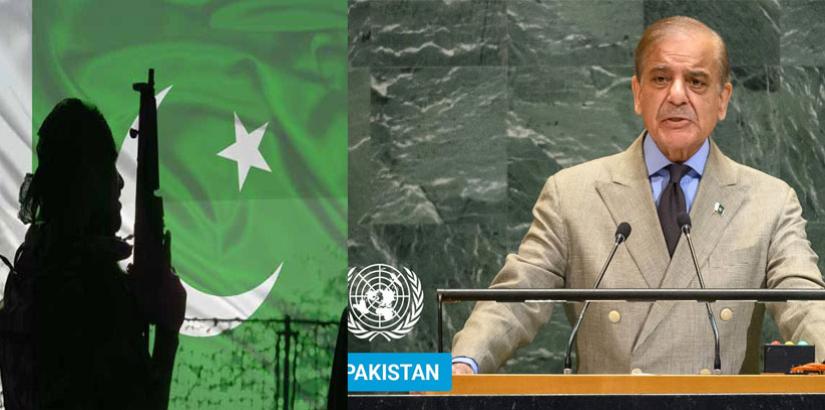
For decades, Islamabad maintained a carefully calibrated fiction on the world stage. Whenever violence spilled across its borders, the official refrain remained fixed: Pakistan was merely a victim of rogue, non-state actors operating beyond the reach of its authorities. This diplomatic shield served to deflect accountability while its military intelligence complex quietly nurtured militant proxies as instruments of asymmetric warfare.
That charade is now crumbling from within. The institutional deception was recently exposed when Prime Minister Shehbaz Sharif delivered a stark warning at the United Nations General Assembly, cautioning that without his country's containment measures these militants would be roaming the streets of major Western capitals.
This involuntary disclosure was soon echoed by Pakistan Defence Minister Khawaja Asif. In a television interview, Asif candidly described outfits like Lashkar-e-Taiba and Jaish-e-Mohammed as "unguided missiles" that have slipped entirely out of state control. He admitted that these groups, cultivated over the last forty to fifty years, now threaten to reduce Pakistan to the chaotic fate of Syria or Iraq.
Organised Proxy Infrastructure
This public acknowledgement exposes a deeper structural reality. The complex ecosystem of violence built around these groups was never a collection of spontaneous regional movements; it was an organized proxy infrastructure designed, trained, and funded with explicit state backing.
By framing these factions as unguided missiles, the defence minister unwittingly validated a reality New Delhi has asserted for decades. The distinction between the state and its non-state actors was always an illusion, engineered to provide plausible deniability while pursuing strategic objectives against neighbours.
The root of this crisis lies in the strategic depth doctrine adopted by the Pakistani military establishment following the Soviet-Afghan war. Militant syndicates were assigned tactical utility, safe havens, and institutional protection. To evade international financial monitors and sanctions, these factions frequently altered their public profiles, reappearing under fresh names while preserving their core operational command structures.
However, proxy groups rarely remain static instruments. Over time, the ideological and logistical autonomy granted to these outfits enabled them to build independent networks, revenue streams, and recruitment pipelines.
Catching up With its Own Legacy
Pakistan now faces the inevitable fallout of this strategy. The state agencies that once controlled these groups can no longer manage them, leaving Islamabad caught in a self-inflicted crisis.
For the international community, these admissions eliminate any remaining doubt. Financial institutions and global monitors have long seen through Islamabad’s official narrative, but direct admissions from the head of government and the defence minister remove any room for diplomatic ambiguity.
At the United Nations, Indian diplomat Kshitij Tyagi highlighted the contradiction, noting that a state reliant on international bailouts continues to export terror while attempting to mask internal instability.
The strategic equation has irrevocably shifted. Pakistan’s long-standing attempt to separate itself from its proxies has failed, replaced by the reality of a state struggling with the infrastructure it created. As these groups operate with increasing autonomy, the world community is left with a clear conclusion: the narrative of the unaccountable non-state actor was never a defense, but an admission of a system catching up with its own legacy.
(The writer is an editor of four-plus decades and a commentator on regional, international, social, cultural and science-related matters. The views expressed here are personal. He may be contacted at krajuster@gmail.com)





Post a Comment