
Sri Lanka's Influential Buddhist Clergy Raise Puts Government in a Spot
Sri Lanka’s Constitution gives Buddhism a special position under Article 9 while also protecting freedom of religion under Article 10 and related constitutional provisions. The government therefore has responsibilities both to protect Buddhist traditions and to ensure that the law is applied fairly across religious communities.
 Oct 21, 2026
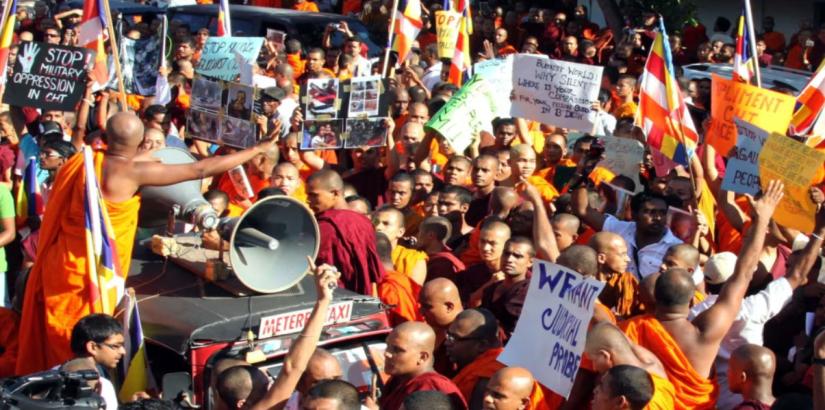
Sri Lanka’s Marxist government’s attempt to break the stranglehold of Buddhist monks over the majority Sinhala Buddhist population has backfired badly, with hundreds of Buddhist monks and laymen taking to the streets to protest the move. They have demanded not only the restoration of a monk’s right to wear his saffron robe but also his release through a presidential pardon.
The maverick monk, Galabodaaththe Gnanasara Thera, was imprisoned for contempt of court in 2019 and sentenced to nine years in prison. However, President Maithripala Sirisena granted him a presidential pardon. When the current government came to power, the Supreme Court ruled that the pardon was invalid because it had been granted without following the requisite official procedures.
When the monk was imprisoned again, the government made a major blunder by ordering prison authorities to bring the convicted monk to court in civilian dress. This triggered strong protests by Buddhist monks over the treatment of imprisoned members of the Sangha.
The controversy surrounding the removal of saffron robes when monks are taken to court or elsewhere outside prison raises questions extending beyond religious sentiment. It touches on the relationship between the state and the Buddhist clergy, the government's respect for Buddhist traditions, the rule of law and political authority.
The future impact of the protests will depend on whether they remain focused on religious dignity and prison procedures or develop into a wider campaign over the government's treatment of Buddhism, governance and public accountability. They could create political pressure on the administration, but they do not automatically translate into a loss of popular support or electoral strength.
Protests and the Government's Response
With the blessings of all four major Buddhist sects, a protest march was organised from Kandy to Colombo. When the protesters surrounded the Presidential Secretariat, the government had to obtain court orders to disperse the monks. The protesters later withdrew to Viharamahadevi Park in central Colombo to continue their demonstration.
Taking a step back, the justice minister announced recommendations allowing imprisoned Buddhist monks to wear their robes when taken outside prison, unless their respective monastic chapters objected. Yet the protests continued, with monks gathering first outside the Presidential Secretariat and later moving to Viharamahadevi Park.
The issue has become a test of the government's relationship with the Maha Sangha. While the government has addressed the controversy over the monks' robes, the wider protest has shifted towards securing Gnanasara Thera's release.
The administration must now manage two separate questions: the religious community's concerns about monastic dignity and the legal consequences of a court conviction.
Maha Sangha's Political Influence
The Maha Sangha has historically played a significant role in Sri Lankan public life. Its influence is not confined to religious observance; Buddhist clergy have also participated in debates over national identity, constitutional reform and the direction of government.
A protest led by influential monks could therefore become a broader platform for expressing dissatisfaction with the administration.
The government appears to be seeking to take advantage of divisions among monks. Different Buddhist sects, temples and individual monks hold differing views on the protests, the government and the appropriate relationship between religion and politics.
Pardon Question and the Rule of Law
The most sensitive issue is whether the president should grant Gnanasara Thera a pardon.
The monk is serving a sentence for contempt of court after the Supreme Court invalidated a pardon granted by former President Maithripala Sirisena. The current campaign therefore raises a difficult constitutional question: how should the government respond to religious and public pressure when a judicial sentence has already been imposed?
One possible face-saving formula for the government would be to grant a pardon through the lawful constitutional process. This would meet the protesters' central demand but could provoke criticism that political or religious pressure had influenced the treatment of a convicted person.
However, a strong section of the Janatha Vimukthi Peramuna (JVP) is vehemently opposed to granting a pardon to the convicted monk, who could continue his attacks on the JVP/National People's Power (NPP) alliance.
The issue also tests the administration's ability to distinguish between legitimate religious concerns and demands for special treatment for an individual. The danger for the government lies not necessarily in the protests themselves, but in the possibility that its response becomes a symbol of inconsistent governance.
Sri Lanka's Constitution gives Buddhism a special position under Article 9 while also protecting freedom of religion under Article 10 and related constitutional provisions.
The government therefore has responsibilities both to protect Buddhist traditions and to ensure that the law is applied fairly across religious communities.
If the controversy results in clear and consistent prison procedures that respect the religious practices of all inmates, it could contribute to better administration. If, instead, it becomes a contest over which religious leaders can exert the greatest political pressure, it could intensify concerns about equality and religious pluralism.
Government in Tricky Spot
The government appears to believe that revised prison rules, consultations with the Maha Sangha and efforts to address the pardon demand through established constitutional procedures will gradually reduce the protests' momentum without either side abandoning its stated principles.
However, if the protests continue, accompanied by public statements from senior monks, pressure on the president and the government is likely to intensify.
In a nutshell, the Buddhist monks' protests present the government with a challenge that cannot be resolved by changing prison regulations alone. The immediate dispute concerns the treatment of a monk in custody; the larger questions concern the authority of the courts, the constitutional responsibilities of the president, the place of Buddhism in public life, and the limits of political pressure.
(The author is a former Sri Lankan diplomat and a political and strategic affairs commentator. The views expressed are personal. He can be reached at sugeeswara@gmail.com.)






Post a Comment