

Xi JInping's China: A Scholarly Look at a Nation Driven by a Sense of Destiny
Kuhn says if the first half of this century is being defined by USA-China relations, the second half may well be defined by India-China relations and, in the New World Order, "India-China relations will likely become the most pivotal.....for the entire world".
 Sep 25, 2026
Plato, the ancient Greek philosopher, was passionate about promoting education and the importance of illustrative storytelling in shaping cultures, promoting desirable behaviours in leaders, and in grooming children to becoming responsible adults. He is attributed as saying that "Those who tell the stories (well) rule society". Centuries later Harvard professor Joseph Nye postulated, "In the information age, the mark of a great power is not just whose army wins, but also whose story wins."
China's modern leader Xi Jinping, who has made the "national rejuvenation of Chinese society'' in this century his paramount goal, and seeks to regain for China its rightful place in the world that it feels was usurped by the West's deceit and treachery, has emphasised the idea of "telling China's stories well".
According to Ashok Kantha, former Indian Ambassador to China, ever since Xi came to power in 2013 "a large institutional ecosystem has grown around what Beijing calls 'discourse power', or the ability to define and control the narrative of how the world reads China's rise which the Chinese have been made to believe it is inevitable (TOI, Sept 13, 2026).
Not leaving the job to state media which may be seen as propagandist, Xi has encouraged the formation of quasi-private think-tanks "with Chinese characteristics" to carry the Chinese story to the rest of the world.
China Through Western Eyes
However, for the outside world, Chinese narratives have their credibility issues because of the "overpowering role" of the Communist Part of China (CPC) as the "vanguard of the.....Chinese nation" through which it oversees and controls every organ of the state and society, including the media and its propaganda affiliates.
However, when wants to know a more objective "inside story" of what is happening in China, there are no dearth of books from Western scholars on China that line library shelves with increasingly important contributions from Japan, Singapore, Australia, Taiwan and India. But few scholars have studied China in the way Robert Lawrence Kuhn has for over three decades, having worked with Chinese leaders and advised their multinational corporations with his corporate strategist and investment banker background.
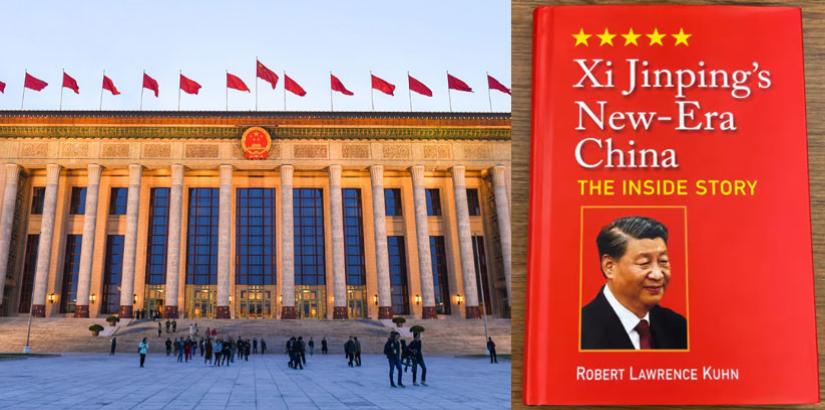
In fact his "Xi Jinping's New-Era China: The Inside Story" (Pentagon Press) seeks to chronicle and explain the thoughts, philosophies and policies of China's most powerful leader since Mao Zedong and how it is shaping the future of a nation of 1.4 billion people that is impacting "every aspect of global economics and politics" and posing a formidable power challenge to the global hegemony of the United States.
A Leader With Unprecedented Power
Xi Jinping, who is not only the nation's president but also general secretary of the CPC and chairman of the Central Military Commission, wields unprecented power and has made China in the space of a decade the only economic, military and technological rival of the United States, a hard reality that was acknowledged by President Donald Trump when he and his wife Melania made an unprecedented departure from protocol to receive him on the airport tarmac as the former began official visit to the US September 23.
Kuhn's 393-page tome chronicles the unprecedented rise of Xi, whom he has been tracking since 2005, his past work, his personality, his thinking, his vision, his leadership and his reformist zeal and his global outreach making China both into an ally for the Global South and a geopolitical rival for aspirational powers like India.
For Xi, "comprehensively deepening reform" was the "fundamental driving goal for promoting Chinese modernisation" leveraging "science and technology and indigenous innovation", an area in which it has become almost a peer of the US, if not having bettered it in many areas of frontier technologies like artificial intelligence and robotics.
Mandatory Reading for China Watchers
The book should be mandatory reading for all those dealing with China, in India and South Asia particularly, as China spreads its tentacles far and wide in this region. As Kuhn himself puts it in his overview of the Indian edition that "India needs to know more about China, especially about Xi Jingping himself: how he thinks, his philosophies, policies and plans, domestic and international".
In recent times, I have come across a few expert views on China, on its dramatic domestic changes and economic and technological transformation and its world view that frames its aspirational pre-eminence. The Economist, for instance, in a column on Why India Baffles China, says that for more than a century since the Qing era, China's elites have looked down on India for allowing itself to be colonised so long and were unimpressed by their non-violence freedom struggle while its "precocious democracy" is seen as "a weakness that holds it back."
"Upon that foundation of condescencion, younger researchers now encounter a country much poorer and less militarily capable, but which likes to talk bit game. No wonder they are dismissive of India's ambitions".
Nuanced Change in Chinese Thinking?
However, post the Modi-Xi meeting, on the sidelines of the BRICS summit in New Delhi in September 2026, there seems to have been a "reset" with a more nuanced understanding of India in official Chinese thinking, according to Arjun Chatterjee, a China-based Indian scholar. In his article in the web journal South Asia Monitor ( https://southasiamonitor.org/geopolitics-security-and-strategic-affairs/india-through-different-lens-post-brics-summit-nuanced), Chatterjee writes that "India is being placed more firmly within Beijing's language of the Global South and multipolarity. The border remains important, but Chinese coverage resists allowing it to become the sole lens through which the relationship is viewed. Economic cooperation, people-to-people exchanges, and multilateral coordination are given space to breathe alongside unresolved strategic questions"
The real change, then, he says is "not merely that Chinese media sounded friendlier towards India. It is that they assigned India a different place in the story. New Delhi appeared as a complex but consequential partner, whose strategic autonomy and cooperation matter to China's imagining of a changing world order."
Kuhn says if the first half of this century is being defined by USA-China relations, the second half may well be defined by India-China relations and, in the New World Order, "India-China relations will likely become the most pivotal.....for the entire world".
In my ten visits to China, including with three Indian prime ministers - P V Narasimha Rao, Atal Bihari Vajpayee and Manmohan Singh - as part of their invited media delegations, what one has learnt is that China and its society is imbued with a firm sense of destiny. All their words and actions are driven into reversing what the Chinese call their "century of humiliation" from Westerners and becoming once again, in their civilizational world view, the "Middle Kingdom" or the power centre of the world, again.
It cannot be therefore gainsaid that the Kuhn book is a treasure trove of first-hand information on China from a scholar who has mined "inside" knowledge of Chinese leadership, governance system, party structure and society from over 150 visits to China while somehow gaining the confidence of its otherwise inscrutable leadership.
(The author a veteran editor and journalist, the editorial director of South Asia Monitor, who has made several trips to China and follows China developments closely. The views expressed are personal. He can be reached at tarunbasu.sps@gmail.com)





Post a Comment