

EU and India Should Cooperate Strategically on Middle East Stability
EU and India could establish a regular EU–India-Middle East Consultative Mechanism involving foreign-policy officials and experts. Its purpose would be to coordinate positions before major international gatherings and meetings.
 Oct 06, 2026
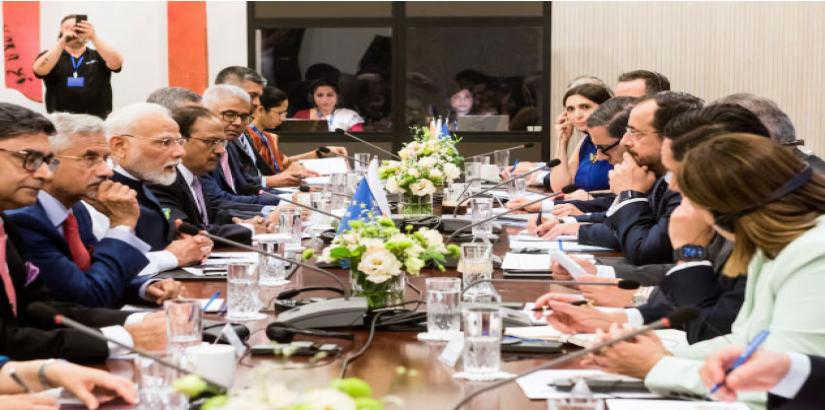
The European Union (EU) and India have maintained a Strategic Partnership since 2004 and are currently seeking even closer cooperation, but yet are not acting together more visibly to stabilise the situation in West Asia (Middle East).
The EU and India view West Asia through different lenses. The 27-member European bloc is mainly concerned with migration, terrorism, energy security, and the impact of instability in West Asia on European societies.
The Palestine question remains one of the principal sources of instability in the region. The EU policy unapologetic is very pro-Israel, but it also supports a two-state solution, humanitarian access and a permanent end to hostilities, while India has also maintained its longstanding support for Palestinian statehood alongside Israel and has called for dialogue and diplomacy.
This gives Brussels and New Delhi a potential common diplomatic platform. Rather than presenting themselves as outside powers attempting to dictate a settlement, they could support regional dialogue.
However, their contribution should probably focus on implementation rather than attempting to replace the principal mediators.
Diverging Strategic Interests
Critics argue that Indian Prime Minister Narendra Modi's closer relationship with Benjamin Netanyahu and the strengthening of India-Israel strategic ties have reduced India's traditional image as a balanced actor in West Asia. India historically supported the Palestinian cause and maintained strong relations with both Arab states and to a lesser extent with Israel.
The visible warmth between New Delhi and Tel Aviv has weakened India's credibility among some constituencies in the Global South and the Arab world.
Some analysts argue that India has not abandoned its broader West Asia engagement. Under Modi, India has simultaneously expanded ties with the UAE, Saudi Arabia and other Gulf states while deepening cooperation with Israel in defence, technology, agriculture and cybersecurity. India and Israel have formally described each other as strategic partners, and bilateral cooperation has grown substantially.
India's priorities in the region are protecting its large expatriate community in the Gulf, ensuring uninterrupted energy supplies, and maintaining balanced relations with all regional players.
As a result, although both the EU and India want stability, their immediate interests are not always identical.
When crises emerge in West Asia, New Delhi often prefers bilateral diplomacy, issue-based cooperation, mediation through multilateral forums, rather than joining collective diplomatic initiatives led by external powers.
This can make India appear less closely aligned with EU diplomatic efforts than traditional Western allies are.
Another often overlooked factor is that the EU is not a state. Foreign policy decisions require substantial agreement among 27 member states, which may have different historical relationships and interests in the region. France, Germany, Italy, Greece, Spain, and eastern European states do not always view regional crises in exactly the same way.
Consequently, the EU's ability to act decisively can be slower and more constrained than that of a single nation-state.
India maintains working relations with almost all major players in the region Saudi Arabia, Iran, United Arab Emirates, Qatar and Oman. The EU also has relations with these countries , but its positions on issues such as sanctions, human rights, and security sometimes create tensions with some regional governments.
India's diplomatic position is potentially useful because it has maintained relations with Iran while simultaneously developing close strategic relationships with Gulf Arab countries.
On the other hand, the EU’s heavy anti-Iran stance has reduced its leverage with Tehran.
India may therefore hesitate to associate itself too closely with initiatives that could be perceived as favouring one side over another.
Cooperation on Connectivity Projects
Although EU-India cooperation in security and defence is growing, it remains relatively modest. Recent discussions have focused on maritime security, defence dialogue, and the Indo-Pacific rather than West Asia/Middle East specifically.
Without deeply integrated military, intelligence, or diplomatic mechanisms, it is more difficult to launch major joint peace initiatives.
On the other hand, West Asia today is not the same as it was twenty years ago. Countries such as Saudi Arabia, UAE, Qatar, Türkiye, Iran, try to play much more autonomous roles. The EU and India may therefore feel that sustainable peace can only emerge if regional states themselves take the lead.
However, it would be inaccurate to say there is no cooperation. One example is the India-Middle East-Europe Economic Corridor (IMEC), which both the EU and India support as a long-term connectivity and development initiative linking India, the Gulf, and Europe. EU institutions have explicitly advocated stronger cooperation with India through IMEC.
But there is an important caveat . Infrastructure cannot create peace by itself. If political conflicts remain unresolved, major corridors can themselves become vulnerable to geopolitical competition. Thus, economic connectivity should accompany—not substitute for—diplomatic conflict resolution.
India's relationship with Iran could sometimes diverge from EU policy, particularly regarding sanctions, nuclear issues and regional security. India's continuing interest in the Chabahar port project illustrates this complexity. India describes Chabahar as important for connectivity with Afghanistan and Central Asia.
The logic here is that economic integration, infrastructure, energy connectivity, and trade can contribute to stability even when direct diplomatic peace-making is difficult.
One could argue that the main issue is not a lack of goodwill but a lack of institutional alignment. The EU and India share many objectives: regional stability, secure energy supplies, freedom of navigation, counter-terrorism, and economic development. However, they differ in diplomatic style, strategic priorities, and preferred methods of engagement.
Need for Closer Consultation
In short, the paradox is that the EU and India largely agree on the desired outcome in West Asia, but they have different ideas about how to achieve it and different strategic incentives that shape their actions.
India's participation in platforms such as the G20, BRICS and other Global South mechanisms can therefore provide diplomatic channels that complement European diplomacy . Hence, India can sometimes communicate with actors that European governments may find more difficult to reach.
Neither the EU nor India possesses the same degree of influence over every regional actor as the United States. Their realistic objective should therefore be conflict management, diplomatic support and institution-building, rather than assuming that they can independently impose settlements.
EU and India could establish a regular EU–India-Middle East Consultative Mechanism involving foreign-policy officials and experts. Its purpose would be to coordinate positions before major international gatherings and meetings. The most important strategic idea is "complementarity, not competition".
The EU and India should avoid trying to become another geopolitical bloc in the Middle East. The answer to whether EU–India cooperation can contribute to peace and stability in West Asia is therefore yes—but with important qualifications.
Their combined contribution would probably be greatest in areas where their interests and capabilities overlap
The EU and India cannot by themselves create peace in West Asia but together they can help create the diplomatic, economic and security conditions in which regional peace becomes more sustainable.
The distinction is crucial. Peace must ultimately be negotiated and owned by the people and states of the region; external partners can help make peace more feasible and more durable.
(The author is Brussels-based Non Resident Fellow of the New Delhi-based Society for Policy Studies who has been tracking and reporting on EU and European affairs and NATO for the past four decades. The views expressed are personal. He can be reached at nawab_khan@hotmail.com. X: @NawabKhan10





Post a Comment