
Odd Summit : Why Shenzhen Should Matter for India
That is the paradox of Shenzhen. An odd summit, convened by three leaders with different compulsions, produced an anodyne declaration that nevertheless impinges onto India's core concerns: UN reform without India, ICC impunity versus UNCLOS, and energy through Hormuz.
 Nov 24, 2026
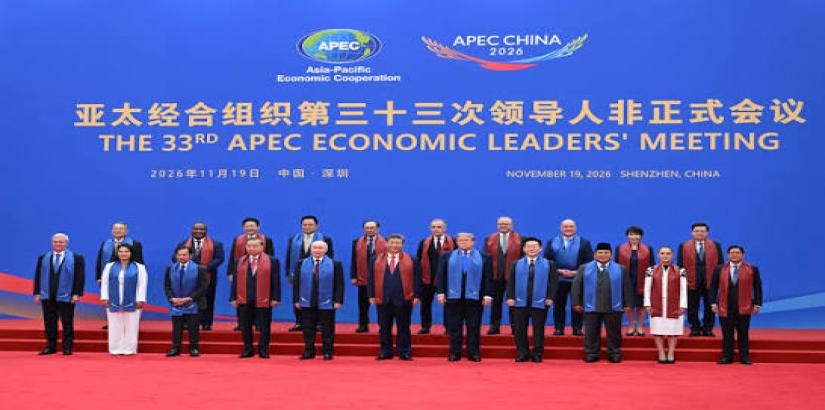
The trilateral summit hosted in Shenzen (Nov 19) by Chinese President Xi Jinping with US President Donald Trump and Russian President Vladimir Putin on the sidelines of the APEC summit was heralded as a defining punctuation in 21st century global geo-politics but it turned out to be an odd event.
It was put together at relatively short notice and it is evident that each of the three countries had its own axe to grind.
For China, as host, it was an opportunity to project itself as a global power capable of convening a summit of this type, a power that can bring Washington and Moscow to its table, on its soil, on its terms.
For Donald Trump, coming out of a drubbing in the midterm elections and the loss of the US Congress, it was an opportunity to project himself as the peacemaker, meeting Putin and Xi, leaders he openly admires, and telling the world the meeting was "bigger than Yalta."
For Vladimir Putin, already in a very messy dilemma over Ukraine, facing a war with no exit and a West that still treats him as a pariah, it was a boost to his image, proof that he is not isolated.
Their compulsions were different and the Shenzhen outcome was very modest and wide-spectrum. The deeper oddity of this surprise summit was that three countries, who are differently mired in military stasis, (Russia in Ukraine, USA in Iran and Xi Jinping over Taiwan) were able to make a declaration on global peace.
Undermining the UN
Three major powers whose only comparable capability is a large nuclear weapon arsenal and each, culpable of using military force in violation of or disregarding international law and unable to resolve its own central confrontation, accorded unto themselves the right to regulate, or give a prescription for, world peace.
And they did it by undermining the existing UN, talking about how the UN itself needs to be revamped, while completely sidelining the other two permanent members, France and the UK.
Further, there was no reference to any of the other major powers. The EU itself has been completely ignored. In that sense, it was odd that the Shenzen trio arrogated to themselves the task of fixing the system, without the system.
A New Three-Power Club?
The four bullets in the joint declaration are relatively anodyne. But each one, read carefully, has a specific relevance for India.
First, the nuclear reference is welcome but not new for India. It noted: "A nuclear war cannot be won and must never be fought." So far there has been no dialogue between the major powers, particularly from China, on the nuclear issue. That dialogue is now, at least on paper as a promise.
However, within a day of the Shenzhen declaration, President Trump tempered expectations regarding nuclear restraint and cautioned that reaching nuclear arms limits with Russia and China will be "very hard to achieve and hard to do psychologically."
But specific to India, this restraint is something Delhi suggested in 1988, global zero. Then Prime Minister Rajiv Gandhi's Action Plan for a Nuclear Weapons Free and Non-Violent World Order, presented to the UN General Assembly in June 1988, called for the complete elimination of nuclear weapons by 2010, in stages, with verification.
India has been an advocate of nuclear restraint ever since, even as it built its own credible minimum deterrence after 1998. In that sense, Xi's revival of the phrase, nuclear weapons as a "sword of Damocles" that must be "comprehensively prohibited and completely destroyed," corresponds with the Indian position. This is to be welcomed even if the goal remains elusive.
What is new is that China, which had refused to join any trilateral framework while it was at 620 warheads as compared to the US and Russian nuclear weapon inventory of 5,000-plus, has now signed its name to a trilateral commitment to dialogue. That is not a concession. It is a precedent.
India should welcome the precedent and insist, as it has since 1988, that any dialogue must be universal, non-discriminatory, and verifiable, not a three-power club that sets the rules for the rest.
Second, UN reform. This is an anomalous prescription. These three countries have “committed to reform the UN so that the UN can respond more effectively to global challenges and conform to its fundamental mission of international peace and security.” The paradox is that they have degraded peace and security by their unilateral actions and did not allow the UN to discharge its duties and are now resorting to righteous concern about ‘peace and security’!
It is evident that there is no blueprint and this is wild scattershot. For India, this is the most odd formulation, precisely because it is the vaguest. India has sought UN Security Council reform for decades, expansion in both permanent and non-permanent categories, with a seat for itself.
What Shenzhen proposes is reform by the three, for the three, without France and UK, without India and other aspirants. It is reform as a prerogative of great powers, not as a democratisation of the system.
New Delhi should read this as a warning. If UN reform becomes a P-3 project, India's claim will be marginalised. If it remains a UN-wide project, India's claim is central. India must insist that no trilateral declaration can substitute for the Intergovernmental Negotiations process in New York.
Third, the ICC (International Criminal Court) reference which is blatantly self-serving. These three nations are not members of the ICC, but yet they have chosen to make a statement about global jurisdiction, in a way trying to teach the ICC to stay within its own limits.
This is a complex and tricky issue. Is Shenzhen suggesting that China will do what it wants in the South China Sea and yet talk about a rules-based order, or norms and principles, as they have said in the Global Security Initiative in Kunming?
Again, this does not gel. One cannot dismiss the 2016 South China Sea arbitration award as "a piece of waste paper," refuse to appear before the tribunal, and then lecture international courts on not abusing jurisdiction.
For India, which is also not an ICC member but has consistently supported UNCLOS and the South China Sea award as a statement of law, the distinction matters.
India does not need the ICC to uphold a rules-based order in Asia. It needs UNCLOS to be respected. If this Shenzhen formulation becomes a norm, it suggests that state unilateral advocacy overrides legal adjudication, which is precisely the argument Beijing uses in the South China Sea and Moscow uses in Ukraine.
India should keep its distance from that logic, even while sharing the three powers' scepticism about the ICC's politicisation.
Paradox of Shenzhen
The last bullet refers to refined petroleum and is an immediate response to the West Asian crisis.
Increasing the production and supply of refined petroleum products looks technical. It is not. In West Asia ( Hormuz and Bab el-Mandeb) where a simmering US-Iran confrontation threatens to choke the world's most critical energy chokepoints.
For India, this is the most material bullet. India imports over 85 percent of its crude, much of it through Hormuz. A disruption there is not a distant war, it is inflation, a current account shock, and a strategic vulnerability.
A trilateral commitment to stable energy flows, if it means anything, means the three powers understand that a Hormuz closure hurts them too: China as the largest importer of Iranian oil, the US as the guarantor of Gulf security and Russia as a beneficiary of high prices but also a victim of a wider war.
However, India should not mistake a sentence for a guarantee. Shenzhen gives no mechanism, no stockpile, no joint patrol. India's insurance remains what it has always been: diversification of supply, strategic petroleum reserves, and naval presence from the Gulf of Aden to the Malacca Strait.
The Quad's maritime surveillance patrol announced in Manila, with P-8 aircraft flying together in 2027, is more relevant to India's energy security than Shenzhen's sentence about refined products.
That is the paradox of Shenzhen. An odd summit, convened by three leaders with different compulsions, produced an anodyne declaration that nevertheless impinges onto India's core concerns: UN reform without India, ICC impunity versus UNCLOS, and energy through Hormuz.
India should welcome the nuclear dialogue, resist the P-3 model of UN reform, reject the ICC immunity logic, and treat the energy promise as a signal, not a shield.
The summit was odd and its declaration fuzzy, incongruously aspirational and indefensible.
(The writer is an Indian Navy veteran and President, Society for Policy Studies, New Delhi. The views expressed are personal. He can be reached at cub.sps@gmail.com)







Post a Comment