

SCO@25: Nonalignment 2.0 and Limits of Multilateral Diplomacy
This is the futility that must be highlighted. India's moral voice is heard politely but it does not stop missiles. The declaration itself is telling - it condemns strikes on Iran, but contains zero mention of Russia's war, because Moscow would veto it. In summary, Nonalignment 2.0 can inhibit the SCO from becoming anti-West or a China-led grouping but it cannot make Russia end a war Moscow intends to win.
 Sep 03, 2026
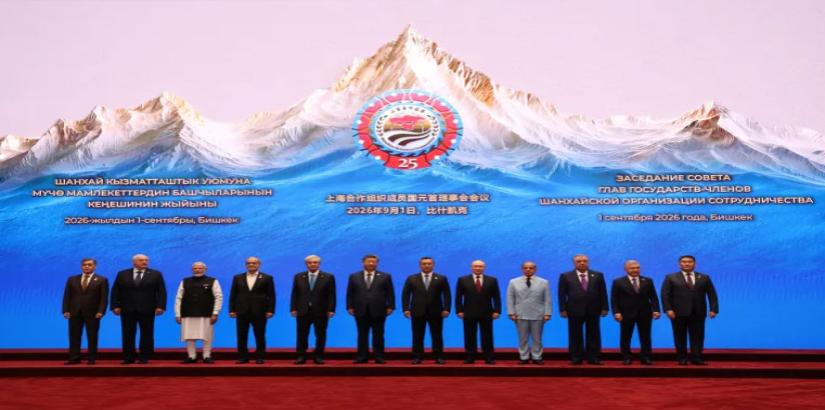
The SCO (Shanghai Cooperation Organization) summit held in Bishkek, Kyrgyzstan that concluded on Tuesday (Sep 1) marked the 25th anniversary of the China-led grouping that began as the Shanghai Five in April 1996.
The original members were China, Russia, Kazakhstan, Kyrgyzstan and Tajikistan. This became the SCO in June 2001 when Uzbekistan also joined and at that time the primary focus was on stabilizing the newly formed Central Asian states – the five ‘stans’ after the disintegration of the former Soviet Union in December 1991. Turkmenistan has chosen to be neutral and is outside this grouping.
The membership has since grown and currently the SCO has ten full members: the original six plus India and Pakistan (joined 2017), Iran (2023) and Belarus (2024) . The two observers are Afghanistan and Mongolia and the 15 Dialogue Partners include Azerbaijan, Armenia, Bahrain, Cambodia, Egypt, Kuwait, Maldives, Myanmar, Nepal, Qatar, Saudi Arabia, Sri Lanka, Turkey, UAE and Laos.
Navigating Geopolitical Turbulence
The 2026 Bishkek Declaration should have been a celebratory anniversary marking 25 years and while the theme is normative: ‘25 Years of the SCO: Together for Sustainable Peace, Development and Prosperity’. A close reading provides some instructive insights about how the organization has navigated the prevailing geopolitical turbulence.
2026 is the year when the US and Israel embarked upon a preemptive war against Iran leading to a costly conflict when the Strait of Hormuz has choked global supply chains and when talk of a new Cold War is gaining traction. Yet the SCO has not become what many in Washington and Brussels feared it would be - an anti-Western bloc.
That choice is the quiet triumph of its 25th year and to a large extent, India is the existential enabler.
A parsing of the summit declaration is instructive. Yes, it condemned the "military strikes on the territory of the "Islamic Republic of Iran" and defended Tehran's "inalienable right" to peaceful nuclear energy, headlines that will be read in the West as anti-American.
But in the next paragraph of the same declaration, the SCO "adheres to an approach that excludes bloc-based and confrontational methods of addressing international and regional development issues." It calls for an "open, transparent, fair, inclusive and non-discriminatory multilateral trading system."
This is not the language of a Sino-Russian compact but what could be termed the semantic of Non-Alignment 2.0, updated for Eurasia. For 25 years, the SCO's most significant contribution has not been trade figures or its Energy Strategy to 2030 or its new Green Technology Corridor or even its new Universal Centre for Countering Threats.
The contribution is structural: it has nurtured a non-military, non-alliance space in the most volatile global geography. When it was founded in 2001 by six nations, the objective was to enhance border confidence-building and force reductions.
Today, it seats India and Pakistan, who diplomatically don't speak to each; India and China, who militarily face off in the Himalayas; Russia and Iran, under Western sanctions, and Central Asian republics whose survival depends on not having to choose between the major powers.
The SCO has refrained from becoming a geopolitically polarized entity and this has been enabled by the Indian presence since 2017. It may be argued that India's presence changes the math. Without India, the SCO would be nine states, six of whom are either in a strategic partnership with China or dependent on Russia for security, plus an isolated Iran.
This could morph into a Sino-Russian compact for sanctioned economies to route around the dollar and for Beijing and Moscow to write Eurasian rules detrimental to Indian interests. With India inside the SCO tent, that is not a default option.
Furthermore, India brings geopolitical diversity for it is the only SCO nation that is also a member of the Quad. Delhi has also been able to garner support for India’s core concerns as in zero tolerance for terrorism, no double standards, and recognition of narco-terrorism.
Summit Optics and Hard Truth
The optics of Bishkek confirmed this balance. Prime Minister Modi held bilateral meetings with Russian President Vladimir Putin and Iran's President Masoud Pezeshkian, two states under Western pressure, and with whom India must keep channels open for energy security and connectivity.
With Chinese President Xi Jinping there was no formal bilateral, only a handshake and a pull-aside after the family photo. The last substantive Modi-Xi bilateral was Tianjin in August 2025.
Now to the hard truth and the limits of the Bishkek summit. On the sidelines in Bishkek, Modi again urged Putin to move from "endless war to end of war," saying that every day of conflict "pushes humanity back." It was a reiteration of Samarkand 2022 - "this is not an era of war."
Hours after that meeting, Russia launched one of its largest overnight barrages - jet-powered drones and ballistic missiles across 28 locations in Ukraine. Twelve were killed, dozens injured, including an Indian national in Kyiv. Ukrainian President Volodmyr Zelenskyy confirmed that even as the SCO summit was being held, a railway depot in Kyiv, a residential block in Boryspil and an export terminal at a crossing with Romania were hit. The next morning in Bishkek, Putin said Russia was winning and would not negotiate with "terrorists."
This is the futility that must be highlighted. India's moral voice is heard politely but it does not stop missiles. The declaration itself is telling - it condemns strikes on Iran, but contains zero mention of Russia's war, because Moscow would veto it. In summary, Nonalignment 2.0 can inhibit the SCO from becoming anti-West or a China-led grouping but it cannot make Russia end a war Moscow intends to win.
India as a Moderating Force
India as a full member signed a text that condemns military action against Iran and says nothing on Ukraine. Critics in Washington and Tel Aviv will read that as a tilt, but that would mistake consensus for conviction. SCO works only by consensus and Russia can block any reference to Ukraine – as it has, has since 2022. Iran can secure the desired language on strikes on its territory because no SCO member opposes it.
India's position remains independently stated elsewhere: respect for sovereignty and territorial integrity under the UN Charter, rejection of use of force, and dialogue. India does not endorse SCO's anti-sanctions rhetoric as a blanket policy; it trades with Russia and Iran on mutually negotiated terms.
India signs not because it agrees with every condemnation but because staying inside is what keeps the SCO from becoming exactly the anti-West block the West fears.
At 25, the SCO's achievement is what it has not become - an Asian NATO, an anti-dollar union, a China-led order. It remains a relatively nonaligned space. That equilibrium exists only as long as India retains clarity and resolve about why it should be in the SCO tent as a committed stakeholder, even while recognizing the regional constraints Delhi faces while pursuing its security and connectivity interests.
(The writer is an Indian Navy veteran, a leading strategic analyst and President, Society for Policy Studies, New Delhi. The views expressed are personal. He can be reached at cudayb@gmail.com)






Post a Comment