

Water Diplomacy Through Riverine Networks: The India-Nepal Mahakali Sambad Example
Supported by the Transboundary Rivers of South Asia Programme (TROSA), this led to formation of grassroots networks, including the India-Nepal Joint Action Forum (INJAF) through which civil society organisations and local communities could raise common riverine concerns with officials in their respective countries. Many women in the community participate in these programs, leading to development of women’s empowerment centres (Mahila Mandals).
 Sep 24, 2026
International relations (IR) has traditionally placed states at the centre of world politics. Networks provide an alternative way to understand how actors construct and engage with the ‘international’. Networks represent the way through which state and Non-State actors (NSA) come into relations with each other through communication, information sharing, and connection building.
Keck and Sikkink describe networks as organisations characterised by "voluntary, reciprocal and horizontal exchanges of communication" (p 91). Such connections are channelised through a dense web of relations both formally and informally bringing new ideas, norms and discourse together across multiple levels.
This emphasis on interconnectedness of things is important for the field of water diplomacy that has narrowly focused on the interactions at the inter-state level. A networked perspective then shifts attention from inter-state interactions alone to building relationships through which people connect, identify shared problems, and develop collective actions. This Mahakali Sambad provides a useful illustration in this regard.
Building Communities through Network Diplomacy
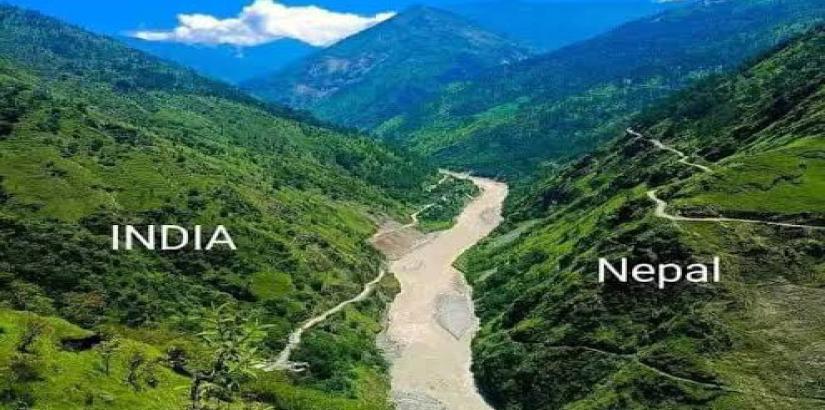
India and Nepal share around 1,880 sq km of border, of which 640 sq km are riverine borderlands. The two countries have about 60 rivers and rivulets flowing across the boundaries. The Mahakali (in Nepal)/Sarda (in India) is one amongst all the major rivers that forms the international boundary between Nepal and India. Its status as a river border has made it inseparable from the wider politics that shape India-Nepal relations.
Disagreements over the river’s origin, water rights and hydropower plants such as the Pancheshwar Multipurpose Project have overtime contributed to tension between the two countries. The Mahakali Treaty of 1966 sought to provide a framework for cooperation over the river water sharing and infrastructure building. Yet the treaty level cooperation has not been able to eliminate tensions.
Emergence of Mahakali Sambad
At the local level, riverine communities across the border continue to face similar problems such as erosion, river pollution, water scarcity, difficulties with fishing, irrigation, sand mining, inadequate early warning system and unannounced water releases. It was within this context that Mahakali Sambad (dialogue) emerged as a platform bringing together trans-border riverine communities, civil society organisations, local government institutions and other stakeholders involved under one platform.
Supported by the Transboundary Rivers of South Asia Programme (TROSA), this led to formation of grassroots networks, including the India-Nepal Joint Action Forum (INJAF) through which civil society organisations and local communities could raise common riverine concerns with officials in their respective countries. Many women in the community participate in these programs, leading to development of women’s empowerment centres (Mahila Mandals).
Case 1: Rafting connecting communities
One of such illustrative cases came from the Bahadure Women Empowerment Centre. Communities on either side of the Mahakali river share religious and cultural connections. Among them are the Purnagiri Mata temple in India and Parshuram Dham in Nepal. Yet travelling between both these places was difficult as there was no convenient bridge or ferry. Local superstitions and suspicion between communities also discouraged movements across the river. During a religious festival at Parshuram Dham, the Bahadure Women Empowerment Centre proposed using rafting to help pilgrims commute the river. What initially appeared to be a local initiative quickly became a cross border project because the Mahakali is an international boundary, permission from authorities in both countries was required. The women’s centre took the proposal into the Mahakali Sambad network.
Through TROSA and INJAF, the idea reached officials from Parshuram Municipality in Nepal and Champawat district in India. This opened the service to connect communities across borderlands and also opened doors for the governments of the two countries to work together.
Case 2 : Alcoholism, Erosion and Women
Another illustrative case comes from the Binayak village on the Nepali side where around 15 people live. These people have community connections with the Indian side of the village, where both communities come together and hold bazaar (market) on the Indian side. People living across both sides share problems such as a lack of clean drinking water, erosion, inundation and water scarcity. However, there was a lack of a common platform where they could come together, sit and discuss these issues.
This led to the establishment of the Suryabinayak Nepal-India Joint Advocacy Forum. One of the major issues highlighted was the increased consumption of liquor. As liquor was banned on the Indian side, Indians would frequently come to the Nepali side for alcohol, which created a nuisance in the village. To counter this, the women from the Indian side proposed a ban to their Nepali counterparts, which was a huge success. The women's collective requested the men to refrain from drinking alcohol and imposed high fines and punishments if anyone was found doing so.
The success of this initiative also spillovers to cooperations in other areas as well, such as problems related to river erosion. The women's centre planted trees on the riverbanks to prevent erosion. For this, the women's centre collaborated with the municipalities on both sides of the border to find nature-based solutions (Nbs) to prevent erosion.
Towards a Networked Riverine South Asia?
The importance of community-building has played a catalytic role in uncovering the root causes of pressing concerns and helped foster partnerships aimed at achieving inclusivity and equitable solutions. Under the TROSA programme, the Mahakali Sambad raises and addresses some of the issues faced by riparian communities and offers alternative perspectives to understand water cooperation differently. However, upscaling these issues still required substantial amounts of ground level work, beyond just management and conservation discourses.
Understanding the struggles of communities demands close attention to the mundane, both epistemologically and methodologically against the traditional IR paradigm. The networked analysis shows that communities living along the Mahakali river also have a gendered dimension that demands much attention.
Similarly, initiatives such as those adopted by TROSA are commendable, however, these are donation based, and in the long run, run out funds and resources.
A more institutionalised form of cooperation is needed, where state actors can play an active role in initiating and sustaining such initiatives. Such network connections across communities could contribute to scaling up issues of cooperation from local level, even if there is tension at the state level, cooperation will still exist at the micro level, which can eventually facilitate cooperation by the state. Such scalar engagement will help build community consciousness around water, thereby localising water diplomacy in South Asia.
(The author is a PhD Candidate in the Faculty of International Studies at South Asian University, New Delhi. He has previously been associated with the Transboundary Rivers of South Asia (TROSA) Programme as a Research Fellow. The views expressed are personal. He can be contacted at yubarajdas@students.sau.ac.in )





Post a Comment