Myanmar, Bangladesh, and India need mutual friendship in their national interest. Bangladesh's improved road and rail connectivity with India will open up new doors of trade and commerce.


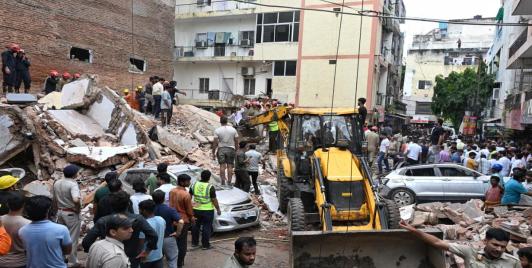
Aggressive migration of youth and workers to metro cities in search of better opportunities is common across the region. And so is the response deficit by local and central governments in providing them with basic, dignified lifestyles. The time has come for the elected representatives to think differently and narrow the gap between government schemes and results on the ground.

These achievements have positioned India as a digital governance exporter. Singapore, Nepal, Bhutan, France, Mauritius, Sri Lanka, and the United Arab Emirates have already established UPI connectivity, and more than 50 countries have expressed interest in replicating aspects of India Stack’s open digital infrastructure.
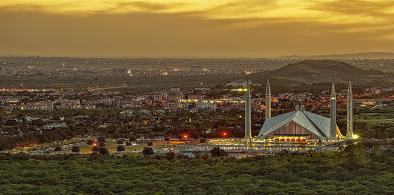
This raises the issue not whether Islamabad has surpassed its outmoded and fragmented administrative structure but whether governance would keep pace with its growth. Islamabad has to evolve from being administered as a capital city into being governed as a metropolis.

The inhabitants of Manipur have had long-standing experiences of living insecurely in their own homeland, even as migrants from the Northeast have encountered prejudice in metropolitan India....India has produced a paradox where communities that belong formally to India can also face exclusion from the social mainstream.

Myanmar, Bangladesh, and India need mutual friendship in their national interest. Bangladesh's improved road and rail connectivity with India will open up new doors of trade and commerce.

The politics being pursued by the BJP and its related organizations have a multipronged strategy to win over indigenous communituies electorally by emotive symbolic actions, to Hinduise them on the one hand, and to maintain the upper-caste hegemony on the other.

Modi's singular aversion to media engagement starkly contrasts with the active media engagement of leaders like Australian Prime Minister Anthony Albanese's one year in office. A notable analysis of his public relations strategy (Sydney Morning Herald, 20 June) reveals his tireless efforts to engage the public.

Gita Press is the intellectual and cultural base on which conservative Hindu values, mainly Brahmanical values, are promoted, and it provides the base for Hindu nationalist politics by promoting and propagating a narrow, exclusive version of Hinduism. Gandhi’s Hinduism was, on the other hand, humane and inclusive and he evolved with time to live the humanistic aspects of religion.

The US has continued to support Pakistan for short-term geopolitical considerations. On the other hand, the US has been unfair to Bangladesh by alleging that the democratic process there had been disrupted.
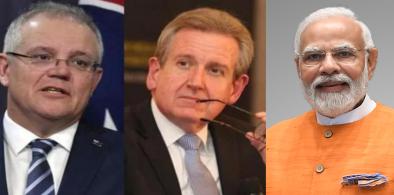
The relationship has grown with extraordinary speed. India and Australia are strategic partners – unthinkable a few years ago! An extraordinary bipartisan friendship reflects the way in which both countries have now come to see each other.

This approximately two-and-a-half-hour operation between Wadi Sayyidna and Jeddah, Saudi Arabia will go down in the annals of IAF history for its sheer audacity and flawless execution - akin to that carried out in Kabul, in which almost 400 Indians were brought back by the IAF in August 2021 in very challenging conditions following the Taliban takeover of Afghanistan.

The rise and fall of FTX’s co-founder Sam Bankman-Fried, a poster boy of the crypto world and seen as a genius, tells a story that has important learnings for all of us. A key learning is that, though talent or ingenuity can erect an empire of fame and riches in a short time, yet devoid of moral and ethical moorings, it can wreak havoc in the long run.

Since the late 1970s, the Indian Army has been paying a heavy price of losing good soldiers in asymmetric warfare waged by Pakistan, which involves having large bodies of regular troops committed on the ground for dealing with a 'handful' of the enemy.

Analysts see the rice-potato trade between the two countries as an extension of their stepped-up bilateral diplomacy. Their expectation is that this incipient commercial relationship can play a major role in resolving the Rohingya humanitarian crisis
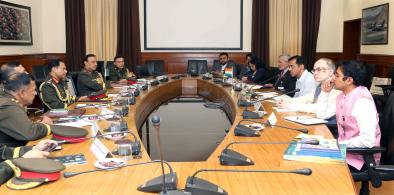
India can assist Bangladesh in achieving the goal of Bangladesh’s military plan “Forces Goal 2030,” a modernization programme that aims to transform Bangladesh's army into a technologically advanced, multi-domain force by 2030.
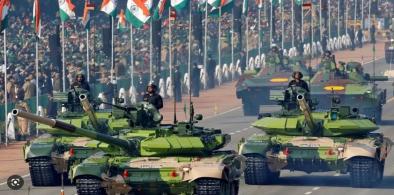
Military spending calculated as a share of the Gross Domestic Product (GDP) was 2.4 per cent for India, an estimated 1.6 per cent for China, 2.6 per cent for Pakistan.

On the one hand, India sees itself as the rising global power, the head of G20 today, and with an economy that is the fifth largest in the world by GDP. On the other hand, India is the story of flourishing gangsters who when they get too big must be taken to a secluded spot and shot.

Bangladesh's zero-tolerance policy against militancy is bearing fruit. So far, eight militant organizations, namely JMB, Shahadat-e-al-Hikma, JMJB, Hizbut Tahrir, Huji-B, ABT, Ansar Al Islam, and Allahr Dal, have been banned by the government. Prime Minister Sheikh Hasina's tough stance has made it possible to virtually dismantle the militant network in Bangladesh.

Herman Kumara, the national convener of the National Fisheries Solidarity Organization (NAFSO) in Sri Lanka, strongly opposes the practice of keeping arrested fishermen in jail even after their punishment has been served.