

The South Asian Health Paradox: A Race Against Time and Biology
Move away from heavy carbohydrate-dominant meals. Increase protein using familiar South Asian foods such as dal, chickpeas, paneer, curd, eggs, and sprouts. Incorporate Sabja (sweet basil seeds) and Isabgol (psyllium husk) daily — these traditional ingredients are excellent for stabilizing blood sugar and improving gut health. A rough 1:1 protein-to-carbohydrate ratio in main meals can significantly reduce inflammation.
 May 31, 2026

South Asia stands at a paradoxical crossroads. While the region’s economies surge forward with impressive momentum — driven by technology, entrepreneurship, and a young, ambitious population — a silent metabolic crisis is quietly undermining the health and future of its people. India, Pakistan, and Bangladesh have become global epicenters of type 2 diabetes and cardiovascular disease. Alarmingly, heart attacks and serious metabolic disorders are now striking in the late 30s and early 40s — nearly a decade earlier than in Western populations.
This is not simply a matter of lifestyle or poor diet. It is rooted in a distinct biological reality: the South Asian “Thin-Fat Phenotype.” People often appear relatively lean on the outside, yet carry dangerously high levels of visceral fat around vital organs. This explains why South Asians develop serious metabolic conditions even at lower body weight. Understanding and addressing this paradox is essential for the long-term economic stability, family welfare, and national resilience of South Asia.
Thrifty Gene and Modern Reality
For centuries, recurring famines and food scarcity shaped South Asian genetics. Natural selection favored individuals whose bodies were highly efficient at storing energy — a survival mechanism now known as the “Thrifty Gene” hypothesis. In an era of abundant calories, sedentary office jobs, motorized transport, and ultra-processed foods, this once-life-saving trait has become a serious liability.
The result is chronic low-grade inflammation, insulin resistance, and accelerated fat storage around organs. For millions of families, a single chronic illness — especially when it strikes the primary breadwinner — can lead to catastrophic medical debt and generational poverty. In South Asia, prevention is no longer just medical advice. It is a strategic necessity for continued economic progress and family security.
Why Standard Weight Measures Fail Us
Traditional BMI (Body Mass Index) and weight charts, developed primarily on Western populations, often give South Asians a false sense of security.
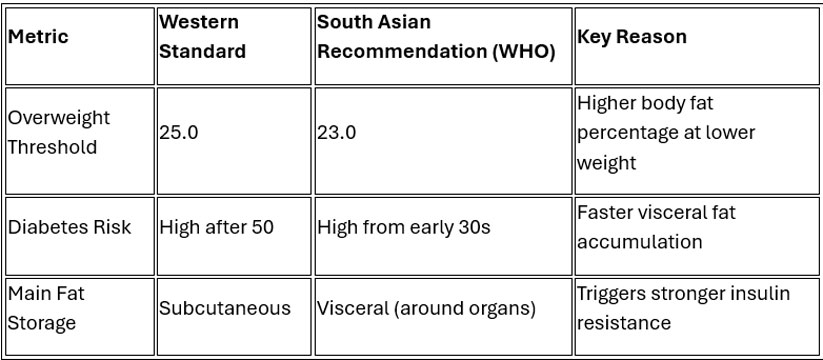
Many South Asians are told they have “normal” weight while already facing high internal risk. This mismatch makes early detection critical.
Movement as Daily Medicine: Exercise Snacking
Western-style fitness culture with expensive gyms and long workout sessions is often unrealistic in South Asia’s crowded cities, traffic, and pollution. Fortunately, science offers a practical and effective alternative: Exercise Snacking.
Research published in journals like Diabetologia shows that short 8–12 minute bursts of movement — such as brisk walking, stair climbing, or light marching — especially 20–30 minutes after meals, significantly reduce dangerous post-meal blood sugar spikes. For the South Asian body, which typically has lower muscle mass (our natural “glucose sink”), these small, consistent actions are particularly powerful. They cost nothing and can be easily integrated into daily life — climbing stairs at work, an evening walk with family, or quick movement during long sitting hours.
Practical Solutions for Families
Get a Basic Metabolic Check Every adult over 30 should establish an annual “Metabolic Baseline” with simple tests: HbA1c (3-month blood sugar average), fasting glucose, blood pressure, kidney function (creatinine), liver enzymes, and TSH for thyroid health. Training local health workers can make this screening accessible even in villages and small towns.
Change the Plate
Move away from heavy carbohydrate-dominant meals. Increase protein using familiar South Asian foods such as dal, chickpeas, paneer, curd, eggs, and sprouts. Incorporate Sabja (sweet basil seeds) and Isabgol (psyllium husk) daily — these traditional ingredients are excellent for stabilizing blood sugar and improving gut health. A rough 1:1 protein-to-carbohydrate ratio in main meals can significantly reduce inflammation.
Use Telehealth Proactively
Regular, affordable telehealth consultations can break the cycle of denial and late diagnosis. A short quarterly call with a doctor can detect problems years before they become medical emergencies.
Use Modern Medicines Wisely
Drugs like Ozempic are powerful tools, but their high cost and risk of muscle loss make them a backup option. They should support — not replace — strong lifestyle foundations, especially in a population already prone to lower muscle mass.
Time to Build Resilience
The South Asian Health Paradox is real, but it is not our destiny. By understanding our unique biology instead of blindly following Western models, we can create solutions that actually work for our bodies and our realities. Simple daily habits — movement, better food choices, and early screening — offer an affordable and effective path forward.
South Asia’s greatest strength has always been its remarkable resilience and adaptability. The same spirit that drives our economic rise must now be applied to safeguarding the health of our people. The time to act is now — for healthier individuals, stronger families, and a more prosperous South Asia.
(The author is the Director of the Reddy Center for Critical and Integrated Thinking. A scientist in biological chemistry with 30 U.S. patents and a former R&D executive, his work evaluates human behavior and geopolitics through an integrated physicalist lens. An IISc alumnus, he has published public commentary in RealClearScience, RealClearMarkets, South Asia Monitor, Mending the Campus, and other prominent outlets. Contact: mpreddyinsights.com, https://lnkd.in/gn2zQJbs, mpreddy54@yahoo.com)







Post a Comment