

Is Delimitation Becoming a Penalty for Good Governance for India's Southern States?
For decades, these states invested heavily in women’s education, public health, industrialisation, literacy and population control. Fertility rates in many southern states have already fallen below replacement levels. In contrast, several northern states lagged behind for years on precisely these indicators. If parliamentary representation now shifts overwhelmingly toward states with higher population growth, the message becomes deeply perverse: governance discipline weakens political power.
 Jun 15, 2026

As India approaches the long-postponed exercise of delimitation after 2026, an uncomfortable constitutional and political truth has begun surfacing with increasing force: should states that succeeded in population control, education, and governance be punished with diminished political influence?
For the southern states, particularly Tamil Nadu, Kerala, Karnataka and Telangana, this is not merely an administrative issue. It is a question of federal fairness and constitutional morality.
India froze the redistribution of Lok Sabha seats based on the 1971 Census through the 42nd Constitutional Amendment during the Emergency, later extended by the 84th Amendment till after the first Census post-2026. The rationale was simple and farsighted: states that implemented family planning and population stabilisation should not lose parliamentary representation because of their success. The constitutional debate surrounding delimitation is often framed as a conflict between democracy and federalism. The northern states argue that parliamentary representation must primarily reflect population. Indeed, Articles 81 and 82 of the Constitution envision representation broadly linked to demographic realities. A citizen in Bihar, it is argued, deserves representation equal to that of a citizen in Tamil Nadu. But this argument, while democratically attractive on the surface, ignores another equally important constitutional principle: India is not merely a majoritarian democracy; it is also a Union of States. The Constitution’s basic structure, repeatedly affirmed by the Supreme Court of India, protects federalism as a foundational feature of the republic. A delimitation exercise that dramatically concentrates political power in a handful of high-population northern states risks upsetting the delicate federal equilibrium that has sustained India’s unity despite vast linguistic, cultural and economic differences. The southern states are justified in asking a difficult but necessary question: why should successful governance reduce political influence?
For decades, these states invested heavily in women’s education, public health, industrialisation, literacy and population control. Fertility rates in many southern states have already fallen below replacement levels. In contrast, several northern states lagged behind for years on precisely these indicators. If parliamentary representation now shifts overwhelmingly toward states with higher population growth, the message becomes deeply perverse: governance discipline weakens political power. In constitutional democracies, incentives matter. One cannot expect states to pursue difficult long-term reforms if the eventual consequence is reduced relevance in national politics. Delimitation based solely on raw population would effectively reward demographic expansion while penalising states that acted responsibly in accordance with national policy objectives.
A Weighted Representation
Critics of this view contend that representation cannot be tied to governance “quality”, because parliament represents citizens, not state governments. This objection deserves serious consideration. A poor voter in Darbhanga is no less an Indian citizen than a software engineer in Mysore. Democracy cannot descend into elitism. Yet this counterargument is incomplete. India’s constitutional architecture already recognises that pure numerical majoritarianism must sometimes yield to broader federal considerations. The composition of the Rajya Sabha itself departs from strict population proportionality. Smaller states receive significantly greater per capita representation than larger states. Likewise, asymmetrical constitutional arrangements under Articles 371A to 371J demonstrate that the Constitution routinely balances formal equality against federal accommodation, regional diversity and institutional stability. One possible solution is a weighted representation formula. Population may remain the primary criterion, but additional weight can legitimately be accorded to indicators such as success in population stabilisation, human development, fiscal contribution, and governance outcomes. Such a model would not deny northern states increased representation altogether. Rather, it would prevent the emergence of overwhelming demographic domination by a few states.
Another alternative would involve substantially increasing the total strength of the Lok Sabha while guaranteeing that no state loses meaningful relative representation. This would preserve democratic legitimacy while avoiding the political alienation of southern India. However, the Indian constitutional structure has never embraced pure numerical majoritarianism as its sole organising principle. The Supreme Court itself has repeatedly recognised that equality under Article 14 does not mandate identical treatment in all circumstances. Differential treatment founded upon intelligible constitutional objectives remains permissible. An illustrative model may allocate:
1)55% weight to population,
2)15% to population stabilisation,
3)20% to human development and governance indicators,
4)10% to fiscal contribution.
The reason for such weightages is that population necessarily remains the dominant criterion because Articles 81 and 326 constitutionally embody representative democracy. Population stabilisation derives legitimacy from the constitutional history underlying the 42nd and 84th Amendments themselves. Human development indicators find support in the Directive Principles of State Policy, particularly Articles 38, 39, 41, 45 and 47, which obligate the State to promote welfare, education and public health. Fiscal contribution reflects broader principles of cooperative federalism and fiscal federalism recognised under Articles 268 to 281 governing distribution of revenues between the Union and the states. Similar Weighted measures have also been used by the Finance Commission Report of 2026-31 and Niti Ayog
Assuming an expanded Lok Sabha strength of 246 seats in a fictional country “IN”, a purely population-based redistribution may approximately resemble the following:
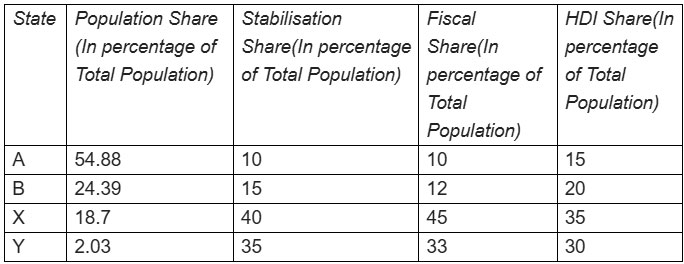
For any given state, its composite score is the sum of its performance shares across all indicators, multiplied by the respective weights assigned to those indicators.
Composite Score = (W1* S1) + (W2 * S2) + (W3* S3) + …..
Where:
W = The weight assigned to a specific indicator (expressed as a decimal, e.g., 55% = 0.55. The sum of all weights must equal to 1
S = The state’s relative share of that specific indicator (expressed as a decimal). The total shares of all states for a single indicator must sum to 1
State and its Estimated Seats (based on Population only i.e.current framework governing allocation of seats)
Northern State A- 135 seats in Lok Sabha
Northern State B- 60 seats in Lok Sabha
Southern State X- 46 seats in Lok Sabha
Southern State Y- 22 seats in Lok sabha
The final share of seats for any state is calculated using the weighted average formula:
Composite Share= [0.55*Population] + [0.2*Population Stabilisation] + [0.15*HDI]+[0.1*fiscal contribution]
Once the composite share is found, it is multiplied by the total pool of 246 seats as taken in the illustration
Composite Share of State A=
Composite Share: (0.55*0.5488) + (0.20*0.10) + (0.15*0.15) + (0.10 *0.10) = 0.301 + 0.020 + 0.022 + 0.010 = 0.354
Seat Allocation: 0.354*246 = 110 seats
Takeaway: By assigning 55% weight to Population, State A and B still retain the largest physical numbers of seats due to sheer demographic size. However, by balancing the remaining 45% of the weight heavily toward the high-performing South Indian states (X and Y) in fiscal and development metrics, you successfully cushion their representation and hit your precise target numbers.
State and its Estimated Seats (based on proposed Weighted Formula)
Northern State A -110
Northern State B -50
Southern State X 56
Southern State Y -30
Preventing Demographic Dominance
The objective of such a framework is not to deny representation to populous states. Rather, it seeks to prevent demographic dominance from overwhelming India’s federal balance and marginalising governance-performing states within the constitutional structure.
Admittedly, implementing such a model would itself require substantial constitutional consensus. Since representation of states in parliament would be directly affected, any serious restructuring would likely require a constitutional amendment under Article 368 together with ratification by at least one-half of the state legislatures.
Yet constitutional difficulty cannot become an excuse for constitutional complacency.
(The writer is Utkarsh Srivastava, Advocate in Delhi High Court & Member of New Delhi Bar Association. He did his masters from World Trade Institute, University of Bern, Switzerland. Views expressed are personal. He can be reached at utkarshsrivastava52@hotmail.com)





Post a Comment