

Khamenei’s Killing: West Asia, Region at the Hormuz Flashpoint
Escalation around Iran narrows diplomatic manoeuvring room across South Asia. India has cultivated strong defence ties with Israel, expanded strategic cooperation with Washington and maintained pragmatic engagement with Tehran, particularly in connectivity and energy sectors. A widening US–Iran confrontation complicates this balancing act.
 Mar 02, 2026
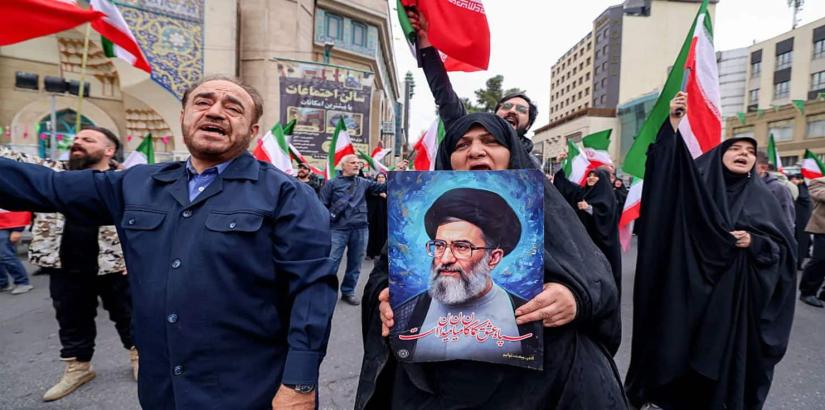
Iranian state television has confirmed that Supreme Leader Ayatollah Ali Khamenei was killed in joint United States–Israeli strikes, declaring a 40-day national mourning period. What began as claims from Washington and Tel Aviv has now been acknowledged by Tehran itself. This was not a battlefield exchange. It was not a defensive intercept. It was the targeted killing of the highest political authority of a sovereign state. With this strike, Donald Trump and Benjamin Netanyahu have crossed a threshold that even the most assertive post-9/11 doctrines approached cautiously: the overt assassination of a rival state’s central leadership figure. The question now is not outrage. It is consequence. Can the architects of this strike control what follows?
Escalation, Hormuz and the Speed of War
In previous confrontations, Iran’s responses were calibrated and delayed. This time, the tempo appears compressed. In modern conflict, timing can be as destabilising as firepower. When retaliation windows shrink from days to hours, miscalculation risks multiply. The Strait of Hormuz — through which roughly one-fifth of the world’s oil transits — now becomes the most sensitive theatre. Even limited disruption to shipping lanes would trigger immediate volatility in global markets. Energy prices, insurance premiums and freight costs would rise sharply. For South Asia, heavily dependent on Gulf energy flows, the economic impact could be swift. India, Pakistan, Bangladesh and Sri Lanka remain deeply exposed to Gulf crude supplies and remittance flows from expatriate workers in the region. Any sustained instability would not remain confined to West Asia; it would transmit through fuel prices, currency pressures and fiscal strain. The confrontation therefore carries systemic implications for energy security and regional stability.
South Asia’s Compressed Strategic Space
Escalation around Iran narrows diplomatic manoeuvring room across South Asia. India has cultivated strong defence ties with Israel, expanded strategic cooperation with Washington and maintained pragmatic engagement with Tehran, particularly in connectivity and energy sectors. A widening US–Iran confrontation complicates this balancing act. New Delhi’s initial response — limited to a procedural advisory concerning travel and visa regularisation — reflects calibrated caution. Silence in such moments is not necessarily indifference; it can signal preservation of strategic flexibility.
Pakistan and China will also recalibrate their posture. Beijing views instability through the lens of maritime security and energy corridors. Islamabad, historically positioned between Gulf monarchies and broader Islamic constituencies, will weigh sectarian sensitivities alongside strategic alignment. For South Asia, escalation is not abstract geopolitics. It intersects directly with domestic economics and regional security.
A Region Already Under Strain
The assassination did not occur in isolation. In the weeks preceding the strike, Iran had been convulsed by widespread protests over economic hardship and political repression. Human rights organisations and UN experts reported severe crackdowns, including live ammunition, mass arrests and harsh sentencing. Casualty figures remain contested, but the unrest had already placed considerable strain on the Iranian state. When internal crisis converges with external military escalation, predictability declines. Decapitation strategies often assume that leadership removal will paralyse a system. Historical experience suggests that such actions can instead consolidate hardline factions or intensify retaliatory resolve.
Record of Regime Change
The assumption that decisive force can recalibrate political systems has appeared repeatedly in modern intervention history. Vietnam concluded in withdrawal rather than transformation. Iraq’s regime removal produced prolonged instability and extremist resurgence. Afghanistan consumed two decades before returning to its political starting point. In Venezuela, sustained sanctions and coercive pressure linked to energy geopolitics have compounded domestic strain without delivering decisive political transition. Across these cases, tactical success did not automatically yield durable political order. Leadership removal rarely guarantees strategic stability.
Law, Sovereignty and Precedent
Under the UN Charter, the lawful use of force is limited to self-defence against an armed attack or action authorised by the Security Council. Targeted killing framed as preventive deterrence occupies legally contested ground. Public justification for the strike has centred on alleged nuclear threat. Yet independent assessments by the International Atomic Energy Agency have not established that Iran possesses nuclear weapons or has crossed the threshold of weaponization. Even where serious human rights violations are documented — and Iran’s domestic repression is widely criticised — such concerns do not automatically create licence for extraterritorial assassination. If targeted killing becomes normalised as an instrument of strategic policy, the restraint architecture of international law erodes incrementally. Precedent rarely remains confined to a single theatre.
Sectarian Reverberations Beyond State
The implications extend beyond statecraft into the political psychology of the Shia world. Ali Khamenei embodied not only executive authority but a specific ideological model of governance under Velayat-e-Faqih. For constituencies aligned with Iran’s revolutionary identity, his killing will be interpreted as more than strategic elimination; it may be read as an assault on symbolic political agency. Shia historical consciousness remains shaped by the memory of Karbala — a narrative of unjust power confronting moral resistance. In such contexts, the language of martyrdom can activate rapidly. Strategic removal intended to weaken a state can generate symbolic consolidation. Yet the Shia world is not monolithic. The Najaf tradition, associated with Grand Ayatollah Ali al-Sistani, rejects Iran’s model of clerical rule.
Shia communities across South Asia, the Gulf and Africa follow diverse authorities and hold varied political views. Reactions will range from grief to caution to deliberate restraint. The greater risk lies in securitisation. Regional escalation around Iran has historically spilled into suspicion and vulnerability for Shia minorities elsewhere. When geopolitics fuses with sectarian identity, communities risk becoming proxies in broader contests. Symbolic consequences often outlast immediate strategic calculations.
Illusion of Controlled Escalation
Perhaps the most consequential assumption underpinning the strike is that escalation can be carefully managed. Military history offers limited reassurance. Once retaliation cycles tighten and asymmetric actors adapt, escalation pathways become difficult to predict. Energy chokepoints, domestic political pressures and alliance commitments can convert calculated risk into cascading crises. The assassination of a central state authority is not merely a tactical development. It represents a structural rupture in regional security dynamics. It suggests that decapitation has re-entered the overt repertoire of major-power competition.
West Asia now faces a period of heightened strategic uncertainty. If escalation centres on the Strait of Hormuz, no actor retains monopoly over outcome. And once conflict tempo accelerates, restoring restraint becomes significantly more difficult than preserving it.
(The author is an Advocate at the Jammu Bench of the High Court of J&K and Ladakh and a Doctoral Scholar at SCALSAR, Symbiosis International (Deemed University), Pune. Views expressed are personal. He can be contacted at aqib.juris@gmail.com )




Post a Comment