
Can South Asia Build a Microfinance System That Protects the Poor?
Samurdhi’s community-based banking system provides a foundation in Sri Lanka through savings, member participation and livelihood support. Bangladesh’s Grameen Bank offers useful lessons in lending without conventional collateral, organising small borrower groups and placing women at the centre of financial participation.
 Oct 29, 2026

e cycle, or when the lender's incentives favour disbursement over suitability.
The fourth group, households genuinely ready for investment may need not only capital but training, market linkages and business support. The IPS survey found that only 19% of MFI participants had received any skills training. Credit without the capacity to deploy it productively rarely generates the income growth needed to repay comfortably and accumulate assets.
"High repayment rates do not establish borrower wellbeing. A household may repay on time while consuming less food or borrowing elsewhere."
Grameen Bank in Bangladesh pioneered group-lending methodology and demonstrated that poor households, including women, can and do repay loans. Yet critics have documented cases of over-indebtedness, coercive group pressure and mission drift as Grameen-style models expanded.
India's 2010 Andhra Pradesh state microfinance crisis, in which rapid MFI growth was followed by a wave of borrower distress and state intervention, illustrated that scale without adequate safeguards can produce harm. Sri Lanka's cooperative movement formalized in 1911 and Samurdhi Banking Societies offer local precedents for community-based financial services, each with lessons about governance, capture and sustainability. No model from one context can simply be copied into another.
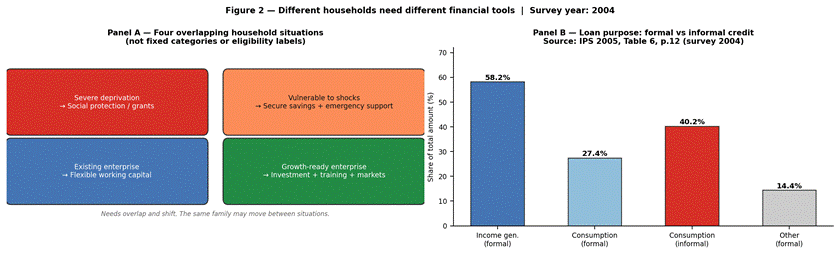
Figure 2- Different households need different support | Left: four overlapping household situations (not fixed categories). Right: loan purpose by share of total amount (IPS, 2005, Table 6, survey year 2004).
What "To the People, Through the People" Would Mean
The central proposal is a community-owned financial services mechanism in which communities are not merely beneficiaries but members with real governance rights. Figure 3 presents this as a proposed model requiring further consultation and feasibility assessment, not a ready-made solution.
“To the People, Through the People” means giving low-income families a meaningful voice in how financial services are designed and managed. Samurdhi’s community-based banking system provides a foundation in Sri Lanka through savings, member participation and livelihood support.
Bangladesh’s Grameen Bank offers useful lessons in lending without conventional collateral, organising small borrower groups and placing women at the centre of financial participation. Its published model also distinguishes group support from repayment liability: individuals remain responsible for their own loans, rather than being required to repay another member’s debt. [Sources: wiki/Grameen_Bank]
Sri Lanka should adapt these lessons to local needs through a small pilot involving selected Samurdhi communities, accountable member representatives and trained financial staff. Transparent charges, repayment schedules matched to seasonal incomes, business guidance and independent complaints procedures should underpin the approach. Groups should provide mutual support without coercion or public shaming, while women’s participation should include real control over financial decisions. Simple digital records could precede carefully tested AI tools that support affordability assessments, identify possible hardship and explain services in Sinhala and Tamil, with people retaining decision-making responsibility. Independent evaluation should assess household debt, livelihood income, savings security and wellbeing before expansion, while families needing grants or emergency assistance should receive appropriate support rather than further loans.
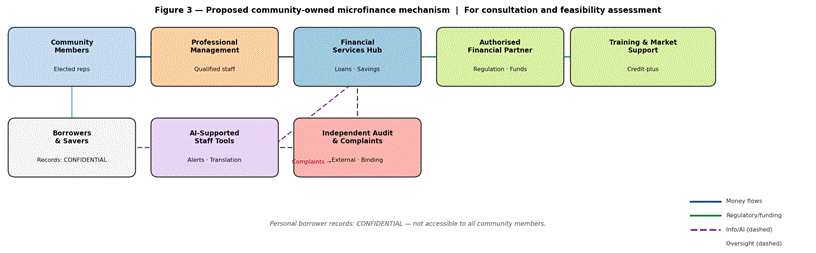
Figure 3 - The proposed community-owned mechanism | Proposed model for consultation and feasibility assessment. Borrower records: CONFIDENTIAL — not accessible to all community members.
Where AI Can Help and Where Human Judgement Must Remain
AI covers a wide range of tools, from simple digital record systems to predictive models and generative language systems. Not all of them are useful for community microfinance, and some carry real risks. The question is not whether AI is impressive, but whether it offers a demonstrable improvement over simpler methods in a specific context.
Can AI Tools Support Microfinance?
Microfinance in Sri Lanka has reached a significant portion of low-income households. The evidence also shows that formal provision coexists with persistent informal borrowing, that repayment pressure sometimes pushes households deeper into debt, and that access to credit alone does not produce income growth. Community ownership, professional management and appropriate regulation could together create a more protective and responsive system. AI tools could support that system in specific, bounded ways improving the quality of staff analysis, extending language accessibility and strengthening oversight.
They could also cause harm through AI biased models, privacy failures, digital exclusion and over-reliance on automated recommendations. The case for including AI tools rests on whether they demonstrably improve outcomes compared with simpler alternatives, not on the technology's novelty.
Governance, appropriate finance, social protection and viable livelihoods determine whether families benefit. AI may make a better tool possible. It cannot substitute for the human decisions, institutional integrity and political commitment that a genuinely protective microfinance system requires.
(The author is an Associate Professor in Generative AI and Machine Learning and leader of the AI for Climate & Disaster Resilience Research Group (AICDRG) at York St John University, UK. He is at the forefront of South Asia's regional transformation in AI research and application. The views expressed are personal.)







Post a Comment