

China’s Troubled Relations with its Maritime Neighbors: A Military Necessity or Violation of Classical Geopolitics?
This tactical aspect of nuclear counter-attack is perhaps the foremost reason why China reckons it needs absolute control over the South China Sea. China’s troubled relations with its maritime neighbors are, from its perspective, a necessary cost it has to pay for its national security.
 Jul 22, 2026
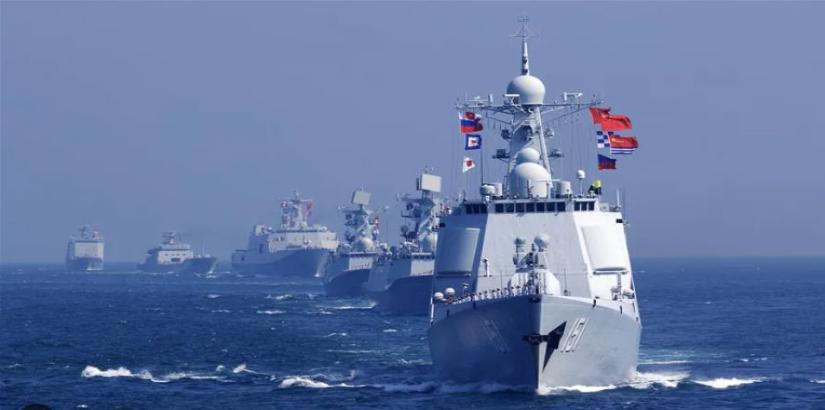
According to the U.S. [SS1] [SS2] Department of Defense (DoD), China's navy “is the largest navy in the world with a battle force of over 370 platforms [i.e., ships], including major surface combatants, submarines, ocean-going amphibious ships, mine warfare ships, aircraft carriers, and fleet auxiliaries. Notably, this figure does not include approximately 60 HOUBEI-class patrol combatants that carry anti-ship cruise missiles (ASCM). The… overall battle force [of China's navy] is expected to grow to 395 ships by 2025 and 435 ships by 2030”.
Unprecedented Investment in Navy
Why does China need such a large naval force? According to Admiral (Retd) Arun Prakash[SS3], a former Indian Navy chief, no nation has ever made such a huge investment in its navy as China has in known history. There are two immediate fallouts for China in having done so.First, military expenditure across China’s maritime neighborhood has risen in response to China’s increasingly assertive military posturing. Second, by investing in a huge naval fleet, China has violated a central premise [SS4] of classical geopolitics.
Japan’s military expenditure rose by 9.7 per cent to reach $62.2 billion in 2025, equivalent to 1.4 per cent of GDP—the highest share since 1958. Likewise, Taiwan’s military spending increased by 14 per cent to $18.2 billion (2.1 per cent of GDP), the largest annual increase since at least 1988, whereas India increased its military spending by 8.9 per cent to $92.1 billion.
According to Diego Lopes da Silva, Senior Researcher with the SIPRI Military Expenditure and Arms Production Programme, “U.S. allies in Asia and Oceania such as Australia, Japan and the Philippines are spending more on their militaries, not only due to long-standing regional tensions but also due to growing uncertainty over U.S. support”.
A key principle of [SS5] classical geopolitics is that a great power located on the Eurasian landmass must “not” invest in a naval fleet. China seems to have violated this cardinal principle. With both access to resources on the Eurasian landmass and a naval fleet, the balance of power turns unfavorable for the maritime powers located around the rim of the Eurasian continent.
According to[SS6] HJ Mackinder (1904), “the oversetting of the balance of power in favour of the pivot state, resulting in its expansion over the marginal lands of Euro-Asia, would permit of the use of vast continental resources for fleet-building, and the empire of the world would then be in sight”. China’s approach towards its naval build-up and strategy proves to be counterproductive and hence, there must be a military necessity that impels its naval build up.
China: A Land Power Cursed by its Geography
China is a land power, and is turning towards the sea only very recently. Throughout its history, China has primarily focused on security threats originating from land. Even when confronted with threats from the sea, China has prioritized developing its land forces and using diplomatic means to address these threats. Until the 1980s, the Chinese Navy performed a supporting role, but from this period onwards, its area of operations gained the significance of being recognized as an independent battlespace.
It was only in December 2008 that the Chinese Navy sent its first ship formation to the Gulf of Aden and Somali waters to conduct escort tasks, which has become a normalized practice nowadays. Like Russia, China is “cursed by its geography” while attempting to link the sea to its national security and development. Both Russia and China cannot deploy their navies like maritime powers (such as United States[SS7] , Japan, United Kingdom, India or Australia) can.
Logistics remains a key vulnerability for both countries. As a land power, China looks towards the sea and feels insecure, having to fight a battle for access. A maritime power, on the other hand, looks toward the sea and feels insecure about freedom of navigation. Since land and sea powers vary in their approach while interpreting the same reality, they are caught up in a structural contradiction. Given its geography, China’s predicament regarding maritime access is evident in the strategic vision of General Liu Huaqing, the father of modern Chinese Navy, who served as Commander of the PLA[SS8] Navy from 1982 to 1987 and lateras a member of the Politburo Standing Committee, from 1992 to 1997.
General Liu Huaqing’s strategic vision called for establishing Chinese naval presence in the area delineated by the “first island chain”, which is defined by a line running through the Kuril Islands, Japan, Taiwan, the Philippines, Borneo and the northern tip of Indonesia by the year 2000. Following this phase, Liu’s strategy envisaged achieving control of the “second island chain”, marked by a line running through Japan, 2000 miles south to the Mariana and Caroline islands in the Central Pacific by 2020. The final phase envisaged the PLAN becoming a global naval force by 2050. According to Admiral (Retd) Arun Prakash, “the non-attainment of Phase 1, the first island chain, weighs heavily on the consciousness of PLAN strategists, because the first island chain is seen as a geographical barrier obstructing China’s access to the high seas”. China may have built a large naval combat fleet and invested in its modernization;; however, its geographical constraints continue to challenge its naval deployment, as it has to negotiate with a tough maritime neighborhood.
South China Sea: A Military Necessity for China?
With China’s access to the high sea blocked in theory, its submarine fleet cannot enter the Indian Ocean without being noticed. The first major expansion of the Chinese Navy was in the Spratly waters following the Johnson Reef naval battle of 1988. Nevertheless, the expansion of its operational area in the Spratly waters commenced only recently. This expansion has come at a cost to China – QUAD and AUKUS.
According to Hei Jin, “completely controlling the Spratly waters would allow our Navy’s ships to threaten the southern part of America’s first island chain, that is, the comparatively weak point that it somewhat neglected in the past. Moreover, having air and sea footholds (lizudian) in the Spratlys can impede (zhiyue) the U.S. and its allies stationed along the second island chain from providing support to the first island chain”.
Moreover, seabed geography is of paramount importance for China’s nuclear fleet, as it has no other place to maneuver ballistic missile nuclear submarines (SSBN’s) to prosecute counterstrikes against an adversary’s homeland and also for nuclear attack submarines conducting patrols and sea denial operations. [SS9] The U.S, China’s principal adversary, can mount a nuclear strike from the Artic, where China has no access and depends on Russia for early-warning support.
This tactical aspect of nuclear counter-attack is perhaps the foremost reason why China reckons it needs absolute control over the South China Sea. China’s troubled relations with its maritime neighbors are, from its perspective, a necessary cost it has to pay for its national security.
(The author is a Lecturer at Sichuan International Studies University, Chongqing, China and a Non-Resident Fellow at the Society for Policy Studies, New Delhi. Views expressed are personal. He can be reached at themayandischool@gmail.com )





Post a Comment