

Is Northeast India's Permit System Inhibiting India-Japan Paradiplomacy? Colonial-Era System may be Stumbling Block to Subnational Exchanges
If India and Japan genuinely envision Northeast India as the gateway connecting South Asia with the Bay of Bengal and the Indo-Pacific, then the next chapter of the partnership cannot remain confined to New Delhi and Tokyo. It must also be written in Guwahati, Shillong, Aizawl, Imphal, Agartala, Kohima, Gangtok and Itanagar
 Jul 24, 2026
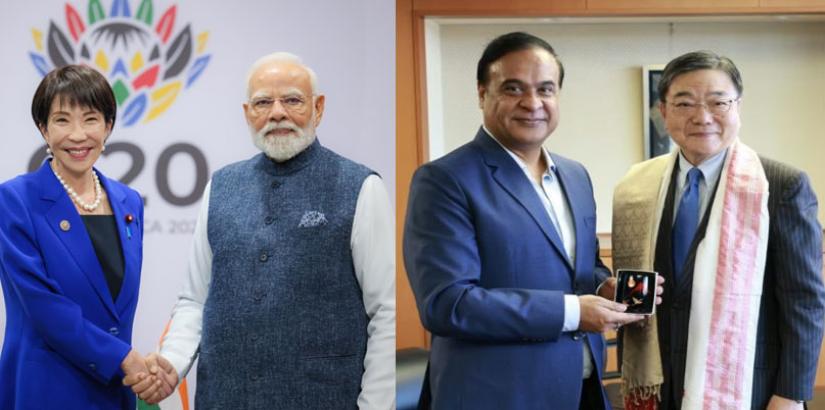
The 16th India Japan Annual Summit in New Delhi July 1-3 has rightly been hailed as another milestone in a partnership that has steadily expanded from development cooperation to strategic collaboration. The Joint Statement is ambitious in its scope, covering defence, economic security, resilient supply chains, artificial intelligence, clean energy, and people-to-people exchanges. For Northeast India too, the summit appears to mark a significant moment. The region is no longer portrayed merely as India's frontier; it is envisioned as a strategic node connecting India with the Bay of Bengal and the wider Indo-Pacific through industrial value chains.
For the first time, an India-Japan Joint Statement explicitly acknowledges the role of subnational governments in advancing bilateral relations, building on the State-Prefecture Partnership Initiative first launched at the 15th Annual Summit in Tokyo in August 2025. It recognises that Indian states and Japanese prefectures and municipalities have become important actors in strengthening economic and people-to-people ties.
The statement goes on to celebrate collaborations between Yamanashi Prefecture and Uttar Pradesh, Toyama Prefecture and Andhra Pradesh, Shizuoka Prefecture and Gujarat, Wakayama Prefecture and Maharashtra, San'in Region and Kerala, Fukuoka Prefecture and Delhi, Ehime Prefecture and Tamil Nadu, Hamamatsu City and Ahmedabad, and Kitakyushu City and Telangana.\
Structural Contradiction
Immediately after recognising the growing importance of subnational diplomacy, the Joint Statement identifies Northeast India as strategically central to the future of India-Japan cooperation. More significantly, it commits both countries to developing industrial value chains connecting Northeast India with the Bay of Bengal in collaboration with regional partners through BIMSTEC. But the alarming question is: why is Northeast absent from the very framework that recognises the importance of state-level diplomacy?
Assam Chief Minister Himanta Biswa Sarma visited Japan from 21–24 January 2025, where he held a bilateral meeting with Parliamentary Vice-Minister for Foreign Affairs Ikuina Akiko, who specifically noted that Japan "attaches great importance to the Indian North Eastern Region, including Assam." During Advantage Assam 2.0, Assam signed an MoU with Japan on education and skill development, including plans for a Japan Language Testing Centre and a stated target of sending roughly 50,000 Assamese youth to work in Japan. By May 2025, a top Japanese government delegation had visited Assam for the fourth time since February of that year, and Sarma had personally invited firms such as Micron and Kameda Seika to invest in the state's semiconductor and food-processing sectors, framed against Assam's own target of a $143 billion GSDP by 2030.
Meghalaya's Chief Minister Conrad Sangma likewise visited Japan from 14–21 April 2025 to run investment roadshows, and by February 2026, Miyagi Prefecture had gone so far as to dispatch its own delegation to Meghalaya to explore cooperation on food exports and IT/tourism human-resource exchange, one of the few instances of a Japanese prefecture proactively reaching into the Northeast rather than the other way around.
None of this, however, has yet crystallised into a named "state–prefecture partnership" of the kind celebrated in the Joint Statement. The deeper explanation lies in the very legal-administrative architecture that governs foreigner access to the Northeast, an architecture that sits uneasily with the kind of sustained, on-the-ground institutional relationship-building that paradiplomacy requires.
The structural contradiction lies at the heart of the Joint Statement's own language. The same document that speaks of Northeast India as a future hub of industrial value chains and BIMSTEC-linked production networks governs the region, in practice, through a permit regime built around restricting and monitoring outsiders, a regime that has, if anything, tightened rather than loosened since 2024-25. A Japanese prefectural delegation can fly into Lucknow or Ahmedabad and move freely; the same delegation visiting Kohima, Imphal, Aizawl or large parts of Arunachal Pradesh operates under permit conditions originally designed for the colonial-era Inner Line system of 1873.
Constraints to Paradiplomacy
It is difficult to build the kind of dense, iterative sub-national relationship that produced the Yamanashi–Uttar Pradesh green hydrogen partnership or the Shizuoka–Gujarat automotive linkage when the entry framework itself treats sustained foreign engagement as a security exception rather than a norm.
Northeast India has among the longest and most numerous international borders of any Indian region, with Bangladesh, Bhutan, Myanmar and China and yet those very borders are the reason its paradiplomatic space remains constrained rather than expanded. Where a border encourages devolved authority elsewhere in the world, in India's securitised Northeast it has historically justified greater central control.
The 2024–2026 period only sharpened this: the FMR's scrapping, the collapse of the Sheikh Hasina government in Bangladesh, the suspension of transshipment facilities, and the ongoing Manipur conflict have all reinforced New Delhi's instinct to manage the region's external relationships centrally rather than devolve them, even as the same period's Joint Statements increasingly describe the region as an economic bridgehead.
Opportunities and Paradox
For Northeast India, paradiplomacy offers opportunities that extend well beyond symbolic sister-city agreements. Assam's growing semiconductor ecosystem; Meghalaya's expertise in disaster resilience; Mizoram's cultural proximity to Myanmar; Tripura's connectivity with Bangladesh; Nagaland's creative industries; Arunachal Pradesh's ecotourism potential; Sikkim's sustainability initiatives; and Manipur's sporting and cultural exchanges all provide distinct avenues for building meaningful partnerships with Japanese prefectures based on complementary strengths rather than ceremonial exchanges. Such partnerships would also strengthen the objectives already outlined in the Joint Statement.
The paradox, therefore, is not that Northeast India has been ignored. On the contrary, the summit places the region at the heart of India's Indo-Pacific strategy, and the region's own leadership has been knocking on Tokyo's door with real urgency. The paradox is that while Northeast India is expected to drive the next phase of India-Japan economic integration, its states remain absent from the very subnational diplomatic architecture that the Joint Statement now explicitly highlights.
If India and Japan genuinely envision Northeast India as the gateway connecting South Asia with the Bay of Bengal and the Indo-Pacific, then the next chapter of the partnership cannot remain confined to New Delhi and Tokyo. It must also be written in Guwahati, Shillong, Aizawl, Imphal, Agartala, Kohima, Gangtok and Itanagar and it will require, alongside institutional relationships, a hard look at whether the permit architecture built for a different security era can coexist with the kind of open, sustained sub-national exchange that paradiplomacy demands.
(Bagmita Borthakur is a PhD Research Scholar of International Relations. Bishaldeep Kakati is a Lawyer, Legal and Political Commentator. The views expressed are personal. They can be contacted at deep.kakati99@gmail.com)





Post a Comment