

The Quad Is Here to Stay: It Survives Because It Is Not Over-Institutionalised
On all these fronts, the Quad is more consequential, based on geography, capability, necessity and the absence of any better alternative. AUKUS’ scope is seen as too narrow, while Camp David is too regional, and the Squad is too limited. Bilateral alliances are too fragmented, while the Quad is seen to have the scale, reach and flexibility to connect the Indian Ocean and Pacific theatres into one strategic framework
 Jun 01, 2026
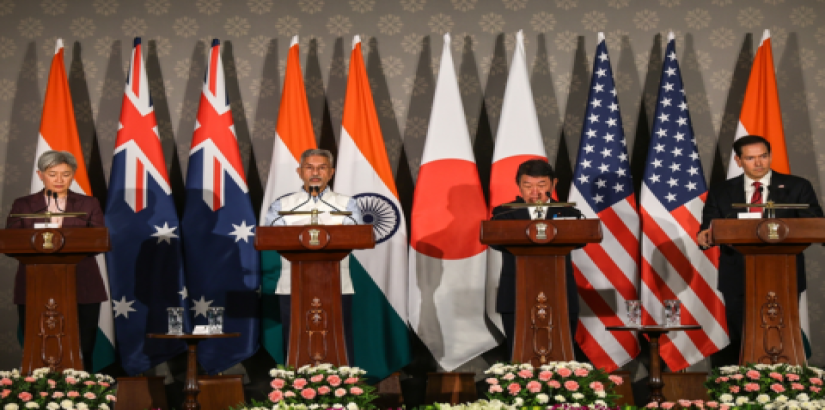
With eyes fixed on West Asia and Europe as they manage turbulence and conflicts, the capacity and relevance of the Quad have been called into question. The Quad Foreign Ministers’ Meeting in New Delhi on 26 May sought to put that notion to rest. Attended by U.S. Secretary of State Marco Rubio and the foreign ministers of India, Japan and Australia, the grouping is moving into a more practical phase.
Arguments suggest that President Donald Trump’s transactional approach to China - reflected in his desire to stabilise trade ties with Beijing and possible ambiguity over Taiwan - has weakened Washington’s appetite for a sharper Indo-Pacific security posture and, in turn, weakened the Quad. The Quad has been seen as losing its edge, becoming too slow and too cautious, while newer formats such as AUKUS, Camp David and the so-called “Squad” may take over the real security function.
Current strategic calculations show otherwise. The Quad is not becoming obsolete; rather, it has gained further credentials as a necessary deterrent and fallback mechanism because the very strategic environment that created it has become more militarised and the threats have deepened.
Quad’s Expanding Strategic and Economic Relevance
The joint statement from the meeting reaffirmed cooperation on maritime domain awareness, critical minerals, energy security, infrastructure, counter-terrorism and regional resilience, while expressing concern over coercive actions in the South China Sea and East China Sea and opposing unilateral attempts to change the status quo.
One of the most important outcomes was the decision to mobilise around US$20 billion in public and private investment for critical minerals supply chains, including mining and processing, directly responding to China’s dominance in rare earths and critical mineral processing.
This reflects a continuing expansion of resilience-building across all dimensions of power, not confined to hard power alone.
Key infrastructure, minerals, energy corridors, data flows and surveillance architecture are now part of the new balance of power. The Quad understands that securing the Indo-Pacific is not only about naval and military assets such as aircraft carriers and missiles, but increasingly about human capital, control of logistics, who finances infrastructure, who monitors maritime movement first, who processes the minerals needed for defence and technology, and who can keep sea lanes open during a crisis.
With the rising arms race and increasing military spending, the Quad is seen as the natural bulwark for its members to maintain relevance.
Asia and Oceania’s military spending rose by 8.1 percent to US$681 billion, while China’s military spending increased by 7.4 percent to an estimated US$336 billion. In response, India’s spending rose by 8.9 percent to US$92.1 billion, while Japan’s spending reached US$62.2 billion, up 9.7 percent.
If U.S.-China relations become more deal-driven, regional partners will want an institutional hedge against sudden bilateral bargains or policy shifts, making the Quad strategically important.
India, Japan and Australia do not want Indo-Pacific security to become hostage to a temporary trade understanding between Washington and Beijing, and the Quad gives them a platform to preserve continuity even when American domestic politics remain unpredictable.
The Quad’s flexibility is its strength. It is not rigidly structured like NATO. It does not force members into a formal alliance but creates strategic convergence where interests overlap, especially in areas of maritime security, freedom of navigation, supply-chain resilience, critical minerals and trusted technology.
India has its own strategic reasons to maintain momentum within the Quad, including the China-India border dispute, the need to strengthen its position in the Indian Ocean, counter Chinese maritime expansion and address supply-chain vulnerabilities.
The Quad also provides Japan and Australia with greater strategic depth, recognising that neither can secure the wider Indo-Pacific alone.
Why Other Frameworks Cannot Replace Quad
The Quad is seen as providing a broader deterrence and resilience capacity within a larger strategic framework compared with other existing mechanisms, including AUKUS, the Camp David framework and the Squad.
AUKUS does not include India or Japan, nor does it provide a wider Indo-Pacific political platform.
The Camp David framework between the United States, Japan and South Korea is important, but it is largely Northeast Asia-centric, driven by concerns over North Korea, China and regional missile threats, while largely excluding the Indian Ocean, South Asia and the wider Pacific.
The Squad - involving the United States, Japan, Australia and the Philippines - is particularly relevant to the South China Sea, especially in light of growing Chinese pressure on Manila.
However, this platform remains geographically narrower and politically less mature than the Quad.
The Quad remains the only platform that links the Pacific and Indian Ocean theatres, connecting the world’s largest economy, the world’s most populous country, Asia’s most advanced maritime democracy and Australia’s southern Indo-Pacific strategic base.
The grouping’s economic weight remains one of its greatest strengths. Together, the Quad countries account for a substantial share of global GDP, advanced technological capacity, naval reach, democratic legitimacy and maritime geography. Their combined population also exceeds 1.8 billion, giving the Quad a scale that no other Indo-Pacific minilateral arrangement can replicate.
The Quad’s future also extends beyond China. Although China remains a central driver, it is not the only one. The Indo-Pacific faces a broader set of structural risks, including maritime chokepoint vulnerabilities, attacks on commercial shipping, grey-zone coercion, illegal fishing, undersea cable threats, energy insecurity, cyber vulnerabilities, disaster-response gaps, transnational crime and public health challenges.
The post-Ukraine factor is also seen as strategically significant. If the United States eventually recalibrates ties with Russia after the war, the strategic centre of gravity will shift even further toward the Indo-Pacific.
A future U.S.-Russia accommodation, however limited or transactional, would allow Washington to redirect greater resources, capabilities and military planning toward Asia. This would further enhance the relevance of the Quad as a mechanism through which the United States can coordinate with India, Japan and Australia without creating a formal Asian NATO.
The Quad does have limitations and constraints. It is not a military alliance. India remains cautious, Australia must manage its economic exposure to China, and Japan continues to face domestic and constitutional constraints.
Yet these limitations are expected. The Quad survives precisely because it is not over-institutionalised, allowing each member to move at its own pace while still building cumulative alignment and flexibility.
The real test of relevance is whether it can shape behaviour, build capacity, deter coercion and offer alternatives. On all these fronts, the Quad is becoming increasingly consequential, driven by geography, capability, necessity and the absence of any better alternative. AUKUS is too narrow in scope, Camp David is too regional, and the Squad is too limited. Bilateral alliances are too fragmented. The Quad alone has the scale, reach and flexibility to connect the Indian and Pacific Oceans into a single strategic framework, helping keep the region open, balanced and secure.
(The author is a Kuala Lumpur-based strategic and security analyst. Views expressed are personal. He can be contacted at collins@um.edu.my.)







Post a Comment