

Top EU Diplomatic Visit Signals Reassessment of Pakistan's Strategic Value
By recognising Pakistan’s role in the Iran crisis, Brussels is signalling that influence in today's international system is increasingly distributed across multiple actors, not concentrated solely in Washington, Beijing, or Moscow. This fits with the EU’s broader effort to develop a more autonomous and flexible foreign policy in a more multipolar world.
 Jun 03, 2026
A common criticism of European foreign policy is that the European bloc often follows the United States on major geopolitical issues, including its engagement with Pakistan. No doubt, the EU's approach toward Pakistan has historically been influenced by American strategic priorities, but between the years Europe has also developed distinct interests and policy instruments that differentiate its relationship with Islamabad from that of Washington.
Historically, Pakistan's importance to Western policymakers was largely defined through a US security lens. During the Cold War, the Soviet intervention in Afghanistan, the post-9/11 war on terrorism, and the NATO mission in Afghanistan, European engagement with Pakistan was often closely linked to broader American strategic objectives. Many European governments viewed Pakistan as an essential partner because of its role in supporting Western operations in Afghanistan and its influence over regional security dynamics. In this sense, EU policy frequently complemented rather than shaped Western strategy.
Appreciation for Islamabad's Mediation Role
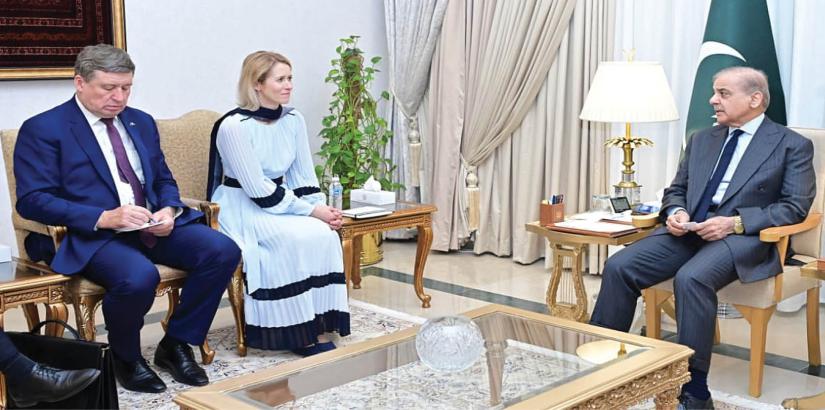
The visit of EU foreign policy chief Kaja Kallas to Islamabad on 1 June comes at a significant diplomatic moment. It follows growing international interest of Pakistan’s role in facilitating contacts between the United States and Iran during one of the most dangerous periods of regional escalation in recent years.
While Pakistan’s mediation efforts remain limited and the diplomatic process is still fragile, the visit suggests that both Washington and Brussels increasingly view Islamabad as a potentially useful interlocutor in managing regional crises.
Only Passing Mention of Kashmir
After a meeting with Pakistani foreign minister Ishaq Dar in Islamabad, Kallas told journalists that “Pakistan has been the main mediator between the United States and Iran. Your diplomatic efforts have helped to prevent a return to full blown war on several occasions, and these efforts are much recognised and appreciated across Europe.”
A joint press communiqué released after the Eighth Round of the European Union-Pakistan Strategic Dialogue on Monday made brief reference to the Kashmir issue saying “the Pakistan side briefed on the issue of Jammu and Kashmir. The EU side briefed on Russia’s war against Ukraine. Both sides expressed support to peaceful resolution of conflicts through dialogue and diplomacy, in accordance with the principles of the UN Charter.”
The reference to the Kashmir issue is politically significant despite its brevity. The limited treatment of a dispute that Pakistan regards as one of its core foreign policy priorities highlights the European Union's longstanding reluctance to become deeply involved in one of South Asia's most sensitive geopolitical conflicts.
For Pakistan, internationalising the Kashmir issue has traditionally been an important diplomatic objective. Pakistani leaders regularly seek support from international partners, including the EU, to draw attention to developments in Jammu and Kashmir and to encourage external actors to play a greater role in promoting dialogue with India. Against this backdrop, the absence of any detailed discussion or substantive EU commitment in the communiqué is notable.
Brussels has consistently viewed Kashmir primarily as a bilateral issue between India and Pakistan. While the EU supports dialogue, de-escalation, and respect for human rights, it has generally avoided endorsing proposals that could be interpreted as external mediation.
Second, the EU has strong incentives to preserve balanced relations with both Pakistan and India. In recent years, India has become an increasingly important partner for Europe in trade, technology, connectivity, supply-chain diversification, and Indo-Pacific strategy.
As Brussels seeks closer economic and strategic cooperation with New Delhi, it is unlikely to adopt positions on Kashmir that could jeopardise that broader relationship. Consequently, the EU often prefers to frame its engagement in terms of regional stability, conflict prevention, and human rights rather than the territorial and sovereignty questions that lie at the heart of the dispute.
Third, the brief reference to Kashmir reflects the limits of European influence in South Asia. Unlike in regions where the EU possesses substantial economic, political, or security leverage, Brussels has relatively few tools that could alter the dynamics of India–Pakistan relations. European policymakers are aware that any attempt to assume a more active role would likely encounter resistance from New Delhi while offering limited prospects for meaningful diplomatic progress. As a result, the EU tends to prioritise areas where cooperation is more achievable, such as trade, development, climate policy, migration, and regional connectivity.
Appreciation for Pakistan's Mediation Role
The timing of the visit of the EU’s top diplomat is important because it reflects a broader reassessment of Pakistan’s strategic value. For several years after the US withdrawal from Afghanistan, many observers believed Pakistan’s geopolitical relevance to Western powers had diminished
From a European perspective, Pakistan’s mediation role on Iran is particularly attractive because the EU has limited direct leverage over the conflict. Europe has strong interests in regional stability, uninterrupted energy flows, and preventing further military escalation, yet it lacks the coercive tools available to the United States and does not possess China's influence over Tehran.
Supporting diplomatic actors such as Pakistan therefore offers Brussels an indirect means of contributing to de-escalation efforts. Kallas’s visit can be interpreted partly as an effort to encourage and reinforce channels of dialogue that may help reduce regional tensions.
At a deeper level, the visit illustrates how middle powers are becoming increasingly important in a fragmented international system. Traditional crisis management has often been dominated by major powers, but growing distrust between leading powers has created greater space for regional actors to play mediating roles. Pakistan appears eager to position itself as one such actor, using diplomacy to enhance its international standing and demonstrate that it can contribute to regional stability rather than merely be viewed through the lenses of security challenges, terrorism, or political instability.
Nevertheless, Europe’s engagement remains cautious. While Brussels has welcomed Pakistan’s diplomatic efforts, it is unlikely to view Islamabad as a decisive mediator capable of resolving the underlying disputes between Washington and Tehran. Questions remain about the durability of Pakistan’s influence, the extent of its leverage over Iran, and whether diplomatic openings can survive broader geopolitical tensions.
Moreover, the EU’s relationship with Pakistan continues to be shaped by concerns over democratic governance, human rights, and regional security dynamics.
The significance of Kallas’s visit therefore lies less in immediate diplomatic outcomes than in what it signals about Pakistan’s changing international position. By recognising Pakistan’s role in the Iran crisis, Brussels is signalling that influence in today's international system is increasingly distributed across multiple actors, not concentrated solely in Washington, Beijing, or Moscow. This fits with the EU’s broader effort to develop a more autonomous and flexible foreign policy in a more multipolar world.
Broader Evolution of EU Foreign Policy
Trade, migration, climate , development cooperation, and regional stability have become increasingly important drivers of European policy. This has given Brussels greater scope to pursue an approach that reflects specifically European priorities rather than simply mirroring Washington's.
Nevertheless, US policy continues to exert considerable influence. On issues such as counterterrorism, nuclear proliferation, sanctions regimes, financial regulation, and relations with China, European and American positions often overlap. European policymakers frequently coordinate with Washington on security-related concerns and share many of the same assessments regarding regional threats. The transatlantic relationship remains a central pillar of European foreign policy, making complete strategic independence unlikely.
At the same time, important differences exist. The United States generally approaches Pakistan through a geopolitical and security framework, focusing on strategic competition, military cooperation, and regional power balances. The EU, by contrast, tends to emphasise economic integration, governance reform, development assistance, and human rights.
The divergence becomes particularly visible when US and European priorities differ. European policymakers have often been more willing to maintain engagement with Pakistan even during periods when US-Pakistan relations were strained.
The return of Donald Trump to the White House has further highlighted these differences. Trump's foreign policy has tended to favour transactional bilateral deals and a narrower definition of national interest. By contrast, the EU continues to frame its engagement with Pakistan within broader objectives related to multilateral cooperation, sustainable development, and regional stability. This creates situations where European interests may not fully align with US priorities, particularly if Washington reduces its focus on South Asia or adopts policies driven primarily by great-power competition with China.
Looking ahead, the key question is not whether the EU follows the United States, but how much strategic autonomy Europe can exercise in its engagement with Pakistan. As global politics becomes more fragmented and the reliability of American leadership becomes less certain, European policymakers have stronger incentives to cultivate direct relationships with regional actors. Pakistan's geographic position, growing population, and influence over developments in Afghanistan and South Asia make it a country that Brussels cannot afford to view solely through an American lens.
Economic considerations further underpin the relationship. The EU remains one of Pakistan's largest export destinations, while Pakistan continues to benefit significantly from the EU's GSP+ trade preferences. For Islamabad, maintaining strong ties with the EU is crucial not only for market access but also for attracting investment, supporting economic reforms, and reducing excessive dependence on any single external partner
Kallas’ visit also reflects a broader evolution in European foreign policy. As global politics becomes increasingly fragmented, the EU is seeking to expand its diplomatic footprint beyond traditional partners and engage more actively with middle powers.
Pakistan's growing diplomatic relevance stems not only from its size and strategic location but also from regional developments, including those related to Afghanistan, China, the Gulf states, and broader South Asian security dynamics.
However, closer cooperation does not eliminate longstanding areas of tension. Human rights remain one of the most sensitive aspects of EU–Pakistan relations. European institutions and policymakers continue to express concerns regarding freedom of expression, media independence, the protection of religious minorities, women's rights, and the use of certain legal provisions that have attracted international criticism.
Future EU-Pakistan relations will depend on whether both sides can develop a pragmatic framework that expands cooperation in areas of mutual interest while maintaining constructive dialogue on more contentious issues.
The significance of Kallas's visit lies precisely in this dual reality: it signals that Pakistan's strategic importance to Europe is rising, but it also highlights that deeper engagement will continue to be shaped by unresolved concerns over human rights, governance, and political reform.
(The author is an Indian journalist and long-time resident of Brussels who has been covering European and EU affairs for the past 40 years. Views expressed are personal. He can be reached at nawab_khan@hotmail.com. X: @NawabKhan10)




Post a Comment