

Why is Trump Betting Big on Pakistan? New Oil and Gas Finds Stir Regional Geopolitics
This is also the terrain through which the US 62 billion China-Pakistan Economic Corridor (CPEC) traverses, facing security threats from north to south, losing men and material in attacks by militants. That being the case, the US entry brings in another global player, ready to guard its interests against China’s looming presence. Is the South Asian region headed for a proxy war?
 Jun 15, 2026
Are India and Pakistan headed for an oil war in the desert terrain of Sindh and Rajasthan in the foreseeable future? As both the United States and China compete for Pakistan’s explorations near the Indian border, could this region, close to the Gulf conflict zone, also get impacted?
While the Chinese came in first, Pakistan's southeastern Sindh province is the latest on the American oil radar. This gets invariably linked to the ongoing Gulf war, where oil is the reason why the US has waged an all-out war against Iran , whatever its other stated goals. And oil is the reason, among many others, why he is wooing Pakistan.
Pakistan has launched a massive offshore energy exploration drive, awarding 23 blocks in the Arabian Sea. Several US companies are participating in these bidding rounds and production-sharing agreements, committing to multi-million-dollar investments across the Indus and Makran basins.
In March this year, explorations backed by Chinese partners, United Energy Pakistan (UEP), found large reserves of 47.98 million cubic feet of gas per day and 64 barrels of crude oil at the Shams-1 well in the Ghotki district of Sindh. It is barely 7 to 8 kilometres from the Indian border, opposite Jaisalmer (Tanot-Longewala zone). And in April, significant oil and gas reserves were found in Sanghar district of Sindh, abutting the border with India.
In August-September last year, well before the attack on Iran began, Pakistan identified significant deposits of oil and natural gas, both onshore and within its territorial waters. Experts now believe that this could be the world’s fourth-largest reserve.
India's Security Concerns
Whatever the role and intentions of the two biggies, India’s concerns arise from their proximity to the border, where it has been conducting its own exploration and extraction. While Sindh-Rajasthan is clearly demarcated, the border in Jammu and Kashmir is disputed and often the scene of conflict and cross-border movement.
Add to that, Sir Creek, the 96 km sea lane along the Gujarat-Sindh border. In dispute, it holds vast untapped oil and gas potential beneath the seabed.
While both nations possess substantial reserves in these contiguous geological formations, India has heavily commercialised its side, whereas Pakistan's exploratory focus has also shifted toward its deep-sea territorial waters.
India heavily exploits this border basin via the Barmer Basin and fields in Jaisalmer. Operated by Cairn India and ONGC, this region serves as India’s largest onshore crude oil hub. It actively produces over 175,000 barrels of oil per day (bpd), alongside major natural gas networks such as the Raageshwari field.
Due to the fluid, interconnected nature of the underground reservoirs, geological experts have highlighted trans-border resource migration. Pakistani energy analysts have noted that while Islamabad lagged in drilling its side of the Sindh border, India systematically extracted massive volumes from the shared geological ecosystem.
Trump Betting on Pakistan
In August 2025, US President Donald Trump announced a bilateral trade agreement with Pakistan, pledging that the US would help the country develop what he described as "massive oil reserves". He facetiously suggested Pakistan might even export oil to India in the future. Clearly, as baffled as much of the world, India was not amused by this suggestion.
Trump ignored widespread cynicism about past failures in Pakistan’s oil finds. He has apparently relied on the US Energy Information Administration’s (EIA) estimates of "technically recoverable" resources in Pakistan, “though high extraction costs often make them commercially unviable,” US reports say.
Following the initial announcement, British newspaper The Guardian cynically wrote, “Trump brags of ‘massive’ oil deal in Pakistan – but drilling has not found any.” Australia’s The Lowy Institute also expressed doubts. Pakistan’s own official statistics indicate only about 243 million barrels of proven oil reserves. Baffled Pakistani experts and former government ministers said that there is no reliable proof that Pakistan has any substantive, untapped oil reserves, despite years of the world’s biggest oil companies attempting to find them.
Everyone cited Pakistan’s record of oil wells going dry, and oil refining seriously constrained by a prolonged economic crisis. In November 20223, Shell Petroleum Company exited Pakistan, leaving the exploration and production activity largely to the Oil and Gas Development Company (OGDC).
But none imagined Trump’s economic push, ostensibly based on American assessment, and the latest reports may prove him right. Interestingly, Trump is willing to spend more to sustain the Pakistani oil find, considered heavy on investment by experts.
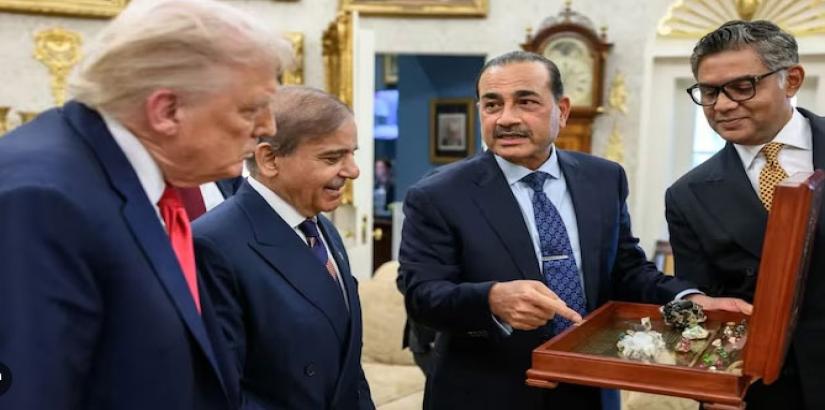
His aim to dominate the global oil market has prompted him to invest in Pakistan’s oil, and explains in part multiple hostings of PM Shehbaz Sharif and Field Marshal Asim Munir and the showering of superlatives on them.
Striking Oil Gold
With US support, in April this year, Pakistan launched output from its 'largest-ever' oil and gas well and now eyes $329 million in annual savings from its oil imports.
According to the OGDC, “The estimated daily revenue stands at PKRs156 million [$560,000], with monthly revenues projected at PKRs4.7 billion [$16.9 million] and annual revenues at PKRs57 billion [$204.7 million].”
The new oil find is in Khyber Pakhtunkhwa province. The Barakzai X-01 well, located in the Nashpa Block in Kohat district, is currently producing around 15,000 barrels of oil per day (bpd) and 45 million standard cubic feet per day (mmscfd) of gas, along with 15 metric tons per day of liquefied petroleum gas, following an initial injection of 5,300 bpd of oil and 17 mmscfd of gas.
Output is projected to rise to 25,000 bpd of oil and 60 mmscfd of gas in the near term, making it the highest-producing well in the country’s history.
Based on 2024 data, Pakistan already has proven reserves equivalent to 1.4 times its annual consumption levels. This means that, without imports, there would be about one year of oil left at 2024 consumption levels and excluding unproven reserves. It imports 85 per cent of its domestic requirement. The new find will add to its reserves.
Growing US Interest in Pakistan's Reserves
The US-Pak energy partnership coincided with the US granting Pakistan a favourable 19 per cent tariff rate on imported goods, significantly lower than the tariffs imposed on several other South Asian nations.
The US and Pakistan also signed a subsequent $500 million investment deal aimed at developing Pakistan's nascent critical minerals sector, including copper and rare earths.
Doubters of Pakistan’s oil quest rightly say that significant portions of the unexplored areas, particularly in restive Balochistan province, pose major security and logistical challenges for extraction.
This is also the terrain through which the US 62 billion China-Pakistan Economic Corridor (CPEC) traverses, facing security threats from north to south, losing men and material in attacks by militants. That being the case, the US entry brings in another global player, ready to guard its strategic interests against China’s looming presence. Is the South Asian region headed for a proxy war?
(The author is a veteran Indian journalist and contemporary affairs analyst. The views expressed are personal. He can be reached at mahendraved07@gmail.com)





Post a Comment