

Xi Jinping’s Loosening Leverage Over North Korea Amid Shifting Indo Pacific Security Dynamics
China in recent times has elevated some of its key bilateral relations, Vietnam, Pakistan, North Korea, to the level where they are now considered by Beijing as consequential to regional and global peace and stability. China’s foreign and 'grand strategy' is aimed at realizing a shared destiny for mankind and nurturing a new type of great-power relations within a multipolar world. This requires a strategic alignment between China’s strategy and others.
 Jun 11, 2026
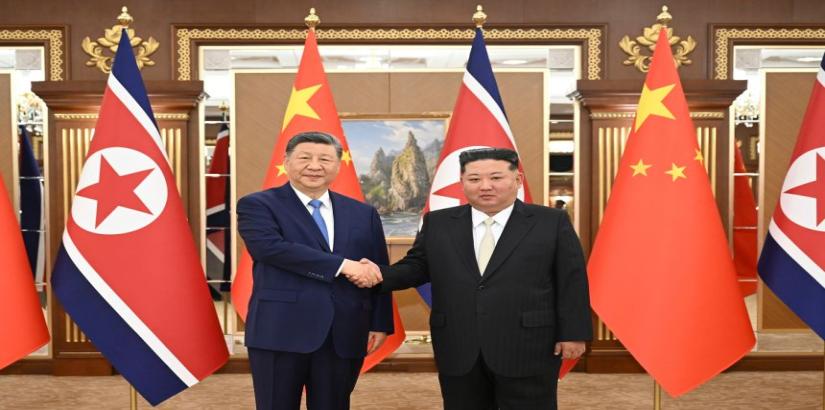
After hosting the heads of state of two great powers, the United States and Russia, within the international system, Chinese President Xi Jinping, general secretary of the Communist Party of China Central Committee, met Kim Jong-un, general secretary of the Workers' Party of Korea and president of the State Affairs of the DPRK in Pyongyang on 8-9 June. This year marks the occasion of the 65th anniversary of the conclusion of the DPRK-China Treaty of Friendship, Cooperation and Mutual Assistance.
Xi’s state visit to DPRK - after a gap of seven years - is a departure from what has come to be a norm in the conduct of Chinese diplomacy in recent years. Xi Jinping prefers meeting foreign heads of state at home and generally avoids traveling abroad as part of its "strategic culture". In 2025, Xi travelled to South-East Asia, Russia, Central Asia and South Korea and diplomatic exchanges with the US have been approached with conditions to establish China’s symbolic superiority.
According to a report published by the Korean Central News Agency (KCNA), Kim Jong-un described President Xi Jinping as the greatest state guest, and said that his visit to Pyongyang as the first foreign trip for this year is an expression of his “top priority” to the DPRK-China friendship as well as the most encouraging support to the Korean people. Kim Jong-un mentioned that his party and government will fully support the policy and stand of the Chinese party and government to defend the core interests on the "one-China" principle. According to some reports (KCNA), Kim Jong Un and Xi Jinping expressed satisfaction and deep emotion over the fact that they provided a “far-reaching blueprint” for the development of the relations. China's state-run Xinhua news agency, in particular, reported Xi as saying he had reached “an important consensus with Kim on developing China-DPRK relations in the new era".
During the talks, views on international and regional issues, issues for boosting the strategic coordination and cooperation between the two parties and two countries, firmly defending the sovereignty, security, development and interests of the two countries and jointly defending peace and development in the region and rest of the world in the complicated world political situation were exchanged and a “satisfactory consensus” of views was reached.
A Challenge for China's Grand Strategy
During the visit to the Friendship Tower, built by the North Korean government to honor the martyrs of the Chinese People’s Volunteer Army in 1959, Xi and Kim agreed to carry forward the great spirit of anti-Americanism. Nothing substantial may have emerged during Xi’s visit and much of the rhetoric remained familiar and symbolic.
Historically, the Korean peninsula is categorized as a tributary in the Chinese world view. However, this is simply not the case in given times. China’s relations with the DPRK remain a major source of challenge for Beijing, where Pyongyang is following an independent strategic policy in North-East Asia. Such a pursuit for strategic independence is not limited to DPRK, but an emerging trend in North-East Asia.
Japan Primary Concern for Beijing
Both South Korea and Japan are heading towards strategic independence given their doubts over US security guarantees. Previously, China condemned the 2006 North Korean nuclear test and approved United Nations Security Council Resolution 1718 (2006) and United Nations Security Council Resolution 1874 (2009) expanding sanctions against North Korea.
The primary concern for China is Japan which has declared its need for upgrading the US-Japan alliance to the level of US-UK alliance. Meaning, Japan may acquire nuclear weapons given North Korea’s growing capability in this regard. While Xi was in DPRK, Japan's Liberal Democratic Party's (LDP) executive council met on June 9 to approve a draft proposal on revising the country's three key national security documents, which refers to China's military development and the “surrounding security environment”, plans by NATO members to raise defense spending to 3.5 percent of GDP, and the need for a substantial increase in defense expenditures, while also calling for strengthening "counter strike capabilities”.
Xi’s opening remarks during the talks called for strengthening top-level planning and strategic guidance for China-DPRK relations in what China’s foreign policy establishment understands as the “New Era”. Such a call comes in the context of growing DPRK’s independent strategic policy bringing it closer to Russia.
Russia's Rapprochement with DPRK
According to Sungmin Cho, of the Center for China Analysis, deepening Russia–North Korea military cooperation stems in part from their own distrust of Beijing which maintains tactical ambiguity to avoid being drawn directly into the conflicts that Moscow and Pyongyang face with the West. For example, while Russia is directly supporting China’s military and combat objectives in its maritime periphery, China distances itself from directly contributing to achieving Russia’s military objectives in the European theater. Russia’s deepening rapprochement with DPRK, in the Chinese view, undermines the stability and strategic balance in North-East Asia.
China in recent times has elevated some of its key bilateral relations with Vietnam, Pakistan, and North Korea to the level where they are now considered by Beijing as consequential to regional and global peace and stability. China’s foreign policy and 'grand strategy' is aimed at realizing what it calls a shared destiny for mankind and nurturing a new type of great-power relations within a multipolar world. This requires a strategic alignment between China’s strategy and others. North Korea in this regard is crucial given its “geographic proximity”.
In the past, events in the Korean peninsula have derailed China from its strategic path. For example, it is now well recognized that China would have achieved its national objective of reunification if the Korean war had not broken out in June 1950. North Korea’s final decision to invade the South remained unknown to China for three days as it was the erstwhile Soviet Union that was at the helm of affairs then. China is unlikely to exercise any meaningful leverage over the Korean peninsula as it once did in the past; yet such a leverage remains crucial for China in the 21st century.
(The author is a Lecturer at Sichuan International Studies University, Chongqing, China and a Non-Resident Fellow at the Society for Policy Studies, New Delhi. Views expressed are personal. He can be reached at themayandischool@gmail.com )




Post a Comment