

China-Pakistan Boundary Commission Activation has Grave Regional Implications
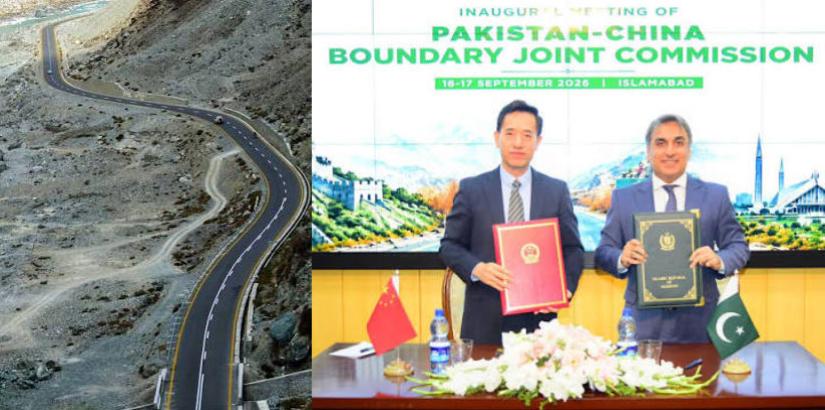
The Pakistan-China Boundary Joint Commission needs to be viewed in backdrop of the fast-changing geopolitics of South Asia and its military implications. The Shaksgam Valley sits immediately north of the Siachen Glacier and just west of Aksai Chin under China's control. By controlling Shaksgam, China can jointly monitor Indian military movements from the north while Pakistan does so from the south.
 Sep 23, 2026
The New Russia Sanctions Bill passed by the US Congress for 100% tariffs on countries buying Russian crude was viewed by cynics as a birthday present for Prime Minister Narendra Modi. The add on was Senator Richard Blumenthal warning India and China like a kindergarten teacher's helper in a punk school.
President Donald Trump has signed the bill.
However, with Beijing indicating it doesn't recognize US sanctions on Iran and Russia, Trump is breaking traditional protocol by personally receiving Chinese President Xi Jinping on the airport tarmac at Joint Base Andrews in Maryland on September 23.
Another emerging regional challenge - that seems to have gone quite unnoticed - is the operationalization of the Pakistan-China Boundary Joint Commission rooted in the 2013 Boundary Management System Agreement and the 1963 Sino-Pakistan Boundary Agreement involving the Shaksgam Valley. The Commission, formally activated at its Islamabad meeting earlier this month, is officially to handle boundary inspections, checkpoint upgrades, and transit security tied to the China-Pakistan Economic Corridor (CPEC).
Pakistan, which didn't share an international border with China, was provided one through British treachery post partition of India creating Pakistan-occupied-Kashmir (POK), including Gilgit-Baltistan (GB), after the princely state of Jammu and Kashmir (J&K) officially acceded to India in 1947. The 5,180 sq km Shaksgam Valley is in POK.
Fast-Changing Regional Geopolitics
On March 2, 1963, Pakistan and China signed the Sino-Pakistan Boundary Agreement under which Pakistan provisionally ceded Shaksgam Valley to China, laying the groundwork for constructing the Karakoram Highway in the 1970s. Today, this tract facilitates the multi-billion-dollar CPEC, part of China's monumental Belt and Road Initiative.
India views the 1963 Sino-Pakistan Boundary Agreement illegal and void since J&K and Ladakh are integral parts of India. Notably, Article 6 of the 1963 agreement stated that the handover was conditional, stipulating that once the Kashmir dispute between India and Pakistan is formally resolved, the sovereign authority would reopen negotiations with Beijing to sign a final boundary treaty.
As to the Pakistan-China Boundary Joint Commission, India maintains that Pakistan lacks legal authority to make border arrangements with third parties concerning illegally occupied territory.
The Pakistan-China Boundary Joint Commission needs to be viewed in backdrop of the fast-changing geopolitics of South Asia and its military implications. The Shaksgam Valley sits immediately north of the Siachen Glacier and just west of Aksai Chin under China's control. By controlling Shaksgam, China can jointly monitor Indian military movements from the north while Pakistan does so from the south.
Strategic Value for China
China's PLA has established military posts and infrastructure in and around Shaksgam Valley for monitoring the sensitive tri-junction area near Siachen Glacier. Intelligence reports and satellite tracking show at least two fully operational military posts inside the valley and a third military base under construction Recent intelligence confirms tunnelling under the 4,850-meter-high Aghil Pass.
PLA troops patrol the newly widened 75-km all-weather road in Shaksgam that links up north of the Karakoram (KK) Pass at Mazar to China’s G219 National Highway (Xinjiang-Tibet Highway). China is pushing the Shaksgam road network toward the Muztagh Pass to connect Yarkand in Xinjiang with Muzaffarabad in POK. This would bypass the KK Highway route, establishing a secondary overland axis to significantly boost China-Pakistani military interoperability.
Waters of Shaksgam River and its tributaries in Shaksgam Valley hold immense strategic value for China, serving as a vital freshwater supply and a critical hydrological choke point to anchor its presence in Xinjiang. Shaksgam River is a major tributary of the Yarkand River, the primary water source for the Tarim Basin in southern Xinjiang. Controlling the headwaters in the Shaksgam Valley ensures China has unregulated access to secure this downstream supply.
From a military logistics standpoint, controlling the Shaksgam River bed is essential for China's local troop deployments. Securing the water channels ensures China's 75-km military road remains operational year-round, allowing the PLA to sustain forward posts, move heavy armour, and maintain a permanent presence directly facing Indian defences in Siachen Glacier area.
The 76-km Siachen Glacier is the world's second-longest glacier outside the polar regions, second only to Fedchenko Glacier in Tajikistan. Melting waters of Siachen Glacier through Nubra and Shyok Rivers end up in the 3,180-km-long Indus River, sustaining the largest contiguous irrigation network on Earth.
China views water strategically because severe internal water scarcity threatens its economic survival. It eyes taking full control of Pangong Tso and, together with Pakistan, control the Siachen Glacier.
China-Pakistan Axiz
Intelligence sources and local political groups reported prominently in early 2012 that Pakistani secretly leased strategic land tracts in Gilgit-Baltistan to China for 30 years under which the PLA took direct charge of providing multi-tiered security for highly sensitive nodes, high-speed railway routes, strategic communication links, and complex highway expansions connecting Xinjiang to Pakistan.
Earlier on August 26, 2010, The New York Times had reported an influx of 7,000 to 11,000 Chinese into GB. Severe security concerns emerged over the building of 22 secret tunnels in restricted zones of GB. Though marketed as a pathway for future gas pipelines, intelligence analysts warn they are structurally designed to serve as concealed missile storage sites and heavily fortified military caches.
A permanent/semi-permanent PLA brigade-level presence in GB alters the geopolitical balance; strengthening the tactical China-Pakistan axis, heightening the long-standing threat of a synchronized two-front conflict along the Line of Control (LoC) and Line of Actual Control (LAC).
Reports In 2025 indicated Pakistan’s acquisition of China's advanced HQ-19 anti-ballistic missile system, engineered to intercept ballistic missiles and hypersonic glide vehicles. Deploying these systems along high-altitude nodes in GB and adjacent parts of POK allows China-Pakistan to build an integrated "kill chain". Earlier satellite imagery captured PLAAF heavy transport aircraft and advanced fighter jets practicing rapid-deployment drills at forward air bases in Skardu and Gilgit.
Finally, the CPEC through POK was established without reference to India and historically China has ignored promises and agreements. Hence, the China-Pakistan Boundary Commission permanently ceding Shaksgam Valley to China should be no surprise.
But that may not be all; some land tracts in GB-POK may be leased to China for 99 years, if not permanently, to locate a PLA formation.
(The author is an Indian Army veteran. The views expressed are personal. )





Post a Comment