

How Korean Noodle Brands Captured the Indian Market
The Korean noodle story is not really about noodles. It is about what happens when cultural influence travels faster than commercial infrastructure and faster than regulatory awareness. India's Gen Z - and possibly that of other South Asian countries - did not wait for brands to tell them what to eat. They watched K-dramas, did spice challenges, and built market demand that brands, regulators, and consumer education campaigns have simply not kept up with.
 Apr 08, 2026

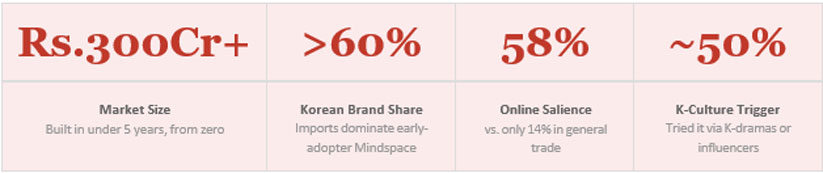
For decades, instant noodles in India meant two things - Maggi and Yippee. Together they controlled roughly 71% of national market share, a duopoly so dominant it had become invisible. Then Korean noodles walked in and carved out a Rs.300 crore sub-category in under five years, almost entirely through channels that legacy brands were not watching.
It was not retail. It was not TV ads. It was Instagram reels, hostel corridors, and the background of every K-drama dinner scene. The Samyang Buldak fire noodle challenge turned a foreign snack into a dare. Nongshim's Shin Ramyun became a hostel staple. And suddenly, shelf space that once belonged to Maggi started looking very contested.
A primary survey of 500+ urban youth (IIFT Team Kairos Case Study) confirmed the uncomfortable truth: media exposure not retail availability was the single biggest trigger for first trial. Gen Z did not discover Korean noodles at a supermarket. They discovered them on a phone screen, in a K-drama, in a reel. Culture preceded commerce.
The Noodle Battlefield
Here is the market as it stands. Three imported brands from South Korea and Japan control 75% of the segment. Every major Indian FMCG giant combined holds less than 20%:
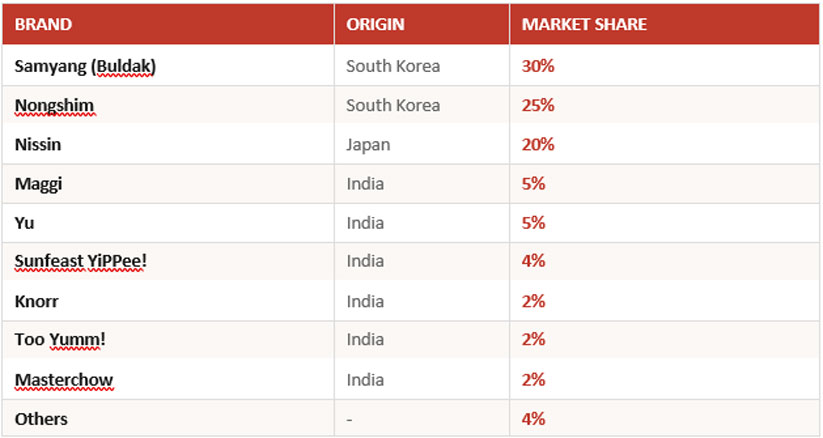
The most credible domestic entrant is Ching's, now under Tata Consumer Products priced at Rs.55- 99; it targets the price-sensitive follower segment that wants Korean vibes without the Rs.150+ import price.
But the strategic reality is blunt you cannot out-Korean the Korean brands. Samyang owns heat; Nongshim owns authenticity. The winning move has to come from somewhere else.
What the Label Doesn't Say
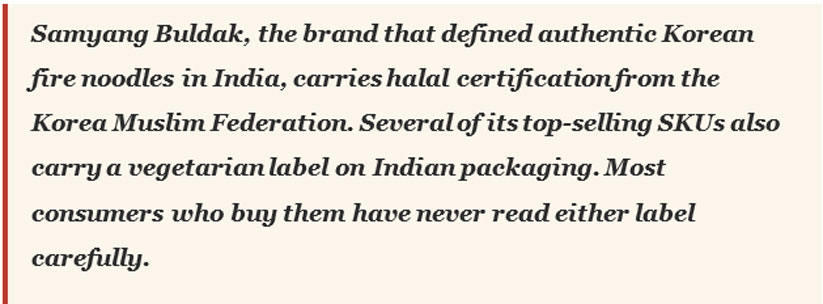
Here is the story that is not being discussed in any boardroom, any food blog, or any regulatory report - the biggest-selling Korean noodle brands in India are halal certified and many of them carry a vegetarian (green dot) label. A large number of Indian consumers - particularly Hindu consumers - have no idea.
What Halal Certification Means
Halal, in food manufacturing, refers to standards governing ingredients, processing, and handling that comply with Islamic dietary law. For instant noodles, this typically means no pork derivatives in the flavouring, no alcohol based additives, and processing that meets halal facility standards.
Samyang Foods obtained halal certification from the Korea Muslim Federation (KMF) one of Asia's most widely recognised certification bodies specifically to access Muslim majority export markets in Southeast Asia and the Middle East. This certification covers a significant portion of their product range, including many SKUs now sold in India.
Similarly, Nongshim holds halal certification for several Shin Ramyun variants. The certification is on the packaging but in small text that most Indian consumers are not reading.
The Vegetarian Label?
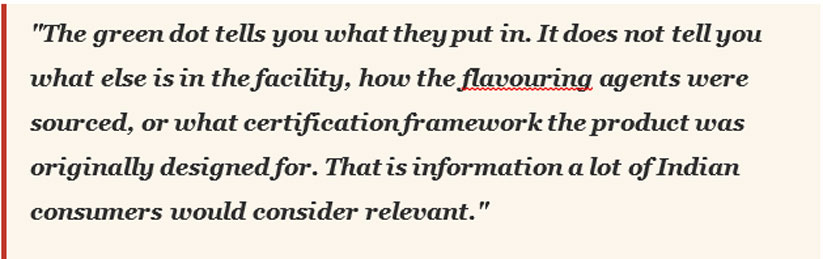
Under FSSAI regulations, all packaged food sold in India must carry a symbol indicating vegetarian or non-vegetarian status. Several Korean noodle products carry a green dot (vegetarian) label on their Indian packaging. This is technically accurate, in a narrow sense, as the base noodles and many broth flavorings are plant derived, with no meat, fish, or eggs as primary ingredients.
But here is what the green dot does not tell you and what most Hindu vegetarian consumers are not aware of: Many Korean instant noodle products are manufactured in facilities that also process meat and seafood. The green dot reflects ingredient composition, not facility segregation. Cross-contamination is a possibility the label does not address.
Halal Doesn't Equal Vegetarian
Halal certification and India's green dot vegetarianism are completely different dietary frameworks. Halal permits meat processed in a specific way. India's green dot indicates no animal derived primary ingredients. A product can be both halal-certified and vegetarian labelled but the two certifications answer entirely different questions.
Some additives and enzymes used in instant noodle flavor manufacturing may be derived from animal sources even when the primary protein ingredient is plant-based. These are not always disclosed in consumer facing labelling, and are not always caught by vegetarian certification processes designed for domestic Indian products.
Consumer Awareness Gap
The primary survey found that the vast majority of self-identified vegetarian Hindu respondents had never read the full ingredient list on their Korean noodle purchases. Most had assumed the product was equivalent to a domestic vegetarian product based on the front of pack green dot alone.
When the survey asked about certification and ingredient awareness among regular Korean noodle consumers:

The implication is significant: a large segment of the Rs.300 crore Korean noodle market is being sustained partly by a consumer awareness gap. Consumers are making purchase decisions based on front of pack signals that were designed for a different regulatory environment, without understanding what those signals do and do not communicate in the Indian dietary context.
What This Means for Market
For domestic brands, this is both a challenge and a genuine opportunity. Any Indian manufacturer entering the Korean noodle space has a structural advantage that imported brands cannot easily replicate the ability to build a product that is transparently, verifiably, and unambiguously suited to Indian dietary frameworks, whether that means fully documented vegetarian supply chains for Hindu consumers, or clearly certified halal options for Muslim consumers who currently find the imported range either inaccessible or confusing.
Ching's, as a Tata Consumer Products brand, has both the manufacturing infrastructure and the regulatory expertise to build products with this kind of labelling clarity. The question is whether the industry recognizes transparency as a competitive advantage or continues to treat it as an afterthought.
Bigger Than Noodles
The Korean noodle story is not really about noodles. It is about what happens when cultural influence travels faster than commercial infrastructure and faster than regulatory awareness. India's Gen Z - and possibly of other South Asian countries as well - did not wait for brands to tell them what to eat. They watched K-dramas, did spice challenges, and built market demand that brands, regulators, and consumer education campaigns have simply not kept up with.
India's food import ecosystem was not designed for the speed of the current cultural import wave. Products arrive, go viral, become staples and the frameworks for consumer information, regulatory oversight, and industry standards follow months or years later, if at all.
The brands that will win in this space are the ones that treat transparency as strategy. The next big food category will be built by an algorithm and amplified by creators. But it will be sustained by consumers who trust what they are actually eating and who have the information to decide for themselves.
(The author is an economics student specializing in Trade and Finance, South Asian studies, and international strategic affairs. Views expressed are personal. She can be contacted at gundaliyasneha7@gmail.com)







Post a Comment