

Fifty-Six Years on, Bangladesh a Nation Still Negotiating What it Means to be Itself
Bangladesh has survived partition, the liberation war, famine, floods, military coups, and democratic collapse. It has always returned. But returning is not the same as resolving. Fifty-six years after independence, the founding paradox remains: a nation whose birth is still debated cannot fully inhabit its future. The gun salutes will be loud and unambiguous. The questions they echo, however, about what Bangladesh is, who founded it, and whose vision should guide it, remain, as they have always been
 Mar 26, 2026
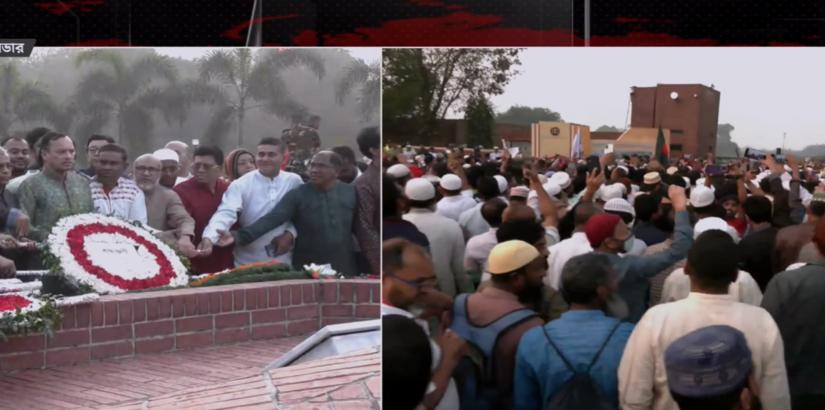
A nation is not born in a day; it is argued into existence across generations. As gun salutes roll across Dhaka and the national flag is raised to mark the 56th Independence Day on March 26, Bangladesh will commemorate the occasion carrying more than ceremonial weight. Nations age differently from human beings. A person of fifty-six stands well into middle life, their character largely settled. However, a nation of fifty-six is still young; its institutions may change, its regimes may fail, but its ethos and ideology endure from decade to decade, age to age. A nation’s spirit outlasts any political arrangement imposed upon it.
Bangladesh is a latecomer to the world of nation-states that, against all odds, has come of age. It became an independent country on December 16, 1971, seceding from Pakistan following a violent liberation struggle. Its independence also remains a singular political event in South Asian history, the only country in the region to emerge from a successful struggle against “internal colonialism”, while its neighbours achieved independence through negotiations between colonial subjects and British power since the wake of the Second World War.
Founding Debate Still Alive
The country, however, carries a distinct identity, perhaps unique in South Asia: it is probably the only country with a dialectical paradox at the very heart of its independence. The founding debate is not merely historical; it is alive, bitter, and unresolved. Who proclaimed independence first? Was it Sheikh Mujibur Rahman or Ziaur Rahman? The question has spilled from political platforms into intellectual discourse and schoolbooks, never settling into consensus.
Over decades, the binary has hardened into something structural: pro-independence versus anti-independence forces, Mujib versus Zia, secularism versus nationalism, Bengali Muslim versus Muslim Bengali, Bengali nationalism versus Islamism. And since August 5, 2024, these divisions have grown sharper still. The National Day celebrations are not simply a commemoration. They are a mirror held up to a nation still negotiating what it means to be itself.
The country is just forty days into Tarique Rahman’s premiership as the eleventh Prime Minister. The 13th Jatiya Sangsad election delivered a BNP alliance majority of 212 of 299 seats; the first verdict in over a decade described by international monitors as credibly competitive. The Bangladesh Awami League, the party of independence itself, sits absent from parliament for the first time since 1996. The July National Charter, endorsed alongside the February election by referendum, commits the new government to significant governance reforms: a bicameral legislature, prime ministerial term limits, and judicial accountability mechanisms that have never previously existed in practice.
On paper, it is the most democratic constitutional architecture Bangladesh has ever produced. What Independence Day cannot answer, and what the occasion’s solemnity quietly holds, is whether the political will to inhabit that architecture genuinely exists, or whether the BNP will follow the pattern its predecessor established: institutional reform as electoral language, and institutional capture as actual policy. The generation that dismantled the Hasina government in the streets of July 2024 is watching with the unsentimental scrutiny of those who have already paid the price of misplaced trust.
Severity of Inherited Challenges
No Independence Day address will dwell honestly on the severity of what the new government has inherited. Food and aggregate inflation heightened under the interim administration. The World Bank cut Bangladesh’s growth forecast for the current fiscal year to four percent. Factories shuttered between mid-2024 and mid-2025, pushing hundreds of thousands of workers into an informal economy that absorbs bodies but not aspirations. Bangladesh’s graduation from Least Developed Country status, the symbolic certificate of its development story, has been indefinitely deferred.
The readymade garment sector faces structural pressure from competitors across Asia and Africa. Successive governments have promised diversification into leather goods, light engineering, and information technology services with the conviction of a manifesto and the follow-through of a footnote. PM Rahman’s administration has repeated those promises. Meeting them is the real test of this anniversary year.
The most consequential foreign policy story of this Independence Day may also not feature in any official address. The “Bangladesh First” doctrine reflects a genuine sovereign instinct. Yet geography does not bend to political sentiment. Encircled on three sides by Indian territory, with the Ganges Water Treaty set to expire in December 2026, Dhaka must translate rhetorical independence into durable diplomatic outcomes.
Bangladesh has survived partition, the liberation war, famine, floods, military coups, and democratic collapse. It has always returned. But returning is not the same as resolving. Fifty-six years after independence, the founding paradox remains: a nation whose birth is still debated cannot fully inhabit its future. The gun salutes will be loud and unambiguous. The questions they echo, however, about what Bangladesh is, who founded it, and whose vision should guide it, remain, as they have always been, stubbornly, vitally alive.
(Dr. Dipannita Maria Bagh is editor and faculty at the Institute of Human Rights and Democratic Governance, Spring University Myanmar who has previously worked on Indian government projects to monitor election developments in Bangladesh. She can be reached at dipannitamariabagh@gmail.com. Tapas Das is an Assistant Professor of Political Science at Kandi Raj College, Murshidabad who is also a senior doctoral researcher at the Department of Political Science, Presidency University, Kolkata. His primary research focus is South Asian politics with a special emphasis on Bangladesh. He can be reached at dtapas319@gmail.com )





Post a Comment