

Jaish-e-Mohammed's Female Brigade: ISI-Backed New Jihadi Units Intensify Counterterrorism Challenges in South Asia
Unlike earlier jihadist cells dominated by Pakistani nationals, this unit deliberately recruits women from Indonesia, the Philippines, Uzbekistan, and other foreign countries. Reason behind recruiting non-Pakistani nationals serves a dual purpose: it complicates attribution and shields Pakistan’s security apparatus from direct accountability. Such operational sophistication reflects ISI’s continued role not merely as a passive enabler but as an active architect of jihadist adaptation.
 Feb 05, 2026
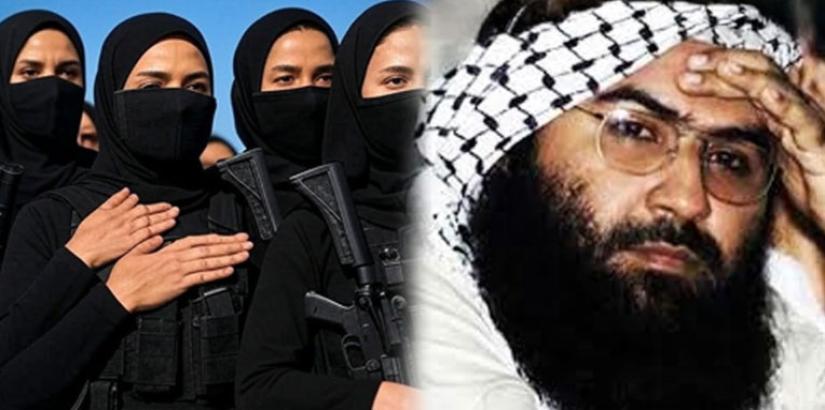
The emergence of female combat units within jihadist organizations has historically marked a turning point in militant evolution. Jaish-e-Mohammed’s recent decision to institutionalize a women-only wing represents precisely such a shift - one with profound implications for Indian, South Asian and global security.
Jaish-e-Mohammed, long recognized as a key component of Pakistan’s proxy warfare doctrine, has launched Jamaat-ul-Mominaat, its first formal female wing, under the supervision of Pakistan’s Inter-Services Intelligence (ISI). Intelligence assessments suggest this move is driven by operational necessity rather than ideological reform, aimed at expanding JeM’s strike capabilities beyond traditional theaters.
The wing was officially unveiled on October 9, 2025, at JeM’s Bahawalpur base. Since then, structured recruitment programs have targeted women through religious seminars, community gatherings, and online indoctrination courses. These initiatives blur the line between faith-based instruction and militant preparation, fostering loyalty before introducing operational roles.
Notably, JeM has revived branding associated with Dukhtaran-e-Islam, a female militant network that emerged in Pakistan-occupied Kashmir during the late 1980s. By re-appropriating this legacy, JeM seeks to normalize female participation in jihad while avoiding immediate scrutiny.
Enlarging Pool of Suicide Attackers
Parallel to this ideological push is the establishment of a special sabotage unit composed largely of foreign female recruits. This unit is reportedly tasked with conducting attacks in soft-target environments - hospitality and entertainment sectors - across South and Southeast Asia, the Middle East, Europe, and North America.
Unlike earlier jihadist cells dominated by Pakistani nationals, this unit deliberately recruits women from Indonesia, the Philippines, Uzbekistan, and other foreign countries. Reason behind recruiting non-Pakistani nationals serves a dual purpose: it complicates attribution and shields Pakistan’s security apparatus from direct accountability. Such operational sophistication reflects ISI’s continued role not merely as a passive enabler but as an active architect of jihadist adaptation.
In October 2025, Masood Azhar released a 21-minute audio address outlining how women would be trained, indoctrinated, and deployed as part of JeM’s long-term “global jihad” architecture. In it, he promised female recruits immediate entry into paradise - a grotesque manipulation of faith designed to erase fear and moral restraint.
On January 12, 2026, Azhar escalated the rhetoric further, boasting that JeM’s pool of suicide attackers is so vast that its disclosure would “shock the world”.
This is not idle propaganda. JeM’s history speaks for itself - from the 2001 attack on India’s Parliament to the murder of American journalist Daniel Pearl, and assassination attempts on Pakistan’s own former president Pervez Musharraf. The organization is designated a terrorist group by the UN, India, the US, the UK, Russia, Australia, and others.
JeM’s capacity for violence is not theoretical. Its record includes the 2001 Indian Parliament attack, the assassination of Daniel Pearl, and multiple assassination attempts against Pakistan’s own leadership. These actions have resulted in JeM’s designation as a terrorist organization by the United Nations and major global powers.
Financially, JeM has also modernized. Open-source intelligence points to increasing use of mobile payments, encrypted platforms, and cryptocurrency. Of particular concern is the exploitation of humanitarian crises - notably Gaza - as fundraising vehicles, masking extremist financing behind charitable rhetoric.
Terrorism Not Static
For South Asia, the rise of female jihad units introduces new layers of complexity in counterterrorism. Security protocols, intelligence profiling, and regional cooperation mechanisms must adapt quickly to address gender-based operational shifts.
The broader lesson is unmistakable: terrorism in South Asia is not static. It evolves in response to pressure, opportunity, and geopolitical complacency. Ignoring these transformations risks allowing old threats to re-emerge in far deadlier forms.
(The author is a journalist, writer, and editor-publisher of the Weekly Blitz. He specializes in counterterrorism and regional geopolitics. He can be contacted at salahuddinshoaibchoudhury@yahoo.com, follow him on X: @Salah_Shoaib )





Post a Comment