

Power, Influence and Covert Intervention in South Asia: Was Bangladesh Target of a Transnational Conspiracy?
Since August 2024, Pakistan’s military establishment, its intelligence apparatus, and associated actors—including Turkey’s MIT—have allegedly been involved in sending weapons and explosives into Bangladesh. These materials are believed to have ended up in the possession of pro-Yunus loyalist mercenaries as well as various extremist groups, including Ansar Al Islam, a local affiliate of Al Qaeda.
 Mar 29, 2026
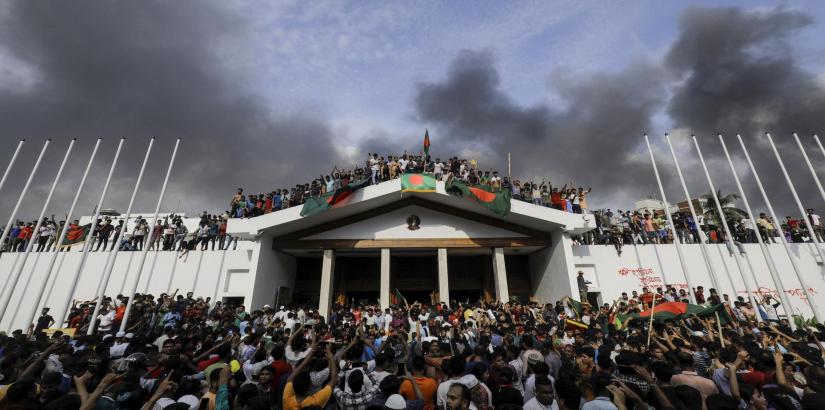
Asif Mahmud Shojib Bhuyain, one of the top lieutenants of Muhammad Yunus, who, following the ouster of Sheikh Hasina on August 5, 2024, told local media outlets that they had prepared for an “armed struggle” if Hasina had not been removed on that date, has now dropped what may be the most explosive revelation yet—disclosing details of an alleged conspiracy involving the US Deep State and Pakistan’s spy agency, the Inter-Services Intelligence (ISI), to keep Yunus in power at least until 2029.
Earlier, on October 20, 2025, a stunning revelation surfaced on social media. Asif Mahmud Shojib Bhuyain publicly announced the recruitment and training of 8,850 individuals across seven training centers. He detailed the program: trainees would undergo martial arts, judo, taekwondo, and firearms instruction. Within hours, screenshots of the post went viral—only to disappear shortly afterward.
At the time, multiple sources confirmed that this was only the first phase of a broader plan. At least five successive batches of 8,850 recruits each were reportedly scheduled to complete training by January 2026. The recruitment process allegedly included written, viva, and physical examinations, all overseen by retired Bangladeshi officers with strong pro-Pakistan leanings, alongside covert representatives of Pakistan’s Inter-Services Intelligence (ISI) and Turkey’s Millî İstihbarat Teşkilatı (MIT).
According to these sources, these were not ordinary security exercises. Selected recruits—both male and female—were reportedly being prepared for “advanced commando” and “espionage” training in Pakistan and Turkey. Intelligence assessments suggested that a portion of these operatives would later be deployed abroad—particularly in India, Nepal, and Myanmar, as well as in Western nations—to conduct subversive or intelligence-gathering missions.
Covert Launch of Revolutionary Militia
The seeds of what has been described as an “Islamic Revolutionary Army” were planted long before the October 20, 2025 revelation by Shojib Bhuyain. In December 2024, a radical group known as the Anti-Discrimination Student Movement—composed largely of student loyalists of Muhammad Yunus—publicly announced the launch of a militia under the same name.
A Facebook post by the group called on youths to gather at Dhaka University at 8 a.m. on December 20 for enrollment. The plan reportedly included a three-day martial arts session, followed by a month-long military-style training program “conducted by army and paramilitary forces”. According to insiders, the movement has allegedly been heavily funded by Western liberal financiers, under the guise of promoting “human rights and youth empowerment”.
In reality, critics argue that the group has evolved into a recruitment funnel for an ideologically driven militia. Its leaders openly advocate replacing what they call the “colonial army structure” with a “revolutionary defense force”, drawing comparisons to Iran’s Islamic Revolutionary Guard Corps (IRGC).
Investigations by Bangladeshi intelligence agencies reportedly revealed a clear pattern of foreign coordination. In November 2024, at least five officers from Pakistan’s Special Services Group (SSG)—traveling through Dubai and Qatar—allegedly entered Dhaka covertly to train IRA cadres. The SSG, headquartered in Tarbela, Pakistan, is widely known for its role in specialized military operations. Intelligence reports suggest these operatives conducted joint sessions with pro-Yunus elements and Islamist student leaders, focusing on guerrilla warfare, surveillance, and sabotage techniques.
Turkey’s MIT also appears to have played an active advisory role. Since Yunus’s political ascendancy, several Turkish “cultural exchange” and “educational cooperation” programs have quietly expanded in Dhaka and Chittagong—developments that observers believe may serve as a façade for broader intelligence-linked activities. The apparent coordination between ISI and MIT in Dhaka suggests a deeper strategic agenda: the possible creation of a proxy militia modeled on Iran’s IRGC, capable of projecting Islamist influence throughout the region.
Pakistan and Turkey's Role
Since August 2024, Pakistan’s military establishment, its intelligence apparatus, and associated actors—including Turkey’s MIT—have allegedly been involved in sending weapons and explosives into Bangladesh. These materials are believed to have ended up in the possession of pro-Yunus loyalist mercenaries as well as various extremist groups, including Ansar Al Islam, a local affiliate of Al Qaeda.
In December 2024, a senior leader of Pakistan’s ruling Pakistan Muslim League-Nawaz (PML-N), Irshad Ahmed Khan, stated on Indian television that arms had been shipped to Bangladesh concealed within commercial goods via Karachi Port. It was also reported that, following its assumption of office, the Yunus-led administration restricted Bangladeshi customs intelligence and law enforcement agencies from fully tracking certain cargo shipments arriving under the guise of agricultural machinery, spare parts, and chemicals—despite suspicions that such consignments could be used to smuggle weapons and explosives.
Such tactics bear resemblance to methods historically employed in Afghanistan during the 1980s, when arms were smuggled under civilian cover, financed through NGOs, and distributed via madrassa networks. Observers suggest that a similar architecture may now be re-emerging in Bangladesh—albeit with far more advanced digital coordination.
Startling Claim on Retaining Power
During a discussion meeting on December 26 at the central office of the National Citizen Party (NCP)—a political entity formed with the patronage of Yunus and his associates—Asif Mahmud Shojib Bhuyain made a striking claim. “When we were in government, in the early days we received offers from powerful institutions—what are often referred to as the ‘deep state’. They suggested that we complete the remaining tenure of Sheikh Hasina, which runs until 2029, and that they would support us in doing so”, he said.
Bhuyain further stated that these actors had “specific demands”, including facilitating their interests in certain areas. “They had even prepared a full roadmap. They argued that leaders of the Bangladesh Nationalist Party (BNP) had existing convictions, and if those remained in place, they would not be able to contest elections. These cases could be prolonged through court procedures—you know how that can be done, by repeatedly delaying hearing dates”.
He added that Tarique Rahman himself had a conviction, and had he remained convicted, even if elections were held in Bangladesh, he would not have been eligible to contest.
Asif Mahmud also claimed that strategies had been outlined on how to retain power. “It was framed as a kind of negotiation or understanding. But we did not agree to it. We consistently upheld democracy, and it was our commitment that ensured the election was held. In fact, to ensure the election would not be questioned, we voluntarily stepped down”.
Dangerous Geopolitical Axis
What emerges from these claims—if substantiated—is not merely a domestic political controversy, but the outline of a far more consequential geopolitical struggle unfolding within Bangladesh. The alleged convergence of foreign intelligence interests, ideological militancy, and engineered political outcomes raises urgent questions about sovereignty, democratic integrity, and regional security. Whether these revelations will trigger serious investigation or be dismissed as political rhetoric remains to be seen. But one thing is certain: the stakes extend far beyond Bangladesh’s borders, and the implications—if proven true—could reshape how the world understands power, influence, and covert intervention in South Asia.
(The author is a journalist, writer, and editor-publisher of the Weekly Blitz. He specializes in counterterrorism and regional geopolitics. He can be contacted at salahuddinshoaibchoudhury@yahoo.com, follow him on X: @Salah_Shoaib )





Post a Comment