

Putin’s Visit Shows How India Uses Multipolarity as a Shield, Not a Slogan
Putin’s 2025 visit to New Delhi was a strategic demonstration of India’s contemporary foreign policy, not a sentimental reunion. For India, multipolarity is a toolkit — a defense built on diverse partnerships, institutional investments, and internal resilience, not an abstract idea. Yet a shield can fail if it is brittle or hollow. To ensure multipolarity remains a durable defense, New Delhi must convert diplomatic goodwill into operational readiness by strengthening domestic supply chains, addressing payment and logistical gaps, and sustaining principled diplomacy that safeguards India’s international standing. Otherwise, multipolarity risks becoming a comforting phrase rather than real protection.
 Dec 10, 2025
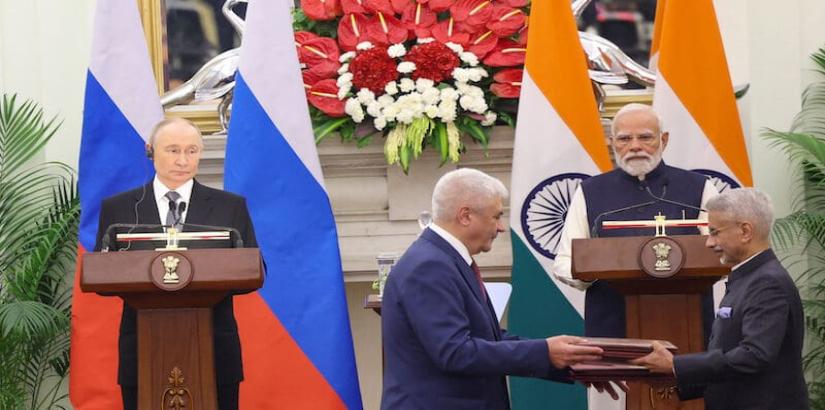
In December 2025, Russian President Vladimir Putin's visit to India — which included lengthy bilateral meals, ceremonial greetings, and several defense and economic agreements — appeared to be a reunion of long-standing friendships. Beneath the photo-ops, however, lay a more significant reality about India's current foreign policy: multipolarity has evolved from a rhetorical device to an operational cover for New Delhi. To protect strategic space, manage external pressure, and advance national goals without formal alignment, the visit crystallized a purposeful, instrumental use of multiple great-power engagements. This was more than Russia’s return as an old ally; it was India showcasing how to use global flux as a buffer and negotiating leverage.
Multipolarity As Strategic Shielding
The visit’s headline results were foreseeable but strategically significant: commitments to strengthen cooperation in fertilizers, nuclear energy, and shipping; agreements to expand trade beyond oil and defense; and a roadmap to deepen bilateral commerce. These agreements matter because they formalize diversity in suppliers, markets, and interdependencies — the practical logic of multipolarity for India. In a world where sanctions shape economic decisions and power is fragmented, India’s aim is not to pick a patron but to ensure no external actor can dictate its internal priorities. Thus, sectoral pacts and trade plans serve as instruments of resilience rather than mere commerce.
Energy diplomacy provided the clearest example of multipolarity as a protective tool. Putin’s public pledge of “uninterrupted” oil supplies to India — despite Western pressure and punitive measures against Russian energy — reflected a shared understanding: India needs dependable, reasonably priced energy to control inflation and sustain growth, while Russia needs buyers outside the sanctions-bound West. For New Delhi, the calculation is simple: ideological alignment is secondary to energy security. By maintaining ties with multiple suppliers, India reduces vulnerability to price shocks and geopolitical pressure. Practical exchange, not ideology, forms the core of multipolar shielding.
However, reducing India’s strategy to transactional opportunism would be a misreading. New Delhi adopts a nuanced approach to avoid overdependence on any partner. It seeks defense technology, investment, and Indo-Pacific security architectures from the United States; maintains nuclear and space cooperation, legacy defense supplies, and alternative energy and raw materials from Russia; and manages calibrated deterrence and trade with China. Achieving all of this simultaneously requires institutional buffers that convert political goodwill into durable policy options — economic corridors, payment systems, diversified defense suppliers, and multilateral forums. In practice, multipolarity becomes a parallel safety-net system.
Domestic Payoffs And Diplomatic Risks
Domestic politics shape this strategy. Indian policymakers must address two audiences simultaneously: a strategic community that values autonomy and a citizenry that prioritizes jobs, stable fertilizer imports, and lower fuel prices. Putin’s assurances on oil and fertilizer supplies carry political weight because they translate grand strategy into tangible benefits. This is critical: India’s multipolar posture is justified not only by non-alignment ideals but also by its ability to produce domestic gains that other partners cannot consistently provide. Thus, the “shield” narrative is both geopolitical and populist — preserving domestic economic stability while defending strategic choices.
Yet the shield is not impenetrable. India’s biggest risk in weaponizing multipolarity lies in reputational and transactional tensions with partners such as the United States. Washington has signalled its disapproval of India’s energy trade with Moscow by imposing economic sanctions; the tools now include diplomatic pressure and threats of punitive tariffs. So far, India has responded by asserting its sovereign right to act in national interest, articulating selective commitment to international norms, and using quiet diplomacy to manage fallout. This balancing act is inherently unstable, requiring constant policy sophistication and the ability to offer compensatory value to other partners. Using multipolarity as a shield, therefore, demands continuous diplomatic investment.
Economic diversification is only useful if supported by payment, logistical, and regulatory structures. While the visit expanded India–Russia ties beyond hydrocarbons, translating memoranda into functioning commerce requires shipping routes, investor protections, and workable payment mechanisms under sanctions. Investing in the institutional, financial, and logistical architecture behind multipolar engagement is a technical but essential task. Without it, multipolarity risks remaining a slogan rather than a safeguard.
Leverage, Realignments And Road Ahead
Putin’s presence also underscored leverage — a subtler but important strategic advantage. By signalling alternative options, whether in energy, defense diversification, or access to different economic blocs, India strengthens its negotiating position with every partner. This is not cynical brinkmanship but a logical way to maximize policy space in a fragmented international system. But leverage is costly: it requires India to remain sufficiently useful and unpredictable for partners to court rather than coerce it.
Longer-term global realignments must also be factored in. If the international system is indeed shifting toward greater multipolarity, India’s early diversification may yield major gains — entry into alternative supply chains, diplomatic weight in global forums, and protection from bloc-level coercion. But this potential depends on domestic governance, investment in hard and soft power, and readiness to assume responsibilities commensurate with India’s rising influence. Multipolarity is an active strategy that demands capacity; it is not a free insurance policy.
Putin’s 2025 visit to New Delhi was a strategic demonstration of India’s contemporary foreign policy, not a sentimental reunion. For India, multipolarity is a toolkit — a defense built on diverse partnerships, institutional investments, and internal resilience, not an abstract idea. Yet a shield can fail if it is brittle or hollow. To ensure multipolarity remains a durable defense, New Delhi must convert diplomatic goodwill into operational readiness by strengthening domestic supply chains, addressing payment and logistical gaps, and sustaining principled diplomacy that safeguards India’s international standing. Otherwise, multipolarity risks becoming a comforting phrase rather than real protection.
(The author is an Assistant Faculty member at Mody University of Science and Technology, with a background in international studies and MPhil and PhD degrees from Jawaharlal Nehru University, New Delhi. His research focuses on migration studies, foreign policy, and peacebuilding. Views are personal. He can be contacted at rajarshi.education@gmail.com.)





Post a Comment