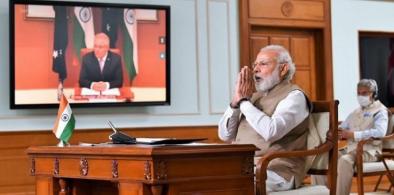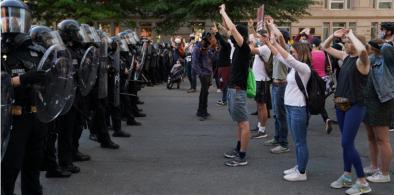
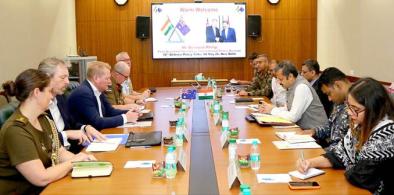
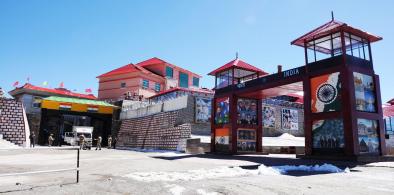
US Assistant Secretary of State S Paul Kapur meeting Sri Lanka President and Chinese officials meeting Sri Lanka party leadership

Colombo to Kathmandu, China Seeks to Counteract US Moves Across South Asia

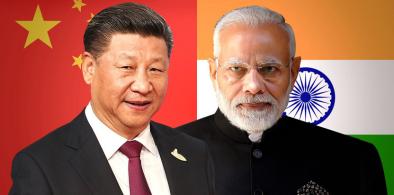
While Washington and New Delhi seek to strengthen bilateral ties with Colombo, Beijing has strategically engaged with the political forces that control the government. By engaging directly with actors at the core of Sri Lanka’s governance, Beijing appears to be signalling its strategic intent—projecting influence and reinforcing ideological ties. 

A Divided EU Faces Growing Scrutiny Over Taliban Contacts

Some analysts accuse the EU of double-standards arguing  that the EU has been condemning Taliban policies since they assumed power, but were now holding direct discussions with them. Such meetings undermine the EU's credibility as a defender of human rights and democratic values.

Sentenced to Silence? Mahrang Baloch’s Life Imprisonment Raises Uncomfortable Questions for Pakistan

Despite the narrative of the Pakistani state, Mahrang Baloch’s international recognition grew  through 2024.  Time magazine included her in its TIME100 Next list of emerging influential figures, citing her advocacy against enforced disappearances while the BBC named her to its 100 Women list. 

Seychelles' Importance to India: Modi Visit and Quest for Maritime Security and Stable Indian Ocean

Great powers realise the strategic value of small island states - refuelling facilities, logistics hubs, electronic listening posts, maritime surveillance nodes, diplomatic partnerships and access to vast EEZs. Their influence derives more from geographic position and political choice than from demographic size. Seychelles exemplifies this reality.

More on Geopolitics and Strategic Affairs

India should push for relocating WHO headquarters to New Delhi

This is a time when India should fashion itself as a new global health hub and provide global leadership in health. Pushing a new agenda for the WHO’s relocation from Geneva to India would make immense sense, writes Ram Krishna Sinha for South Asia Monitor

South Asia’s rubber farmers hit hard by COVID-19

From Bangladesh to India and to Sri Lanka, the natural rubbers producers are getting squeezed under lockdowns and social distancing. It is sounding the death knell of the region’s rubber economy,  writes K S Nayar for South Asia Monitor

Future challenge of banks: Bringing digital banking to the last man standing

Banks are generally very traditional in nature even though all the banks and financial institutions are going digital. Traditional nature change is again a challenge. The lockdown has come as a blessing in disguise as the changeover to digital systems can now pick pace, as it  becomes the need of the day, writes Ashim Kumar Goswami for South Asia Monitor 

Have Nepal's communists made it China’s proxy?

Indian policy towards Nepal has been lackadaisical. Belief of mutual Hindu traditions should be viewed in the context of power in Nepal lying with the communists for whom religion is anathema, writes Lt Gen P. C. Katoch (retd) for South Asia Monitor
Lessons from Cyclone Amphan: Need to rethink development strategy

The question that arises uppermost is that are we learning the right lessons from these recurring weather episodes or just concentrating  on immediate short-term disaster relief without taking any steps to make the regions ecologically sustainable and disaster resistant, writes Partha Pratim Mitra for South Asia Monitor

Will the sun shine again on Maldives tourism?

The coronavirus outbreak has hit the Maldivian economy hard, as travel restrictions and other preventive measures affected the country’s lucrative tourism industry, which contributes to the bulk of the island nation’s state revenue and foreign reserves, writes Kavita Bajeli-Datt for South Asia Monitor

A global partnership is needed to combat COVID-19

On April 23, 2020, in a virtual conference ‘Enhancing regional cooperation in South Asia to combat COVID-19 related impact on its economics’ organized by the World Economic Forum, Bangladesh PM Sheikh Hasina placed five-point proposals to combat this global crisis with collective responsibility and partnership from every society, writes Dr. Mohammad Tarikul Islam for South Asia Monitor

Can India and Nepal resolve border dispute with elephant in the room?

The Kalapani issue first came into prominence in 1997 when the Indian and Chinese governments came to an agreement to open a route for the annual Kailash-Mansarovar yatra through Lipulekh pass. Nepal objected to the use of Lipulekh, writes Shubha Singh for South Asia Monitor

Bihar's migrant crisis compounded by resource crunch and communication breakdown

Bihar is the poorest state of the country in per capita terms. Can it find the enormous resources required to fight the virus and its impact on the economy? writes Gulrez Hoda for South Asia Monitor

A territorial dispute with an actress caught in its midst!

The row between the two nations heated up when Nepal’s Communist Prime Minister K P Sharma Oli  on May 20 vowed before the country’s Parliament to reclaim the three “disputed areas” from New Delhi., writes Kavita Bajeli-Datt for South Asia Monitor

Job loss, hunger stalk South Asia in COVID-19 times

South Asia is home to over 1.8 billion people and houses half of the world’s impoverished communities, writes Aashish Kiphayet for South Asia Monitor

Honour killings continue in Pakistan: Feudal-patriarchal mindset still rules

Honour killing has been part of social traditions in Pakistan’s deeply conservative tribal society, but not confined to it. Killings have been reported in Lahore, Karachi and other places as well, writes Mahendra Ved for South Asia Monitor

In post-COVID-19, Kerala needs innovation in governance

There is a need for a radical attitudinal change in governance and also among Malayalees.  Skilling graduates, who are mostly unemployable, should be top priority, writes K S Nayar for South Asia Monitor

India needs to keep up its assertive stance against terrorism

The shift in the approach towards terrorism is mildly indicative of India's assertive and uncompromising stance in dealing with terrorism, writes Jay Maniyar for South Asia Monitor

Whither self-reliance in defence hardware? Need for complete revamp of India's DTIB

India’s political establishment seems to have utterly failed to appreciate the need for self-sufficiency in military hardware. Consequently, no roadmap or grand strategy has ever been drawn up, for attaining autonomy in defence-production, writes Admiral Arun Prakash (retd) for South Asia Monitor