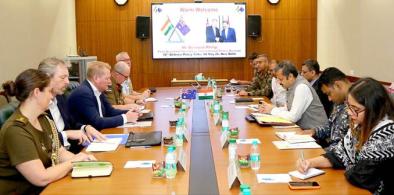
US Assistant Secretary of State S Paul Kapur meeting Sri Lanka President and Chinese officials meeting Sri Lanka party leadership

Colombo to Kathmandu, China Seeks to Counteract US Moves Across South Asia

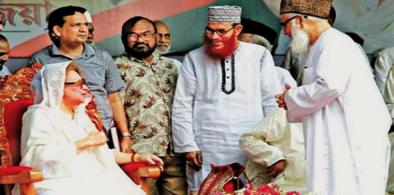
While Washington and New Delhi seek to strengthen bilateral ties with Colombo, Beijing has strategically engaged with the political forces that control the government. By engaging directly with actors at the core of Sri Lanka’s governance, Beijing appears to be signalling its strategic intent—projecting influence and reinforcing ideological ties. 

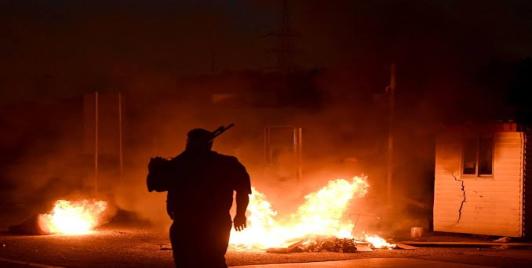
A Divided EU Faces Growing Scrutiny Over Taliban Contacts

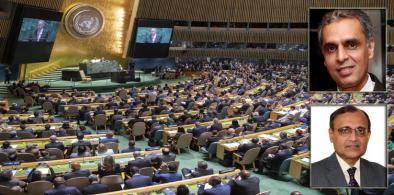
Some analysts accuse the EU of double-standards arguing  that the EU has been condemning Taliban policies since they assumed power, but were now holding direct discussions with them. Such meetings undermine the EU's credibility as a defender of human rights and democratic values.

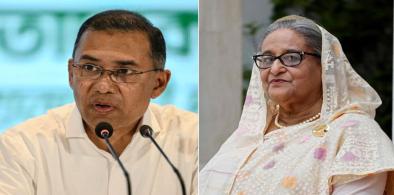
Sentenced to Silence? Mahrang Baloch’s Life Imprisonment Raises Uncomfortable Questions for Pakistan

Despite the narrative of the Pakistani state, Mahrang Baloch’s international recognition grew  through 2024.  Time magazine included her in its TIME100 Next list of emerging influential figures, citing her advocacy against enforced disappearances while the BBC named her to its 100 Women list. 

Seychelles' Importance to India: Modi Visit and Quest for Maritime Security and Stable Indian Ocean

Great powers realise the strategic value of small island states - refuelling facilities, logistics hubs, electronic listening posts, maritime surveillance nodes, diplomatic partnerships and access to vast EEZs. Their influence derives more from geographic position and political choice than from demographic size. Seychelles exemplifies this reality.

More on Geopolitics and Strategic Affairs

Has BJP lost touch with India's masses?

The pandemic has revealed the Jana Sangh-BJP’s basic faultline which marks the breach between the affluent and the non-trader lower castes and the lower middle and working classes, writes Amulya Ganguli for South Asia Monitor 

Universal Basic Income is answer to the migrant labour crisis

With livelihoods suddenly coming to an end due to the lockdown, the option left for the migrant workers was to make a hasty retreat to their home towns. The presence of some form of Universal Basic Income (UBI) could have mitigated their uncertainties to a certain extent, writes Partha Pratim Mitra for South Asia Monitor

Its Modi’s moment to transform rural India with reverse migration

This is Modi’s moment to transform India. He has the ability to not waste this opportunity to make the migrants stay in their safe homes and not allow them back to the cities., writes Rajendra Shende for South Asia Monitor

Kerala model: Praise abroad, concerns at home

Kerala certainly has reasons to be proud of its record so far and the praise showered on it is well deserved. But the real test is yet to come, writes Amb T. P. Sreenivasan (retd) for South Asia Monitor

No permanent friend or enemies: Need for India’s deeper and bolder engagement in Afghanistan

India is one of the key actors to have contributed to the post-war redevelopment of Afghanistan. So far, India has contributed USD 3 billion to it, which makes Delhi the largest donor to Afghanistan in South Asia and the fifth largest in the world, writes Chayanika Saxena for South Asia Monitor

A success story: Good leadership, timely responses help Bhutan contain COVID-19

Bhutan’s energetic and collective response under the personal leadership of King Jigme Khesar Namgyel Wangchuck helped to deal with the crisis. Bhutan has the advantage of both the Prime Minister Lotay Tshering and Foreign Minister Tandi Dorji being medical doctors with a background of public health,  writes Shubha Singh for South Asia Monitor

Is India planning an operation in POK?

The Modi government is methodically trying to resolve the Kashmir issue, which is lingering since the partition of the Subcontinent in 1947. India and Pakistan have already fought three wars, including the Kargil conflict of 1999, on Kashmir, writes Jai Kumar Verma for South Asia Monitor 

Visakhapatnam gas leak: Need for stricter enforcement of labour laws

While in these difficult times when there is a need for more workers' protection,  relaxation of labour laws may not be in the overall interest of workers and there is a need for a rethink on the entire issue, particularly after incidents such as the Visakhapatnam gas leak,  writes Partha Pratim Mitra for South Asia Monitor

Sri Lanka's rise in strategic importance in Chinese geopolitical calculus

Major power interest in Sri Lanka despite the COVID-19 pandemic was noticed  earlier  this year when Russian Foreign Minister Sergey Lavrov, US Principal Deputy Assistant Secretary of State for South and Central Asia, Alice G Wells, and China’s Foreign Minister Wang Yi,  all visited Sri Lanka in January to hold bilateral talks with the Sri Lankan government, writes Lt Gen P. C. Katoch (retd) for South Asia Monitor

The power of social media: It can win or lose a war today

India's immediate neighbours, especially China, and its client state Pakistan, are conducting social media war against it. Countering them is a challenge, especially against opaque, digitally isolated China, writes   Lt Gen P R Kumar (retd) for South Asia Monitor

Democracy in Nepal is under threat

The present regime in Nepal has been blamed for attempting to push through several controversial bills, including the Media Council Bill and Information Technology Bill, among others. The intention and some provision of the bills are against the basic notion of democracy, writes Ravi Nayak for South Asia Monitor

Aurangabad tragedy a scar on the Indian consciousness: Migrant workers need more State empathy

The 2011 census had revealed that India has as many as 453 million internal migrants and this includes both inter-state migrants and those within each state.  Absent credible national data for the last few years, some studies have suggested that this figure may now be in excess of 600 million, writes C Uday Bhaskar for South Asia Monitor

Bangladesh lowest in press freedom rankings in South Asia

Bangladesh ranked the worst position in any country in South Asia. Even it’s worse than war-ravaged Afghanistan, which has been placed at 122, Pakistan (145), India (142), Sri Lanka (127), Nepal 112, Bhutan (67), and Maldives (79), writes Aashish Kiphayet for South Asia Monitor

India needs to hit Pakistan economically; carry out limited military operations

With Pakistan in an economic mess more should be done to hurt its economy. Limited military means to do so remains a viable option, with all other unstated options open, writes  Lt Gen Syed Ata Hasnain (retd)  for South Asia Monitor

Bangladesh's paradox of reopening its garment industry: Time to end dangerous working conditions

Considering the working environment and densely populated area combined with shabby living conditions of the workers, Dhaka and its neighboring districts of about 2.87 million people could be the next hotspot of the coronavirus outbreak, write Dr. Mohammad Rezaul Karim and Dr. Mohammad Tarikul Islam for South Asia Monitor