

AI Encounters in Indian Higher Education: In Search of Humans in the Loop
Considering the potential of AI in solving complex questions and generating contents in individual writing styles, institutions need to ask a few fundamental questions - what is the role of academia in ensuring that the learners are not being slaves to AI, but masters who are aware of the potential bias and hallucinations that has a huge impact on knowledge acquisition and dissemination? Should it be a social responsibility of higher educational institutions to ensure meaningful curriculum and assessment practices which make learners future ready in such a rapidly changing AI era?
 Feb 27, 2026
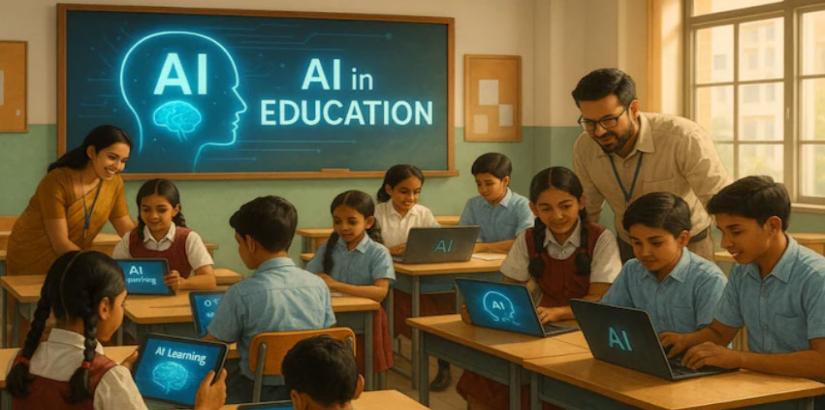
Artificial Intelligence, especially Generative AI, has made a huge leap in all walks of life including higher education. AI literacy has been recognised by Higher Educational Institutions (HEI) as a key competency required for learners. What do we mean by AI literacy? Is it only to know about the prompts to be given to generate data or does it also involve our ability to critically examine the data? Are we using it only for content generation/ gathering information ? This raises the question of how responsibly we are using AI and the ethical considerations to be addressed through institutional level AI policies.
AI integration in education offers personalized learning but risks cognitive offloading and reduced agency. In the context of artificial intelligence in education, agency is defined as a learner’s capacity to make intentional, informed, and autonomous choices, which is fundamentally underpinned by self-regulation, meta-cognition, and critical thinking (Favero et al., 2026). The uncritical adoption of AI tools presents significant risks that can erode a student's sense of self and independent action. Excessive reliance on AI leads to a state of cognitive offloading where students stop verifying information. LLMs are trained on existing datasets and they tend to provide the most statistically probable or normative answers. This nudges students toward standardized thought patterns and removes space for diverse interpretations that usually drive intellectual breakthroughs. The sheer convenience of AI-generated content can transform learning from an active construction of knowledge into a passive consumption of answers.
Agency of Students
The key argument here is the question of ‘agency’ of students - the right and ability of the student to be the primary architect of their own beliefs and knowledge and the ‘moral’ / ‘social’question on the responsibility of higher education in addressing this challenge. The ultimate goal of education should not be to optimize students for compliance with intelligent systems, but to prepare them to question, understand, and responsibly use those systems. What are the ways in which we, the humans in the loop, would be able to do this?
The Indian higher education ecosystem has taken up various projects to integrate AI across different academic disciplines including STEM subjects, Management and Liberal Arts. Dedicated centres and funded projects build a conducive ecosystem. Apart from this, higher educational institutions are also playing a crucial role in creating AI awareness among the public - like the Swayam pro course by IIT Madras as well as the AI Samarth initiative to provide AI literacy at school levels.
According to the FICCI-EY-P AI Adoption Survey 2025 based on responses from 30 institutions, 57 percent of Indian HEIs already have AI policy. On one hand, this is a small sample and there are no accurate details on how many institutions have it. On the other hand, the critical insight is to know how these AI policies are implemented at the institutional level. How do higher education institutions understand ‘AI literacy’ and design strategies to help their students and educators to have the competency? Although there is no universal definition of AI literacy, most definitions focus on four dimensions: functional literacy, ethical literacy, rhetorical literacy and pedagogical literacy.
Questions for HEIs
Although ethical /responsible use of AI has been a focus in all the policies, institutions need to bring in more clarity on how this would be addressed in the everyday learning environment. According to a survey conducted by the Digital Education Council (2024), among students from 16 countries 86 percent of students use AI tools but 1 in 2 students do not feel that they are AI ready. Are institutions exploring how their students use AI? Can the ethical use of AI be taught through a webinar or set of training or whether it should be embedded in the curriculum?
AI resistant assessments and plagiarism checking used to be the most popular ways of negotiating with AI use in higher education in the first phase. But addressing academic dishonesty through stricter measures and penalties will not create a safe learning space as trust building is essential. Now the thrust is on AI integrated learning and assessments where educators rely on more authentic assessments with AI as a collaborator. Here instructors decide and communicate the role that AI can play in learning and assessments.
Considering the potential of AI in solving complex questions and generating contents in individual writing styles, institutions need to ask a few fundamental questions - what is the role of academia in ensuring that the learners are not being slaves to AI, but masters who are aware of the potential bias and hallucinations that has a huge impact on knowledge acquisition and dissemination? Should it be a social responsibility of higher educational institutions to ensure meaningful curriculum and assessment practices which make learners future ready in such a rapidly changing AI era?
Role of Educators
From a social constructivist lens, higher education institutions are spaces where knowledge is emergent, negotiated and socially constructed. It requires a learning model which is non linear, iterative and emergent and thus the pedagogic goal extends beyond cognitive achievement. It requires teaching and learning and requires strategies that foster deep inquiry and critical thinking skills. The role of educators as facilitators becomes significant here. As one of the founding theorists in critical pedagogy Henry Giroux (2018) argues, educators need to be transformative intellectuals. They move away from being technicians who transact the curriculum. They focus on social justice and democratic change.
The discussions in the South should focus on the possible impact of AI on marginalized communities and the algorithms that silences regions and communities. Classrooms thus become contested spaces and not neutral spaces of instruction. Can higher educational institutions retain the essence of these practices in an AI-invasive learning space? Rather than having diverse policies and practices in isolation, higher education institutions can come together to debate on this responsibility of inculcating awareness on having ‘critical’ AI literacy in a meaningful way.
(The writer is an Associate Professor of Sociology and Coordinator of Teaching Learning Enhancement Cell at CHRIST (Deemed to be University), Bangalore. Views expressed are personal. She can be reached at maya.m@christuniversity.in/ www.linkedin.com/in/maya-m-b6968836)








Post a Comment