

Bangladesh's Strategic Balancing and India's Neighbourhood Challenge: China Will Consolidate Influence if New Delhi Fails to Deliver
In several neighbouring countries, including Bangladesh, Sri Lanka and Nepal, China has demonstrated an ability to move from agreements to implementation far more rapidly than many competitors. India, despite enjoying unmatched geographic and cultural advantages, has often struggled with delays
 Jul 24, 2026
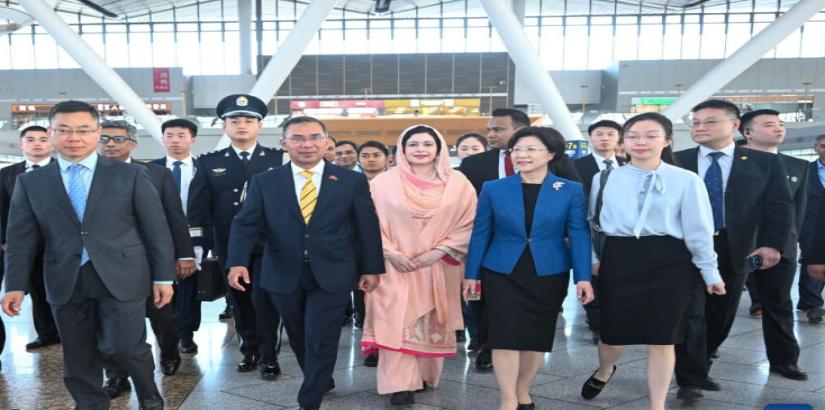
Bangladesh Prime Minister Tarique Rahman's visit to China from June 22 to 26 marks an important milestone in South Asian geopolitics. Beyond the optics of his decision to visit Beijing before New Delhi, the outcomes of the visit suggest that China and Bangladesh are moving towards a more structured and comprehensive strategic partnership.
The joint communiqué issued at the end of the visit announced the elevation of bilateral ties to a "Comprehensive Strategic Cooperative Partnership" aimed at building a "China-Bangladesh Community with a Shared Future in the New Era." It also outlined an ambitious agenda encompassing diplomacy, defence, trade, infrastructure, water resources, connectivity, education, and multilateral cooperation.
While the visit has understandably raised concerns in India, it should not be viewed simply as another chapter in the strategic rivalry between New Delhi and Beijing. Rather, it is a reminder that Bangladesh is pursuing its own national interests and that India's regional influence will increasingly depend on its ability to deliver, not merely on geography or historical goodwill.
India's Security Concerns
Among the agreements reached during the visit, two projects stand out because of their strategic implications for India. The first is China's support for the Teesta River Comprehensive Management and Restoration Project (TRCMRP), including assistance in completing its feasibility study. The second is the joint advancement of the Mongla Port Facilities Modernisation and Expansion Project alongside the development of a Chinese Economic and Industrial Zone.
These projects are located close to India's eastern frontier. The Teesta project lies near the Siliguri Corridor, the narrow stretch of territory connecting mainland India with its northeastern states, while Mongla Port is situated close to the Bay of Bengal, where China has steadily expanded its maritime footprint. Unsurprisingly, these developments have reinforced Indian concerns about the growing Chinese strategic presence in its immediate neighbourhood.
Yet focusing exclusively on the security dimension risks overlooking a more fundamental reality. Bangladesh did not suddenly discover China as a development partner. Beijing has spent nearly two decades steadily expanding its economic engagement with Bangladesh through investments in roads, bridges, railways, ports, power plants, telecommunications and industrial infrastructure.
China is Bangladesh's largest trading partner, its principal supplier of defence equipment and one of its biggest sources of development finance. The latest agreements therefore represent continuity rather than a dramatic policy shift.
A Partner Who Delivered
More importantly, many of these opportunities arose because Bangladesh perceived China as a partner capable of delivering projects more quickly and on a larger financial scale. The Mongla Port project illustrates this clearly. Bangladesh initially allocated land to India in 2015 for the development of a Special Economic Zone near Mongla. However, despite securing the project, India failed to begin implementation. Years of delays eventually prompted Dhaka to cancel the arrangement and invite Chinese participation.
Likewise, Bangladesh's growing openness to Chinese involvement in the Teesta River project reflects years of frustration over the failure to conclude the long-pending India-Bangladesh Teesta water-sharing agreement. Although New Delhi later proposed financing river management works, its initiative came after Bangladesh had already begun exploring alternatives.
This points to a broader lesson. China's growing influence in South Asia is not simply the product of its financial resources. It also stems from its reputation for timely implementation. Infrastructure projects are instruments of statecraft. Governments evaluate partners not only by the promises they make but by the speed with which they fulfil them.
In several neighbouring countries, including Bangladesh, Sri Lanka and Nepal, China has demonstrated an ability to move from agreements to implementation far more rapidly than many competitors. India, despite enjoying unmatched geographic and cultural advantages, has often struggled with delays arising from bureaucratic procedures, funding uncertainties and domestic political constraints.
Indian Indispensability Will Remain
The China-Bangladesh communiqué also signals an expansion of bilateral cooperation beyond infrastructure. The two sides agreed to establish a strategic dialogue between their foreign ministers and explore a 2+2 dialogue involving diplomacy and defence. They committed themselves to deeper cooperation in maritime affairs, scientific research, digital connectivity, green energy, disaster management and climate resilience.
China pledged continued support for Bangladesh's industrialisation and agricultural modernisation under the Belt and Road Initiative. Bangladesh, in turn, reaffirmed its support for the One China policy and welcomed China's backing for its participation in BRICS and its application to become a partner of the Shanghai Cooperation Organisation. Taken together, these initiatives indicate that the relationship is acquiring an institutional depth that extends beyond economics.
None of this necessarily means that Bangladesh is abandoning India. Contemporary international politics is increasingly characterised by strategic diversification rather than exclusive alignments. Medium-sized states seek to maximise opportunities by engaging multiple major powers simultaneously. Bangladesh is no exception. It depends on China for investment and infrastructure, but it also depends on India for trade, connectivity, energy cooperation, security coordination and access to its northeastern markets. Shared rivers, a 4,000-kilometre border, extensive people-to-people contacts and deep economic interdependence ensure that India will remain indispensable to Bangladesh irrespective of China's growing role.
Indeed, recent months have already witnessed cautious efforts to improve India-Bangladesh relations after a period of considerable strain following the political upheaval in Dhaka in 2024. Cross-border transport services have resumed, tourist visas are gradually being restored, and bilateral trade continues at substantial levels. India has supplied emergency fuel during periods of regional energy disruption, while both governments have resumed high-level diplomatic engagement. These developments suggest that neither side wishes to allow political differences to undermine broader strategic interests.
Need to Address Unresolved Issues
At the same time, unresolved issues continue to cast a shadow over the relationship. The Teesta water-sharing dispute, concerns over border management and illegal migration are some of these. Unless these issues are addressed with greater urgency, they will continue to create diplomatic space for external powers to expand their influence.
For India, the principal lesson from Rahman's China visit is neither to panic nor to dismiss its significance. It is to recognise that neighbourhood policy cannot rely on historical assumptions or expectations of automatic goodwill. Geography undoubtedly gives India enduring advantages, but geography alone does not guarantee influence. That influence must be sustained through timely delivery of infrastructure projects, responsiveness to neighbours' development priorities and respect for their strategic autonomy.
India's security concerns regarding Chinese involvement in projects close to its borders are entirely legitimate. Any expansion of Chinese commercial and technical presence near the Siliguri Corridor or along the Bay of Bengal inevitably carries strategic implications. However, the most effective way to address these concerns is not by objecting to Bangladesh's sovereign choices but by ensuring that India remains the preferred partner whenever opportunities arise. That requires faster project implementation, more competitive financing, greater policy consistency and stronger political engagement.
Broadening Strategic Options
Bangladesh's foreign policy under Tarique Rahman reflects a broader trend visible across the Global South. Countries increasingly refuse to choose between competing powers. Instead, they seek to derive economic and strategic benefits from all available partners while preserving their own autonomy. India itself has successfully pursued such a strategy in its relations with the United States, Russia, Europe and even China. It should therefore expect its neighbours to do the same.
Rahman's Beijing visit is thus less a story of Bangladesh moving away from India than one of Bangladesh broadening its strategic options. Whether China ultimately consolidates its influence will depend not only on Beijing's ambitions but also on New Delhi's performance.
If India can combine its natural geographic advantages with credible delivery, sustained diplomacy and greater sensitivity to the aspirations of its neighbours, it will remain an indispensable partner in Bangladesh's development. If not, China will continue to occupy the strategic space that India leaves unfilled.
(The author is an Associate Fellow, Manohar Parrikar Institute for Defence Studies and Analyses (MP-IDSA), New Delhi. Views expressed are personal. He can be contacted at anand_rai@hotmail.com )







Post a Comment