

Air Power and National Security: Strategic Choices that the Indian Air Force Needs to Make
Air power will remain central to national security. Whether India has enough of it, in the right form, and can afford it in scarce dollars, is still an open question. ACM Singh is to be commended for his distinguished service and stellar leadership – and more importantly – rendering objective professional advice to the apex leadership, an increasingly rare trait in the current times.
 Oct 15, 2026
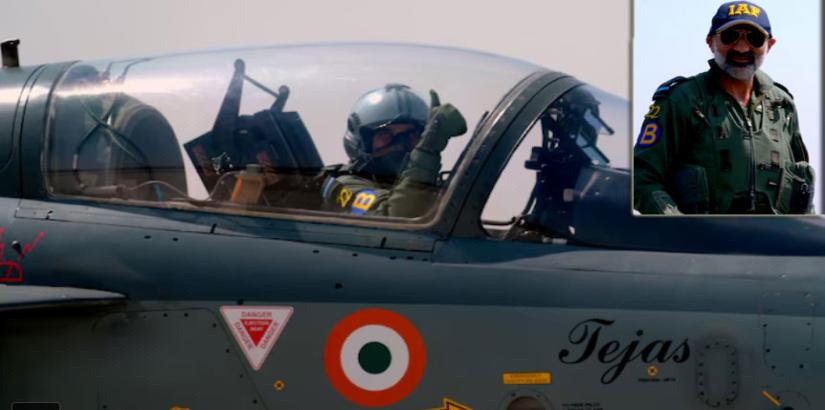
The chief of the Indian Air Force, Air Chief Marshal A P Singh, who superannuates at the end of October, flew his last fighter-jet sortie on an indigenous LCA (Light Combat Aircraft) Tejas on Oct 12.
A distinguished pilot who has flown more than 5,000 hours in different aircraft, Singh is also an accomplished test-pilot who validated the Tejas at HAL (Hindustan Aeronautics Limited) in Bengaluru in the critical design phase .
Air power is a critical element of India’s comprehensive military strength, and Air Chief Marshal AP Singh has often drawn attention to the challenges the nation must address if this capability is to safeguard national security.
The air chief used his final public appearances to state the obvious, and to state it in a candid and constructive manner.
On October 7, on the eve of the 94th anniversary of the Indian Air Force, he said the service was moving in the right direction, but the pace needed to be faster. On October 8, Air Force Day, at Hindon, he said what conflicts around the world have made clear: air power is the primary means of protecting national interests.
Narrowing the Inventory Gap
Between these two statements lies the abiding challenge to Indian air power today.ACM Singh hands over the IAF to Air Marshal Ashutosh Dixit, who will lead a force that has proved its operational worth but is structurally depleted. Fighter squadron strength, sanctioned at 42 for a two-front contingency, is down to 29–30 squadrons after the MiG-21 retirement.
At his annual press conference on October 3, Singh said plainly: delays hurt, and the IAF needs 36–40 fighters every year just to arrest the decline.
The LCA Tejas Mk-1A is the textbook case. The IAF has a contract for 180 aircraft - 83 ordered in February 2021 for Rs. 48,000 crore, first delivery due March 2024, plus 97 more cleared in September 2025 for Rs. 62,370 crore.Not a single aircraft from that first batch has been delivered yet. HAL has roughly 27 airframes ready, but has been waiting on engines.
That brings in the second vulnerability. The Tejas depends on the GE F404-IN20 from the United States. The first engine under the 2021 order arrived only in March 2025. HAL has now received 14 in total, after four more in September 2026, with a further 12 promised by December.
On October 7 Singh’s comment was telling: “We have come to a way forward, and now we are waiting for HAL to complete whatever has been promised.” This lapse was highlighted earlier in February 2025 when the slow pace of induction of the Tejas was flagged by him and he exhorted HAL to adhere to the delivery schedules that had been promised.
This is not just a supply-chain glitch but a potential strategic risk. At a time of geopolitical tension with Washington over tariffs and technology controls, dependence on a single US engine line for the backbone of the Indian fighter fleet creates uncertainty. It also underscores why co-production of the more powerful GE F414 in India for Tejas Mk-2 and AMCA, with a stated 80 per cent transfer of technology, should not be allowed to slip.
The other inventory gap that merits attention is helicopters. ACM Singh spoke mainly about fighters, but the helicopter gap is as stark, for both the IAF and the Army.
The Indian armed forces fly one of the world’s largest rotary fleets on paper, but it is ageing and accident-prone in the light utility segment. The French-derived Chetak/Cheetah fleet is of 1960s vintage and should have been retired a decade ago. Their replacement, the Ka-226T and HAL’s Light Utility Helicopter, has moved at glacial pace.
The Army and IAF together need over 400 light helicopters. In the medium lift, the Mi-17 workhorse, (over 220 in service), faces serviceability and spares issues linked to the Ukraine war. HAL’s Indian Multi Role Helicopter, meant to replace it, is still five to seven years away.
On the heavy and attack side, the inductions have been boutique, not bulk: 15 Chinooks and 22 Apaches imported from the United States. That gives the Indian military capability at a few bases, not mass across the Himalayas, where helicopters are not a luxury but the logistics lifeline.
The ALH (Advanced Light Helicopter) Dhruv grounding exposed how thin the margin is. After a fatal Coast Guard crash at Porbandar on 5 January 2025, the entire fleet of more than 330 was grounded. Army and IAF variants were cleared around May 2025; Navy and Coast Guard machines, operating in a saline environment where swashplate cracking was found, remained down into 2026 pending a fix.
A two-front war will not be fought by fighters alone. Without utility helicopters for casualty evacuation, troop lift and high-altitude supply, air power cannot sustain the ground battle.
The budget reality, modest in global terms, gets shrunk further in dollar terms. India’s defence allocation for 2026–27 was Rs 7.85 lakh crore ($ 85 bn) and about 2 percent of estimated GDP. Capital outlay on defence services was Rs 2.19 lakh crore ($23.9 bn)
Within that, the Aircraft and Aero Engine head , a cross-service category, not just the IAF’s exclusive capital share is about Rs. 63,734 crore ( $ 6.95 bn).
That rupee outlay is also shrinking in dollar terms. When the Tejas Mk-1A contract was signed in 2021, the rupee was in the low 70s to the dollar. Today (Oct 14) it is at 95 to the dollar.
Every GE engine, every Rafale, every S-400 spares package, every mid-life upgrade for the Mirage and MiG-29 is dollar-denominated. A depreciation of that order in four to five years is a cut in import purchasing power without a single paisa cut on paper.
For a force whose capital commitments remain heavily import-linked, that is a direct hit on air power.
How can this be redressed? ACM Singh hinted at the way out when he said the IAF has moved from platform-centric to capability-centric. That assertion demands a national security and military-capability rethink.
First, does India still need to chase the totemic 42 when the texture of air power is changing? Ukraine and West Asia indicate that the air war is no longer a classical fighter-led contest but a distributed, drone-saturated, missile-heavy one.
Low-cost drones, loitering munitions, long-range vectors and integrated air defence are reshaping combat mass.
Composite National Air Power
Operation Sindoor is instructive and Singh highlighted that the world saw the speed with which the IAF moved into combat with both its destructive power and air defence. It was not a pure air-force operation. Missile strikes had an Army artillery component as well.
Composite national air power, not IAF fighter squadrons alone, is what mattered. Acquiring sufficiency in that matrix means accelerating several tracks in parallel: Tejas Mk-1A induction to stem the inventory bleed; scaling HAL toward a sustainable rate of 20–24 aircraft a year; unmanned combat aerial vehicles and loyal wingmen for mass; and a dedicated push on helicopters — fast-track LUH induction, lease or emergency buy of medium helicopters.
Traditionally air forces have been built around the fighter, and India has invested in multi-role and advanced combat aircraft. The strategic challenge is to determine what kind of air-power platforms India will require over the next three decades, to 2056 at least. Aerospace power is technology-driven, and the rate of change is bewildering for the policymaker.
The final challenge is theatre commands. ACM Singh has been consistent, like his predecessors: the IAF is not against theatre commands and is committed to jointness, but India is not ready for a hastily implemented template.
After Operation Sindoor he said discussions had taken a slightly different direction. Air power is not an easily divisible asset to be parceled out; its range and speed give it theatre-wide effects. Any structure must preserve central orchestration.
Objective Professional Advice
Singh’s farewell was thus both reassurance and warning. The IAF is alert and ready, but technology delayed is technology denied. Getting back to the drawing board means fixing the engine pipeline, funding a helicopter recovery plan, accepting that a modest budget in dollars needs far more efficient rupee planning, and budgeting adequately for drones and autonomy.
Air power will remain central to national security. Whether India has enough of it, in the right form, and can afford it in scarce dollars, is still an open question. ACM Singh is to be commended for his distinguished service and stellar leadership – and more importantly – rendering objective professional advice to the apex leadership, an increasingly rare trait in the current times.
Once a fighter pilot, always a fighter pilot. Farewell ACM AP Singh. Blue skies and tailwinds as you embark on your veteran flight on October 31.
(The writer is an Indian Navy veteran and President, Society for Policy Studies, New Delhi. The views expressed are personal. He can be reached at cudayb@gmail.com)







Post a Comment