

Managing India--Border Tensions - and the 'New Normal'
It is an elegantly worded statement and impossible to disprove. It turns a dispute about differing LAC perceptions, acknowledged since 1993, into a story of Chinese compliance and Indian deviation. This is the new China that India must manage, not the old one.
 Nov 05, 2026
The Fifth Plenary Session of the 20th Communist Party of China (CPC) Central Committee concluded in Beijing on 29 October 2026, and a central military takeaway was the further reinforcement of absolute loyalty to the CPC, expressed through the persona of General Secretary Xi Jinping as core leader and chairman of the Central Military Commission (CMC).
Xi elevated political reliability—absolute party leadership over the armed forces and personal allegiance to himself as CMC Chairman—as a top priority for the PLA. Official messaging and subsequent PLA commentary stressed resolute fealty to the party supreme Central Committee, and Chairman Xi, along with the “Two Establishes” and “Two Safeguards.”
Experts note that when promotion and survival depend heavily on demonstrating political reliability, this incentive structure can encourage commanders to treat assertive operational behavior as a visible currency of compliance, potentially elevating political signaling over operational restraint.
Border Tensions a Reality
For India, the disputed LAC (Line of Actual Control) - the undemarcated de facto border - is an abiding challenge and some preliminary inferences from the Beijing deliberations merit review.
Prioritizing loyalty at the higher levels of the Chinese military (PLA) means that the probability of miscalculation and aggressive local action rises sharply — not necessarily by design in Beijing, but by incentive at the theatre level. In effect, India must prepare for a more assertive, less restrained PLA in the near future.
Recent developments related to the LAC in the Indian context are instructive. In a disquieting but unsurprising revelation (Oct 22), the same day that the CPC concluded, the Indo-Tibetan Border Police (ITBP) DG Shatrujeet Singh Kapoor stated that face-offs with PLA troops along the LAC have been continuing since July at several locations in Arunachal Pradesh and are ongoing.
He was referring to recent standoffs near Asaphila and Taksing in Upper Subansiri. Specific details about injuries or casualties have not been mentioned and both governments have sought to play down the incidents – but the military tension along the LAC is a reality.
This pattern of contested territorial claims along the unsettled LAC has a recent context that merits recall.
Beijing's 'New' Doctrine
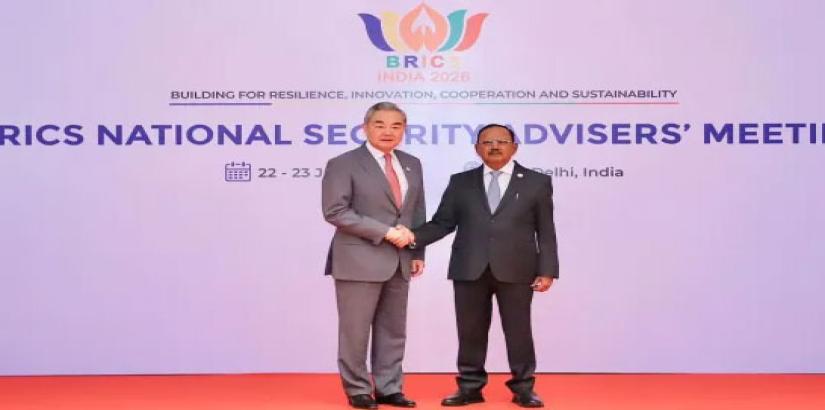
Two months ago in Beijing, China’s Foreign Minister Wang Yi told India’s National Security Adviser Ajit Doval what Beijing now calls "normal". On August 25, in the 25th round of Special Representative talks, the two sides announced an eight-point consensus. It was a rare joint statement.
First, maintain peace and tranquility along the LAC and stabilize bilateral relations. Second, advance boundary negotiations under the 2005 Agreement for a fair, reasonable and mutually acceptable settlement.
Third, two working groups to work on boundary delimitation and border management — to finalize Terms of Reference for an “Early and Substantial Harvest.”
Fourth, any ground situation to be addressed promptly through existing channels : WMCC (Working Mechanism for Consultation and Coordination), local commander meetings. Fifth, two new military hotline channels in the eastern and middle sectors and two new meeting venues.
Sixth, reopen three designated border trade points and expand the Kailash Mansarovar Yatra (Hindu pilgrimage). Seventh, an expert group on trans-border rivers in September. Eighth, hold 26th Special Representative (SR) talks in India in 2027.
Wang Yi’s framing in the Chinese readout was more political. He said the two sides positively assessed progress since the Kazan meeting between Prime Minister Narendra Modi and Xi; that peace had been maintained since the 23rd SR meeting; and that China-India relations “have transcended the bilateral scope and possess global and strategic significance.”
His consistent line: put the boundary question in its “proper place,” respect each other’s core interests, view each other as partners not rivals.
That is the new doctrine according to Beijing and it was tested as per the details provided by the ITBP chief. To his credit, DG Kapoor also offered some valuable policy suggestions about how India should respond.
The recommendations include drone platoons in every border battalion, Shaurya commando teams trained for Galwan-like battles, and underground bunkers along the LAC.
Asked about Kapoor’s remarks, Ministry of External Affairs (MEA) spokesperson Randhir Jaiswal on October 24 did not deny them. He said: “The situation in the India-China border areas gets disturbed from time to time when Chinese forces diverge from established patrolling patterns.” Peace and tranquility, he repeated, is essential for the development of ties.
Then came Beijing’s reiteration of Wang Yi’s consensus. On October 26, Foreign Ministry spokesperson Guo Jiakun said: “China strictly abides by the relevant agreements and common understandings reached between the two countries, and conducts normal border patrol and control activities to safeguard its territorial sovereignty and stability in the border areas. We hope that India will work with China in the same direction by jointly implementing the common understandings... and maintaining peace and tranquility... with concrete actions.”
Read together, Wang Yi in August and Guo in October convey the same Chinese message: We abide by consensus, we patrol 'normally', disturbance happens when India diverges.
It is an elegantly worded statement and impossible to disprove. It turns a dispute about differing LAC perceptions, acknowledged since 1993, into a story of Chinese compliance and Indian deviation.
This is the new China that India must manage, not the old one. The old assumption was that more hotlines and meeting points - like the two new hotlines agreed in Wang Yi and Doval talks - would prevent crises.
The new reality is that protocols can be followed in letter, while being violated in spirit. If the PLA sets up tents inside India’s perceived LAC near Asaphila, then calls it “normal patrol,” a hotline will only convey that message faster.
So prudent management of the LAC cannot be only diplomatic. It must be operational and technological.
Here the equivalence trap must be avoided. China has pursued large-scale military drone programmes, including AI-enabled swarm concepts and mothership platforms such as the Jiu Tian that can launch swarms mid-air. Its commercial drone industry is vast — running into the millions of units annually — and can be drawn upon under Military-Civil Fusion, while it continues to supply systems such as the Wing Loong II to Pakistan.
Open-source reporting has also pointed to ambitious orders for large numbers of one-way attack drones.
In contrast, India operates a fleet of dozens of MALE drones, primarily Heron variants, and has pursued additional Heron Mk II buys under emergency procurement after Operation Sindoor.
It has 31 MQ-9B on order since October 2024, with deliveries expected toward the end of the decade, and is working to scale domestic production of smaller platforms over the next two years.
Recent trends in drone warfare prioritise regeneration and integration: lessons from Ukraine and Iran that India has already internalised but must scale up and widen its tactical options.
First, make the LAC transparent by an innovative deployment of appropriate drone platoons, thereby providing near continuous surveillance data to the battalion commanders. Army Chief Gen Dhiraj Seth’s visit in late October to Joshimath and Mana, the very middle-sector meeting point agreed with Wang Yi, emphasised “greater technology integration, continuous capability enhancement and sustained operational vigilance”.
Second, invert the cost exchange. Ukraine has achieved high drone shoot-down rates not primarily with expensive SAMs but with guns, interceptor drones and EW. Iran’s Shahed model showed mass cheap drones can impose costs far beyond their price. India saw this in Operation Sindoor in May 2025, and Army Chief Gen Upendra Dwivedi said it validated the “operational utility of drones and loitering munitions” to “compress sensor-to-shooter cycle.”
Third, build for replacement, not for parade. India’s defence production hit Rs 1.78 lakh crore in FY 25-26 and private sector share was 24%, but engines and chips remain imported.
Shield Against Ground Intrusions
A 2024 internal audit found 400 Indian vendor drones with Chinese parts. Defence Minister Rajnath Singh’s line this year: “from mould to software, everything must be made in India” ought to become a zero-China-component mandate. A clear recommended target should be 200,000 low-cost loitering munitions per year by 2028 from MSMEs, not just state-owned defence industry assembly lines.
Wang Yi said China and India should “respect each other, understand each other, trust each other” and that relations “transcend bilateral scope.” That is the diplomatic frame India will have to live with until at least the 26th SR talks in 2027.
But trust cannot be built on a phrase - “normal patrol” that sanctifies one side’s patrolling while vilifying the other’s. The eight-point consensus is valuable for hotlines, pilgrimage and trade. It is NOT a shield against ground intrusions.
Managing this 'new China' means accepting Wang Yi’s consensus language in Delhi and Beijing, while ensuring Kapoor’s drone platoons, underground bunkers and guerrilla forces are ready in Taksing and Asaphila.
Peace and tranquility along the LAC, as both sides say, is essential. But it will be maintained not by statements about "normal patrols", but by enough autonomous eyes to see every divergence, and enough inexpensive drones and shooters to make it costly.
(The writer is an Indian Navy veteran. president, Society for Policy Studies, New Delhi and a leading security analyst. The views expressed are personal. He can be reached at cub.sps@gmail.com)







Post a Comment