

AI in Elder Care: Potential for Broader Social Transformation
For India, the opportunity is significant as its robust digital infrastructure and large demographic dividend can create a significant opportunity for adoption and deployment of Artificial Intelligence across sectors, particularly in the care economy. There is an ample room for the development of age-friendly products and services using AI innovation which are of scalable commercial value.
 Mar 25, 2026
The AI Impact Summit held in February 2026 in New Delhi showcased India’s ambitious trajectory of technological evolution. AI driven digital infrastructure across the fields of health, education and automation is increasingly seen as the fuel to India’s economic growth engine. Expansion of AI enabled services in the fields of data analytics, robotics, platform design and digital service management have opened new arenas of job opportunities for India’s thriving young population.
The care economy remains one less talked about area where AI could prove to be largely consequential. Strategic integration of AI-driven technologies and geriatrics can change the landscape of labour markets in India. It can potentially address the rising care needs along with creating new job opportunities. According to the International Labour Organisation report titled “Advancing decent work and the care economy: An essential component of social development” (2025), care work is crucial to build resilient labour markets and cater the needs of 2.3 billion people by 2030. The report further suggests that by 2035 care work could create 300 million decent jobs for both women and young workers.
Digital Economy and Care Services
As for India, the country has witnessed remarkable growth in its digital economy with a projected rise of 23.5 million gig and platform workers by 2029–30 (NITI Aayog). India’s gig economy which was mostly concentrated around ride-hailing and delivery services, is now expanding to household services as well. Online platforms like Urban Company, Pronto, Snabbit, Care24 etc are making daily chores easy for the families, but organised care services in elder care still remain a less attended aspect of the digital revolution in India. Demographic transition coupled with decreasing fertility rate (less than 2.0) and increasing life expectancy (more than 70 years), India’s elderly population is expected to translate into 104 million people, accounting for 19.5% of the total population by 2050 (NITI Aayog, 2024). Other socio-economic factors such as shrinking family sizes, growing urbanisation and separated generations due to job migration also contribute to the sharp rise in the demand for elderly care in India.
Traditionally the burden of care work in the Indian household is largely borne by the women, leading to unequal distribution of work. This is corroborated by the findings of the Time Use Survey conducted by the National Statistical Office (MoSPI, 2024), which states that the Indian female spends around 140 minutes in a day on unpaid caregiving activities, almost double the time spent by the male members of the same household. This has resulted in limited participation of women in paid employment.
The digital platforms have formalised the traditional informal feminised care sector in India. All the work ranging from cleaning to childcare or eldercare is now being managed through mobile applications rather than neighbourhood networks. On one hand digitisation has increased efficiency and convenience for households, but on the other hand this has also introduced new forms of labour control through opaque algorithms that allocate tasks and rating systems that determine future opportunities. In a society like India, where socio-economic factors are instrumental in determining one’s future prospects, the digitisation reinforce precarity particularly for women and other vulnerable populations.
AI in Elderly Care
But along with challenges, there is also a positive side of technological transformation. As AI takes over the world, it opens new avenues of jobs for the young population of India. Particularly, AI technology coupled with care systems have a lot to offer in terms of employment opportunities. There is a substantial demand for skill sets in the fields concerning software engineering, data science, robotics, user-interface design, digital operations and algorithm management.
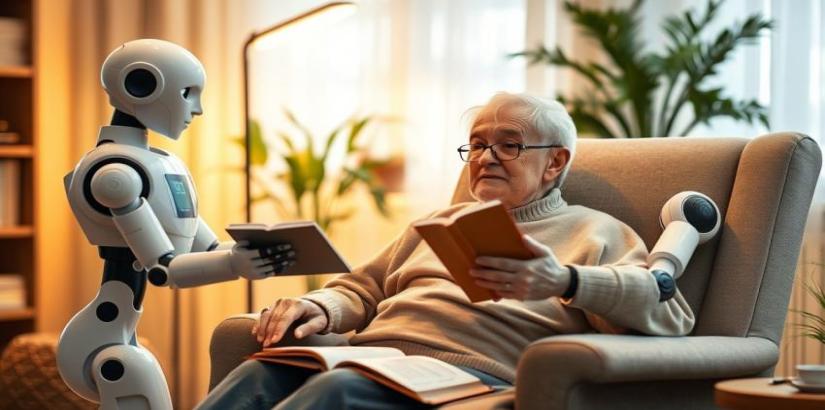
Internationally, there are examples - PARO Therapeutic Robot (robotic seal used in dementia care), Pepper Robot (social companion robot), Robear Care Robot (for lifting patients etc.) from the Southeast Asian and European nations who have successfully utilised assistive care robots and AI-enabled devices in their elderly care. These technologies have proved highly useful in combating the labour shortage and aiding the care givers in lifting the patients, monitoring their health indicators and support mobility.
For India, the opportunity is significant as its robust digital infrastructure and large demographic dividend can create a significant opportunity for adoption and deployment of Artificial Intelligence across sectors, particularly in the care economy. There is an ample room for the development of age-friendly products and services using AI innovation which are of scalable commercial value. This innovation potentially addresses the long-standing challenges in eldercare supply and demand. Traditional eldercare models requiring a compelling shift towards intelligent aging solutions can be smoothly facilitated through AI-driven digital technologies. This shift has led to the emergence of new service formats in care activities such as health management, intelligent companionship, elder finance, and cultural tourism, thus supporting the daily lives of older population and empowering the “silver economy”. AI enabled care ecosystem could thus provide significant career opportunities for both skilled young workforce in digital economy and workers seeking employment in care services.
Social Transformation Value
Therefore, devising a broader strategy regarding care economy is utmost priority for India. By combining technological innovation and social investment, India could expand its childcare and eldercare infrastructure. By investing in training and certification programmes for caregivers, and ensuring transparency and protections in algorithmic management, care giving profession could be formalised and made sustainable. While we are more focussed in start-ups as the strength of our digital revolution, a much more consequential transformation remains less discussed. Since AI-enabled care directly penetrates the society and households, it has a potential of broader social transformation - by filling the gaps in terms of demographic change, gender equality and youth employment.
(The authors are Assistant Professors in the Department of Humanities & Social Sciences at Jaypee Institute of Information Technology (JIIT), Noida, India. The views expressed are personal. Authors can be reached at vandanaa09@gmail.com or ilacps@gmail.com )





Post a Comment