

AI Impact Summit: Will Artificial Intelligence Eclipse Nature’s Wisdom?
AI is neither inevitable trauma nor guaranteed transformation. It is an amplifier. The Delhi summit must therefore convey Bharat’s civilisational wisdom — the natural intelligence systems that sustained life long before algorithms. The future of nature will depend not on how intelligent our machines become, but on whether humanity remains wise enough to align them with the only system that has sustained life for billions of years. Artificial Intelligence may dominate global conversation. But Natural Intelligence remains the foundation of survival.
 Feb 16, 2026
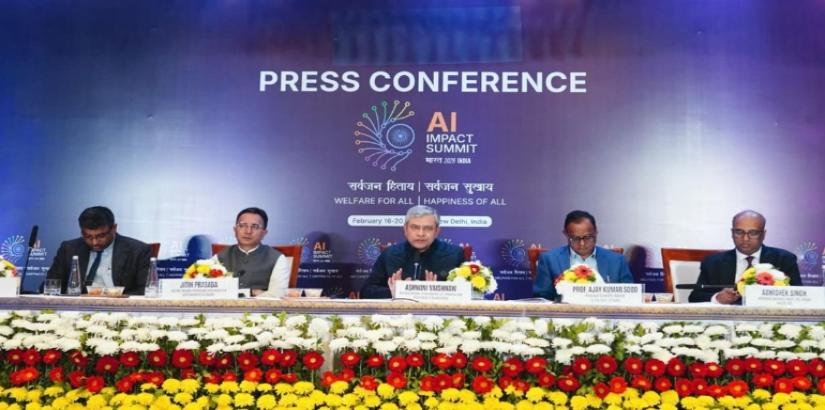
Artificial Intelligence has captured global attention with unprecedented intensity. Governments worldwide are investing billions. Corporations are restructuring strategies. Communities are preparing for adaptation. Universities are redesigning education.
India’s Global AI Impact Summit (16–20 February 2026) reflects this historic turning point. Humanity stands at the threshold of a technological transformation that will reshape economies, societies and governance systems.
Yet amid this excitement, a deeper and more fundamental question remains largely absent from public discourse: as humanity accelerates toward Artificial Intelligence, is it drifting away from nature’s intelligence that has sustained life on Earth for 4.5 billion years and survived five mass extinctions?
Nature’s Wisdom vs Artificial Intelligence
This question assumes critical significance as India hosts the 2026 global summit — the largest of the four such summits held so far. The Indian Knowledge System places wisdom above mere intelligence. It encompasses observations ranging from microbes to mammoths, teachings from mountains to meadows, and insights from rivers, forests and oceans. Human civilisation shaped science, philosophy, agriculture, yoga and the arts through sustained observation of nature over millennia.
In the race to lead the development of Artificial Intelligence in the 21st century, India must not forget the deeply rooted intelligence of nature that shaped its civilisational wisdom. The summit offers India a unique opportunity to present this foundational perspective, drawing from traditions such as the Vedas, while contributing meaningfully to global debates on AI governance.
The United Nations is attempting to address AI-related risks while harnessing its transformative potential through:
-
Developing globally inclusive and distributed governance architecture based on international cooperation;
-
Addressing gaps in current AI governance arrangements;
-
Protecting human rights in the context of emerging AI systems.
India can expand this discourse by bringing attention to what may be called the “planet’s rights” — the right of natural systems to maintain ecological balance and regenerative cycles. AI must not “chip in” to further destabilise the triple planetary crisis of climate change, biodiversity loss and pollution.
Silicon Valley in Delhi: Will Nature Get Equal Attention?
As technology leaders such as Sundar Pichai and Sam Altman gather alongside political leaders including Narendra Modi, Emmanuel Macron and Luiz Inacio Lula da Silva, will equal attention be given to nature’s wisdom?
Nature is not a passive ecological backdrop. It is the most powerful, durable and resilient intelligence system known to humanity. It has repeatedly demonstrated regenerative capacity after each of the five mass extinctions — the last occurring 65 million years ago when dinosaurs disappeared. Without global summits, conferences or algorithms, nature restored balance and sustainability.
Nature does not regenerate by recalling coded patterns as AI does. It adapts through resilience, diversity and regeneration. Indigenous civilisations developed ecological systems based on observing these principles. Sustainability did not begin with algorithms, but with attentive observation of natural cycles.
The exception has been the last 300 years since the Industrial Revolution. Human activity has destabilised the planetary balance achieved over millions of years. Artificial Intelligence arrives at this fragile and precarious moment. It offers extraordinary potential — but also profound risk.
AI can accelerate climate modelling, optimise energy systems, enhance environmental monitoring, and improve resource efficiency. It can empower policymakers, engineers and students to make informed sustainability decisions. Used wisely, AI could become humanity’s most powerful sustainability accelerator.
But AI also carries a paradox. Its rapid advancement commands attention, capital and ambition on a scale rarely seen before. There is a growing risk that humanity becomes so focused on building artificial intelligence that it neglects its relationship with nature’s intelligence.
If AI becomes an intermediary that distances humans from direct engagement with natural systems, the consequences could be severe. When humans stop observing nature, they stop understanding it. When they stop understanding it, they stop protecting it. And when they stop protecting it, they edge toward self-destruction.
Artificial Intelligence must enhance humanity’s connection with nature — not replace it.
There is also a fundamental distinction: AI optimises efficiency; nature optimises resilience. Efficiency improves short-term performance. Resilience ensures long-term survival.
Nature preserves biodiversity and redundancy to ensure adaptability. Technological systems often eliminate redundancy in pursuit of efficiency, making them vulnerable to disruption. The sustainability challenge demands resilience, not efficiency alone.
AI itself has an environmental footprint. Data centres consume vast amounts of electricity. AI hardware depends on rare-earth mineral extraction. Electronic waste is rising rapidly — from computers to EV batteries and solar panels. AI does not operate independently of planetary ecosystems; it draws energy and materials from them.
Ethical Imperative in AI Era
First, AI itself must become sustainable.
But the deeper challenge is ethical. Artificial Intelligence can generate answers based on patterns humans design. It can process information. But it cannot generate conscience. It cannot define responsibility.
The planetary crisis was not caused by lack of intelligence, but by lack of wisdom — by intelligent systems deployed without regard for ecological consequences.
This is where experiential education becomes critical. Universities must move beyond teaching sustainability as theory. They must become living laboratories where students use AI to measure emissions, manage energy systems, and implement real solutions. In the AI era, universities must evolve from centres of knowledge into hubs of action.
Artificial Intelligence should amplify human capacity, not dilute human responsibility. The ultimate goal is not artificial intelligence, but planetary intelligence — humanity’s ability to align technological progress with ecological stability.
AI is neither inevitable trauma nor guaranteed transformation. It is an amplifier. The Delhi summit must therefore convey Bharat’s civilisational wisdom — the natural intelligence systems that sustained life long before algorithms. The future of nature will depend not on how intelligent our machines become, but on whether humanity remains wise enough to align them with the only system that has sustained life for billions of years. Artificial Intelligence may dominate global conversation. But Natural Intelligence remains the foundation of survival.
Perhaps the real question is this: can AI stand not merely for Artificial Intelligence, but for Accelerated Implementation — implementation guided by conscience?
(The author is former Director, UNEP OzonAction; Coordinating Lead Author, Nobel Peace Prize–winning IPCC (2007); and Founder, Green TERRE Foundation. Views expressed are personal.)





Post a Comment