Back-To-Back Visits And Differential Access: Sri Lanka’s Clever Foreign Policy Balancing Between India And China
Some analysts are of the view that Sri Lanka’s differential access — full executive level for India versus foreign ministry level for China — may reflect Sri Lanka’s carefully calibrated foreign policy. Sri Lanka is leveraging India for urgent, high-impact assistance and wider policy coordination and engaging China for strategic reassurance and medium-to-long-term cooperative alignment that is less intertwined with immediate executive decisions.
 Jan 16, 2026
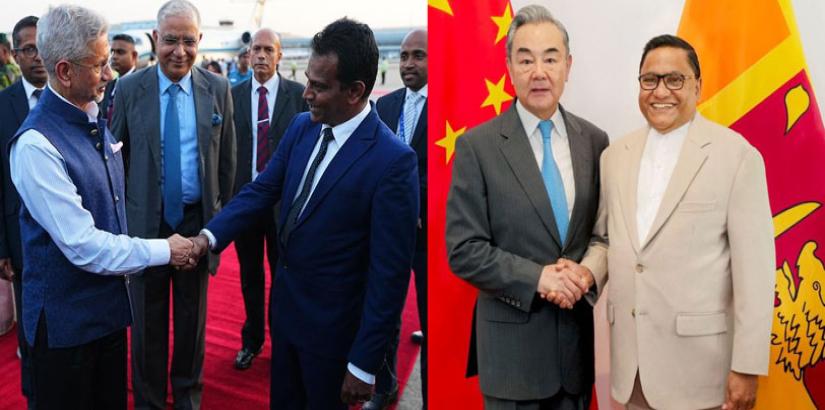
The nearly back-to-back high-level visits by India’s External Affairs Minister Subramanyam Jaishankar and China’s Foreign Minister Wang Yi to Sri Lanka in late December 2025 and mid-January 2026 respectively need to be viewed by focusing on their purpose, messaging, geopolitical context, and implications for Sri Lanka’s foreign policy. Sri Lanka strives to balance great-power relations with care and there is no secret that Colombo wants practical support and high-priority engagement from India, given geographic proximity and immediate logistical needs and, at the same time, needs to maintain strategic ties with China for longer-term infrastructure, economic cooperation and political support in multilateral forums.
Some analysts have questioned why Wang did not call on President Anura Kumara Dissanayake or Prime Minister Harini Amarasuriya, even though China and Sri Lanka had prior high-level engagements earlier, including the visit of a Chinese Communist Party delegation that called on both President Dissanayake and Prime Minister Amarasuriya. They claim that meeting only Foreign Minister Vijitha Herath, though diplomatically respectable, places Beijing’s messaging and commitments at the bureaucratic or mid-level policy channel rather than at the strategic executive level.
Contrasting Visits
However, high level sources pointed out that Wang Yi’s visit was a stopover and limited in scope. His discussions with Herath focused on bilateral ties, cyclone recovery cooperation, governance exchanges, people-to-people links, and reaffirmation of strategic partnership commitment. The visit, though brief, reaffirms deep strategic partnership and signals long-term cooperation spanning governance, economic ties, and diplomatic alignment.
In contrast, Jaishankar's visit was full-spectrum diplomatic engagement, defined by rapid humanitarian action and reconstruction commitments, underscoring Indian Prime Minister Narendra Modi’s Neighbourhood First policy and SAGAR programme that offered practical cooperation and a supportive role. Jaishankar met with all three top leaders, the President, the Prime Minister, and Foreign Minister as well as theOpposition Leader and Tamil leaders and conveyed India’s largest post-disaster support package of US $450 million, including grants and lines of credit.
India emphasized solidarity in crisis by appearing as a first responder and a long-term partnership beyond short-term relief. It also offered to strengthen economic cooperation and investment ties.
The almost back to back visits by the Indian and Chinese foreign ministers to Sri Lanka reflect a strategic confluence of humanitarian urgency and geopolitical diplomacy. Together, these visits showed how Sri Lanka, at the intersection of regional power engagements, was balancing short-term needs with long-term strategic partnerships.
Wang's Focused Meetings
Sinhala newspaper Mawrata commented that the inability of President Dissanayake and Prime Minister Amarasuriya to find time to meet the Chinese foreign minister was "most surprising”. It pointed out that former President Ranil Wickremesinghe had gone to the airport to meet the French and South African presidents during their transit halts in Colombo during his tenure and stated, “China is more important to Sri Lanka than France or South Africa”.
However, Wang Yi’s selective meeting pattern suggests a focused, less intrusive diplomatic touchpoint, likely calibrated to reaffirm ties without overwhelming Sri Lanka’s leadership while they are busy with crisis recovery. It signals continuity of strategic partnership without assuming immediate decision-making influence.
During the visit Wang Yi's emphasis on building a “China-Sri Lanka community with a shared future” and defending multilateralism and rights of developing countries — a broader diplomatic framing. By this visit, China signalled a continuation of its strategic cooperative partnership with Sri Lanka and willingness to support Sri Lanka’s recovery but framed within long-term diplomatic engagement, governance exchange and broader cooperation goals rather than emergency relief.
China’s long-term economic and strategic interests in Sri Lanka, including in infrastructure, investment, and political alignment, were reaffirmed by Wang Yi.
Jaishankar's Political Engagements
Jaishankar’s broader engagement underscores India’s deeper political and operational partnership, positioning New Delhi not just as a partner in rhetoric but an active collaborator with the highest political leadership of Sri Lanka. India’s approach, by engaging the top leadership, shapes short-term priorities and policy planning. Indian High Commissioner Santosh Jha’s continuous participation at various project implementation ceremonies and his speeches also confirms this policy.
China’s approach is likely a steady reinforcement of long-term strategic partnership, but not necessarily aiming for immediate positioning in key decisions on funding priorities, infrastructural planning, or security cooperation.
China’s limited direct engagement with Sri Lanka’s top executive could be intentional to avoid perceptions of Beijing's assertiveness during a sensitive recovery phase. A full-spectrum visit involving the head of state or government may be seen domestically or regionally as trying to exert undue influence in sensitive areas amidst a growing India–China rivalry in South Asia.
A limited, targeted engagement through the foreign ministry reinforces diplomatic continuity without escalation, keeping channels open while respecting Sri Lanka’s pressing internal focus.
India’s broader engagement, calling on all senior leadership as well as Opposition Leader Sajith Premadasa and a delegation of Tamil political parties plays to its strengths as the immediate neighbour with operational capacities to provide relief, reconstruction, and logistics assistance. India is signalling high readiness, operational depth, and political priority, reinforcing perceptions of it as Sri Lanka’s first responder and a principal strategic interlocutor.
China is signalling partnership without overcommitment - a ‘mild but solid’ diplomatic reinforcement of bilateral cooperation, aimed at longer-term political and economic alignment rather than immediate crisis support.
Calibrated Foreign Policy
Some analysts are of the view that Colombo’s differential access — highest political level for India versus foreign ministry level for China — is a reflection of Sri Lanka’s carefully calibrated foreign policy. Sri Lanka is leveraging India for urgent, high-impact assistance and wider policy coordination while engaging China for strategic reassurance and medium-to-long-term cooperative alignment that is less intertwined with immediate executive decisions.
India’s wide access and strong commitments position it to shape short-term policy directions and cement goodwill, while China’s engagement keeps it anchored as a key strategic partner without appearing to compete directly in leadership influence or domestic political agendas.
(The author, a former Sri Lankan diplomat, is a political and strategic affairs commentator. Views expressed are personal. He can be reached at sugeeswara@gmail.com.)