

Bangladesh and India: Charting a New Pathway Towards Inter-Dependent Relations
Our shared values should call for appreciating others’ needs, endowment and expectations. In the closest proximity as ours, should there be difficult or sensitive issues, those can – and ought to be – addressed forthright in all sincerity and candour, be in trade, security or sharing natural resources.
 Mar 29, 2026
Each year, on March 26, as Bangladesh celebrates its National Day, every Bangladeshi across generations pays homage to our freedom fighters for their bravery and supreme sacrifice made in the nine-month, bloody War of Liberation in 1971. We remember the women and men who withstood a genocide, for standing against the Pakistani occupying forces, merely to uphold their identity and dignity, their yearning for freedom and sovereignty. We remember so many across India who stood by us – emotionally, physically, materially – in West Bengal, Tripura, other parts of the North-East, and beyond. We remember so much of the support and succour provided to the young Mukti Bahini Force Commanders in India. We remember Major Ziaur Rahman for making the Declaration of War of Independence for the people. Not least the 1,668 Indian soldiers who laid their lives on our soil, for our freedom and justice.
Bangladesh and India share a unique and multi-dimensional relationship. Here are two large population who celebrate heritage in farming, weaving, craftsmanship, poetry, music, art. From Tagore to Nazrul, from Ritwik Ghatak to Satyajit Roy, from P C Roy to Satyen Bose, from Ustad Alauddin Khan to Pandit Ravi Shankar. Little do we note that Ravi Shankar’s Concert for Bangladesh turned global public attention to the ‘Bangladesh Liberation War’ from the ‘Civil War in East Pakistan’ frame!
All such portray our deeper human and cultural mosaic, replete with enduring oral history and practices. Within this vast multitude, one would see how syncretism and eclecticism define our people. So much so that our syncretic tradition ensures every citizen of Bangladesh lives and prospers freely, irrespective of one’s faith or belief.
Mutually Respectful Relationship
On 12th February, 76 million men and women in Bangladesh exercised their franchise, freely and fairly. The world witnessed a participatory and exceptionally peaceful transition to democracy in Bangladesh.
In the lead-up to the election, Indian External Affairs Minister Dr. S Jaishankar attended the funeral of late Prime Minister Begum Khaleda Zia in Dhaka. In Delhi, Defense Minister Rajnath Singh was here at the High Commission to pay homage to Begum Zia. Indian Lok Sabha Speaker Om Birla and Foreign Secretary Vikram Misri joined the new government's swearing-in in Dhaka.
In articulating the vision of the government – as Bangladesh First – Prime Minister Tarique Rahman reiterated commitment to maintain a pragmatic and mutually respectful and beneficial partnership with India for shared prosperity.
As we speak, both our countries navigate complexities and uncertainties in the global order. While we foresee tumultuous times ahead, Bangladesh looks forward to walk and work together to preserve the values and principles of open regionalism and multilateralism, for both as responsive and responsible nations.
It would be apt to share what Prime Minister Tarique Rahman conveyed to Prime Minister Narendra Modi last month.
“… Bangladesh accords high importance to its relationship with India, a partnership shaped by history, culture, and geography that we share. Our two people share considerable commonality and enjoy deep-rooted ties.
Our Shared Future
As our government embarks on a robust mandate, we look forward to advancing our ties and engagements with India, premised on dignity, equality, mutual trust and respect, and shared benefits. I do believe, if Dhaka and Delhi would address issues in ways that yield gains for the common people, there is so much that our two countries can accomplish in shared interests….”
It has been nearly a year that I have been in India as the High Commissioner.To me, our ties go far beyond the $12 billion in bilateral goods trade. Conservative estimates point to comprehensive economic transactions in the order of 28 to 30 billion dollars, minimum.
While trade and investment are important, I choose to reach out to every possible Indian, be in politics or the press. From Agartala through Gujarat, I reckoned that our future rests firmly on the people’s shared belief in democracy and common developmental aspiration. Our demography is such that the median age in Bangladesh is 27 years, whereas the all-India average is 28 years. In our neighbourhood, in North-East India, it's just 22 years. From the villages through metros, both people aspire for a peaceful, harmonious, and prosperous future, within and beyond.
Such should be our shared future, where none would prosper as others around lag behind or stay constrained. Our shared values should call for appreciating others’ needs, endowment and expectations. In the closest proximity as ours, should there be difficult or sensitive issues, those can – and ought to be – addressed forthright in all sincerity and candour, be in trade, security or sharing natural resources.
In spite of our limitations, Bangladeshis remain proud of the society’s openness. We celebrate argumentation as a quintessential DNA. Yet, throughout the 2026 electoral campaign and the day of voting, Bangladesh witnessed remarkable convergence, particularly on issues relating to our neighbourhood. People’s overarching focus was on peace, stability, rule of law and development, within and beyond our borders. So much less on religion.
Missing Zubeen Garg
We therefore didn’t hesitate to welcome around 100 Indian journalists. All returned with authentic impressions and accounts of the people, seeing the ground first-hand, unhindered. As you walked to this lawn, the lineup of twenty photographs, in black and white, presented by Shome Basu, would suffice for what Bangladesh is. And, promises to remain.
This evening, I miss one Indian friend whom I met last July in Guwahati, Zubeen Garg. Zubeen promised me that he would be on this stage to render the national anthems of Bangladesh and India, both anthems authored by Rabindranath Thakur. Much to the regret of millions – in Assam, North-East, and Bangladesh – he left us for eternal rest. In the one hour I was with him, Zubeen told me how he viewed people and nature connecting across our shared rivers, wetlands, and agro-ecology, rising above all ethnic, religious, and social divides.
It is indeed possible for us to chart a pathway towards inter-dependent relations for generations to advance in Bangladesh and India, beyond all differences or divergences. The musicians and the Kacchi Biryani crew from Dhaka (present at the National Day reception) serve as modest reminders. May Indo-Bangladesh friendship thrive in that direction.
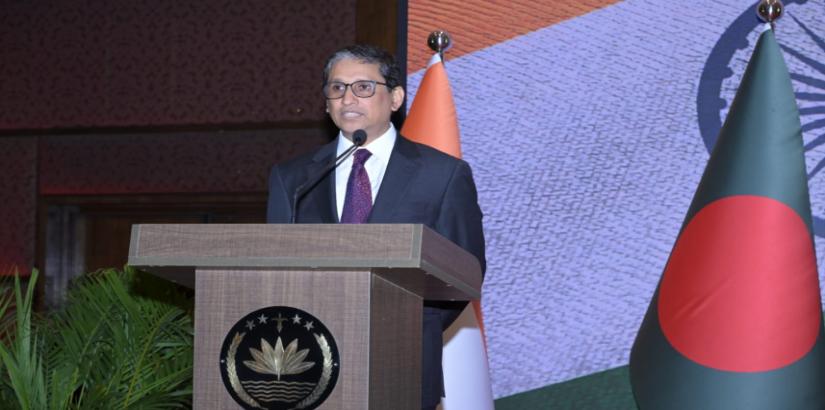
(The author is Bangladesh High Commissioner to India. Excerpted, and nominally edited, with permission from the address given by him on the occasion of Bangladesh National Day reception in New Delhi on March 26.)





Post a Comment