

Tarique Rahman's Past Will Shadow His Nation's Future: Is Bangladesh Headed For Post-Election Conflict?
Keen observers of international and regional politics will not have missed the tacit presence of the invisible hand of the US in determining the democratic transition in Bangladesh. Obviously, TarIque had been tutored by the Americans about the best way forward for the transition towards democratic rule and delivering on the promises of cooperation on regional security. The intelligentsia inside the country could have hoped for Tarique referring to ‘’historical’’ figures from the Indian subcontinent, the Muslim world, and Bangladesh’s past.
 Jan 10, 2026
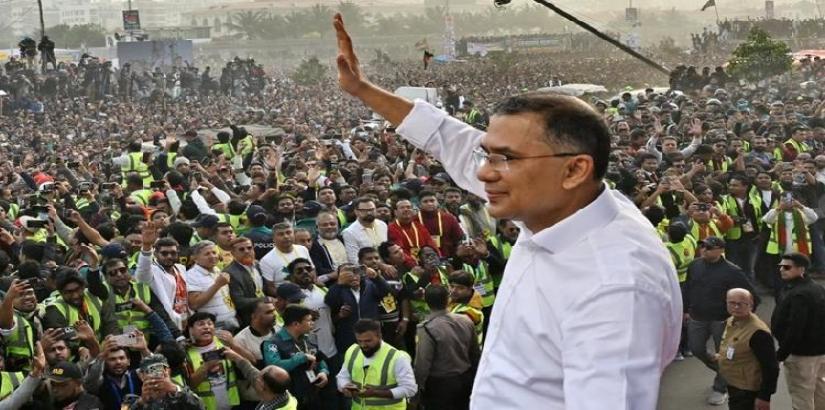
Discord between the Bangladesh Army chief Waker Uz Zaman and Muhammad Yunus, Chief Advisor of the Interim Government, over the “bloody corridor” placed the latter in a difficult position, having promised Washington that he would facilitate the entry of American aid and arms through Bangladesh under the Burma Act. The London meeting guaranteed Yunus a safe exit and the BNP leader Tarique Rahman a safe re-entry. This was evident from the armed escort of the BNP, which resembled the escorts of Kim Jong Un and other despicable dictators.
Tarique accepted the plan hatched by Yunus and his co-conspirators to facilitate “a corridor to the Americans on the coast of the Bay of Bengal,” consistent with the Burma Act, in exchange for the endorsement of his bid for the prime ministership. The double-layered security protection provided by the Bangladesh armed forces carried the implicit assurance of the American government aimed at bolstering the confidence of the party leader, emboldening him to deliver on the promises to the patronizing powers. It amply demonstrated to Tarique that delivering on the promises may be dangerous and risky, but the leadership would be shielded from any people’s movement protesting access to the corridor.
Western observers are supportive of Tarique’s candidacy, knowing that the elections will open the door for the US and Western powers to enter the fray — to deter Chinese expansionism, promote the democratization of Myanmar, and prevent Bangladesh from falling deeper into the Russo‑Chinese authoritarian axis.
TarIque’s pledge to the people, at his first appearance after 17 years of exile, rested on American wisdom. “Bangladesh First” is a carbon copy of Trump’s “America First,” and his reference to Martin Luther King’s famous words — “I have a dream” — adapted to “I have a plan,” failed to address the people’s yearning for a corruption‑free country and a return to democratic rule. He sounded firm and resolute about his plans to lead, yet offered no mention of the ways and means for achieving the end goals. Instead, he leaned on the past accomplishments of the party’s founder and his father, Major‑General Ziaur Rahman, emphasizing upon ’71 more than ’24 and riding on his father’s legacy. Nothing in the speech seemed original, raising questions about the leader’s capability to guide the country out of a crisis situation.
Presence Of Invisible Hand
Keen observers of international and regional politics will not have missed the tacit presence of the invisible hand of the US in determining the democratic transition in Bangladesh. Obviously, Tarique had been tutored by the Americans about the best way forward for the transition towards democratic rule and delivering on the promises of cooperation on regional security. The intelligentsia inside the country could have hoped for Tarique referring to ‘’historical’’ figures from the Indian subcontinent, the Muslim world, and Bangladesh’s past.
A large gathering of party followers thronged the airports on his arrival and attended the BNP‑organized event, funded by bankers and businessmen loyal to the party. The speech was scripted and sounded cold and resolute, reminding the audience of his intent to rule with a heavy hand. People, knowing TarIque’s past, remained silent about their suspicions of his candidacy for prime minister. Much of the concern stems from the complicity of the Interim Administration — including Mohammad Yunus, the judiciary, and the home ministry — in waiving allegations of abuse of power, expunging crimes committed by the acting BNP leader, and the reign of terror during his mother, PM Khaleda’s term in office.
Tarique ran a parallel government next to his mother from a facility known as Hawa Bhaban. International observers note the collusion and complicity of the governmental machinery in cleaning up the image of the acting head of BNP, allowing the exiled leader to contest elections — a danger signal of the depth and extent of criminality prevailing in the country. One would therefore conclude that this does not bode well for Bangladesh’s future, and the way ahead may be full of thorny statecraft. Ultimately, with Tarique’s past as predictor, Bangladesh risks becoming a narco‑terrorist state.
Divisive Trends And Fissures
An alliance between the NCP and Jamaat has been finalized to counteract the BNP in the February 26 elections. Skeptics, however, doubt the survivability of this marriage of convenience past the elections, pointing at the possibility of disintegration down the road. NCP is a student-led party aiming at the creation of a "New Republic", motivated by the desire to establish a corruption-free country through institutional reform for ending dictatorships and rejecting dynastic rule. Jamaat, on the other hand, is bent upon the establishment of an Islamic State based on Sharia law—if not at the onset, then gradually encroaching into people’s lives and livelihoods.
Some of the female figures within the NCP, fearing a religious clampdown from fundamentalist elements of the alliance, chose to leave the party. The alliance formed by the prominent student leaders of the July movement with Jamaat is anchored in Shibir, the student wing of the Islamic parties, having marched shoulder to shoulder in ousting the autocratic leader.
The divisive trends and fissures noticeable among the political contestants underscore the likelihood of a post-election conflict between the imposition of fundamental Islamic values and the pursuit of a democratic society. With the nation nurturing religious fundamentalism, the inevitability of intervention by external and regional powers becomes highly probable.
As a contingency, the U.S.–India defense pact prioritizes Indo-Pacific stability over Bangladesh’s sovereignty. Alternatively, Washington may align with Dhaka, provided Yunus and his successors deliver on their geopolitical commitments.
(The author is a strategic analyst and Managing Partner, Enertech International, Inc., Dhaka, Bangladesh. Views expressed are personal. He can be contacted at sheikhR2020@gmail.com)





Post a Comment