

The Tragic Loop of Bangladesh Politics: Did the People Vote for Change or Replacement?
Bangladesh’s political future depends on whether the BNP can discipline its own networks before citizens conclude that elections only rotate predators. It must act against extortion, land grabbing, political violence, campus capture, and intimidation, not as public relations damage, but as regime-defining threats.
 May 05, 2026
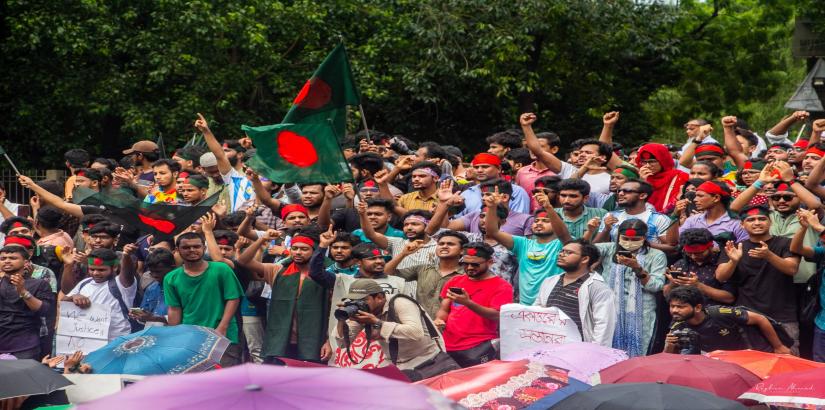
Bangladeshis did not risk their lives in 2024 because they believed one old party would automatically become morally superior to another. They resisted because life under the previous regime had become politically suffocating. The July uprising, thus, was not simply an anti-Awami League event. It was a rebellion against fear, humiliation, impunity, and the everyday feeling that citizens had become subjects.
That is why the present moment feels so painful. The Bangladesh Nationalist Party returned to power after the February 2026 election, with Tarique Rahman sworn in as prime minister after the BNP’s landslide victory. The election was widely understood as the first major political opening after Sheikh Hasina’s fall, but the moral question did not end with the transfer of office.
The uncomfortable question now being asked - if the political style of the BNP begins to resemble the Awami League’s old repertoire, then what exactly changed?
Political Culture Reproduces Itself
Indeed, regime change alone does not transform political culture. Bangladesh’s problem has never been only one leader, one party, or one election. It is a deeper political grammar that sets in winner-takes-all power, party capture of institutions, muscle-based local dominance, politicized policing, rent seeking, and the conversion of public office into private entitlement.
This is why political culture reproduces itself. Parties change positions, but the rules of survival remain familiar. When a party is out of power, it speaks the language of rights, democracy, justice, and freedom. Once it enters power, many of its local networks quickly rediscover the older language of occupation, revenge, extraction, and control.
Vote for Change or Replacement?
The reports emerging after 2024 are worrisome. Transparency International Bangladesh’s study found that a large majority of post August 5 political violence incidents were linked to BNP actors, while Awami League, Jamaat, and other groups were also implicated. The figures differ slightly across reports, but the pattern remains the same.
This does not mean BNP and Awami League are identical in every historical, ideological, or organizational sense. That kind of lazy equivalence weakens analysis. But it does mean that both parties have operated within a political field where control of the state is treated as control over resources, protection, punishment, and status.
In such a field, politics becomes less about programmatic competition and more about access regarding who gets the tender, who controls the market, who occupies the campus hall, who dominates the transport sector, who can call the police station, and who can force silence.
The tragedy of Bangladesh is that ordinary citizens often vote for change, but party machines prepare for replacement. People imagine a new political beginning. Local strongmen imagine vacancies.
This is the difference between a democratic transition and a democratic transformation. A transition replaces rulers. A transformation changes the incentives that make rulers behave like their predecessors.
Moral Test for Ruling BNP
The sacrifices people made in July 2024 cannot be reduced to the BNP’s later conduct. It belongs to the citizens, students, workers, parents, journalists, and ordinary people who refuse to remain afraid. But the BNP now faces a severe moral test: whether it understands itself as the beneficiary of a people’s uprising, or merely as the next proprietor of the state.
Political scientist Charles Tilly argued that political actors learn and repeat “repertoires” of contention. In Bangladesh, ruling parties have also learned repertoires of domination. Pierre Bourdieu would call this a habitus of power: a set of embodied instincts about how politics is done. Douglass North would push us toward institutions: when formal rules are weak and informal networks are strong, actors follow the rules that actually pay. In Bangladesh, the rule that has often been applied is not constitutionalism. It is proximity to power.
This is why corruption and violence feel so repetitive. They are part of a political economy. A young activist does not join local party politics only because he has read a manifesto. Often, he joins because party proximity can bring protection, employment, contracts, masculine status, and social authority. A businessman does not fund political networks only because he loves ideology. He may do so because power protects capital. A police officer may not follow partisan pressure only because he is personally partisan. He may do so because neutrality is costly and obedience is safer. So the same question returns: why does Bangladesh’s political culture reproduce itself?
Because the party is stronger than the institution. Because loyalty is rewarded more than legality. Because opposition politics teaches resistance, but not necessarily restraint. Because parties that suffer repression often learn the pain of exclusion without learning the ethics of power. Because the state remains a prize, not a public trust. Because local political economies are built around access to offices, contracts, land, licenses, police, and impunity. Because citizens are repeatedly asked to choose between fear of the old and fear of the new.
Need for Three Recognitions
Now, hinging on democratic politics would begin with three recognitions.
First, the Awami League’s authoritarianism does not give moral license to the BNP’s disorder. Second, anti-fascism is not democracy by itself. Third, the real test of democracy is not how a party treats its supporters. It is how it treats critics, minorities, defeated opponents, journalists, students, and people with no party protection.
Bangladesh’s political future depends on whether the BNP can discipline its own networks before citizens conclude that elections only rotate predators. It must act against extortion, land grabbing, political violence, campus capture, and intimidation, not as public relations damage, but as regime-defining threats. The party cannot claim democratic renewal while allowing local actors to behave like victorious militias.
But responsibility does not belong to the BNP alone. Civil society, students, journalists, courts, the Election Commission, anti-corruption bodies, local administration, and ordinary voters must resist the old emotional trap of partisan forgiveness.
(The author is PhD Student (Political Science and Government) and a Graduate Teaching Assistant at University of Alabama, Tuscaloosa, USA. Views expressed here are personal. He can be contacted arahaman@crimson.ua.edu )





Post a Comment