

When Fish was on the Ballot: Elections 2026 Saw Spicy Debate Over Bengal's Plate, Pride and Palate
In the run-up to the Bengal elections, 2026, the fish debate did exactly that. Banerjee stitched fish to language, secularism and regional pride, painting the BJP as a Hindi-heartland force that would impose vegetarian norms. The BJP countered by showcasing its own non-vegetarian leaders from Assam and elsewhere, eating “macher jhol” on camera, and promising “Bengal’s way of life will not change.”
 May 05, 2026
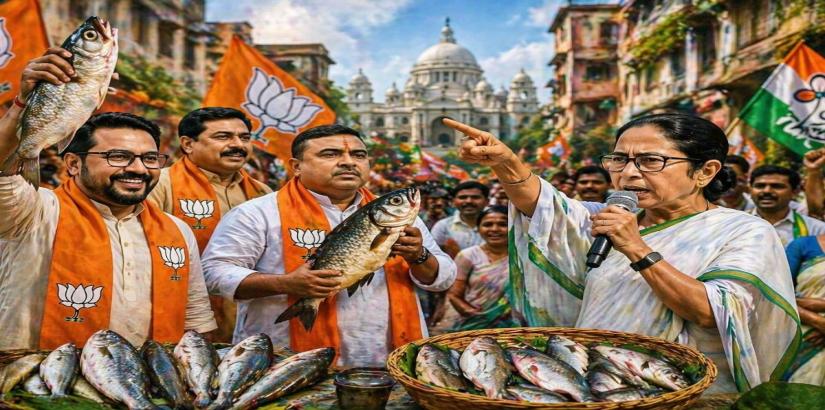
In the heat of the 2026 West Bengal Assembly elections, politics has taken a distinct culinary turn. The ongoing political exchanges between Himanta Biswa Sarma and Mamata Banerjee over the eating of fish, may appear insignificant at first glance, but it illuminates a deeper and long-standing dynamic in Indian electoral politics. Banerjee, in her political campaign speeches, has repeatedly warned that a BJP victory would threaten Bengal’s way of life, claiming the party would not allow them to eat fish and other non-vegetarian items. Assam Chief Minister Himanta Biswa Sarma, a senior BJP leader, threw a light-hearted dig at West Bengal Chief Minister Mamata Banerjee by daring the Trinamool Congress leader to a fish-eating contest, amid accusations that a BJP government in Bengal would curb fish and meat consumption in the eastern state.
Bigger than the political battle, the exchange of words between the leaders reflects the symbolisation of food as a marker of identity, a tool of political communication, and an instrument of soft cultural assertion. In West Bengal, food is beyond just survival. It carries with it the community’s identity, memory and shared emotions. The proverb “Mache bhate Bangali” colloquially defines a Bengali by their love of fish and rice, reflecting a relationship shaped by geography and history.
Food as Political Instrument
For the residents of West Bengal, fish and rice are the twin pillars of Bengali identity: non-negotiable symbols of cultural survival. Historical texts bear witness to this deep bond. The 11th-century Charyapadas mention fish and rice alongside vegetables and greens as the diet of medieval Bengal. By the 15th century, the epic Manasamangal describes lavish wedding banquets serving 12 varieties of fish and five meats. The 12th-century Naishadhacharita similarly records feasts featuring multiple fish preparations like fried, curried, roasted in banana leaves, or steamed with coconut and mustard. Even today, the belief that “mach khao, buddhi barbe”, (eat fish and your intelligence will grow), persists.
The use of food as a political instrument, however, is neither new to West Bengal nor to contemporary India. The idea can be traced back to Arjun Appadurai’s concept of “gastro-politics”, emphasizing on the non-neutrality of food and its deep ties to power, identity, and social relationships. Historically, food has played a significant role in political mobilisation. During the Indian freedom struggle, Mahatma Gandhi employed dietary practices as a form of political expression, advocating simplicity, vegetarianism, and fasting as moral tools against colonial rule. His fasts were not merely personal acts of asceticism but powerful political statements that mobilised public sentiment and exerted pressure on colonial authorities.
In post-independence India, food has often been central to welfare politics. The introduction of subsidised food schemes, such as the Public Distribution System (PDS), has been a critical factor in electoral strategies, particularly in states with high levels of poverty. In Tamil Nadu, for example, the establishment of state-run canteens providing low-cost meals (Amma canteens) became a defining feature of electoral politics, linking food security with governance legitimacy. Similarly, mid-day meal schemes in schools have served both as welfare measures and as instruments of political outreach, reinforcing the connection between food and state responsibility.
Culinary Traditions and Gastrodiplomacy
Globally, the political use of food is equally evident. In the United States, electoral campaigns frequently incorporate regional culinary traditions, with candidates participating in local food events to establish relatability and cultural connection. Food diplomacy has also been a key aspect of international relations, with States using cuisine to project soft power and cultural influence.
The concept of “gastrodiplomacy,” as seen in countries like Thailand and South Korea, underscores how food can function as a medium of cultural outreach and identity construction on the global stage and also to win hearts. Thailand’s Global Thai programme, South Korea’s "kimchi” (now UNESCO-listed) and Peru’s “ceviche push” are classic examples. India promotes millet at G20 summits, exports premium-quality mangoes and hosts thali diplomacy.
The Fishy Debate
In the run-up to the Bengal elections, 2026, the fish debate did exactly that. Banerjee stitched fish to language, secularism and regional pride, painting the BJP as a Hindi-heartland force that would impose vegetarian norms. The BJP countered by showcasing its own non-vegetarian leaders from Assam and elsewhere, eating “macher jhol” on camera, and promising “Bengal’s way of life will not change.”
Sarma’s contest offer cleverly turns defence into playful camaraderie. The rhetorical emphasis on food also reflects a broader shift in political communication, where tangible, everyday experiences are increasingly used to engage voters. Unlike abstract policy discussions, food resonates at the ground level, evoking familiarity, nostalgia, and emotional attachment. This makes it a particularly effective tool for political messaging, allowing leaders to connect with diverse constituencies through a shared cultural vocabulary.
Food as a Political Symbol and Identity Marker
Thus, the exchange between the two chief ministers serves as a microcosm of a larger phenomenon, where food operates as a multifaceted political symbol encompassing identity, economy, and ideology. What may appear as a casual remark about fish-eating is, in reality, part of a carefully calibrated political narrative that seeks to align cultural practices with electoral objectives.However, the rhetoric of ‘food politics’ is often termed by critics as election theatre, but data exactly shows the reasons behind its working. In Bengal, fish and rice move across class and caste. In a state where 65.7 per cent of Bengalis eat fish weekly (21.9 per cent daily), fisheries add ₹24,300 crore to the state’s economy, any threat, real or perceived, feels personal. Thus, when politicians brandish a giant katla fish at rallies, they signal “I understand your daily life.” Promises of jobs and roads matter, but so does the right to celebrate with “bhapa ilish” or “chingri malai curry”.
The prominence of food in political discourse underscores the evolving nature of democratic engagement. Elections are no longer contested solely through manifestos and policy proposals but through the mobilisation of cultural symbols that resonate with the lived experiences of voters. In this context, the politics of the plate becomes a powerful reminder that the boundaries between the personal and the political are increasingly blurred, with everyday practices such as eating acquiring new significance in the arena of electoral competition.
It is still uncertain whether Sarma and Banerjee will ever hold that fish-eating competition, but the real contest over who shall best protect Bengal’s plate, pride and palate echoed in the ballot box. Food is not just fuel here. It is identity, history and the language of belonging. For 2026, it was firmly on the electoral menu.
(Bishaldeep Kakati is an Advocate at Gauhati High Court and the Assamese Advisory Board Member of Sahitya Akademi. Bipasha Saikia is an Assistant Professor at JB Law College and a PhD Research Scholar, NLUJA. Views expressed are personal. The can be contacted at deep.kakati99@gmail.com )





Post a Comment